Loading...

 BetaBeta
Your toolkit can already do two things, and each one took a full lesson to earn. It can hash: fingerprint any bytes into 64 characters that scramble completely if a single bit moves. It can sign: prove a message came from a key nobody else holds, and let a stranger verify that without ever trusting you. Those are the exact two primitives the graveyard companies from the opener had too. DigiCash shipped both, years ahead of everyone, and still died. What none of them ever assembled is the thing you build in the next fifteen minutes: a way to append to a shared history that has no owner.
So build one. Bitcoin, minus the internet: your laptop, a private chain, and a mining command that returns before you finish reading it, because the difficulty is dropped to the floor. No peers, no pool, no real electricity. You need Bitcoin Core installed (the bitcoind daemon plus the bitcoin-cli client) and a terminal.
bitcoind -regtest -daemon -fallbackfee=0.0002
bitcoin-cli -regtest -named createwallet wallet_name=lab load_on_startup=true
ADDR=$(bitcoin-cli -regtest getnewaddress)
bitcoin-cli -regtest generatetoaddress 101 "$ADDR"
bitcoin-cli -regtest getblockcount
Two of those flags are there to save you from a wall you would otherwise hit next lesson, and both are worth naming now rather than debugging later.
-fallbackfee=0.0002 gives the node a fee rate to use when it has no idea what fees are. Bitcoin Core normally estimates fees from the last few hundred blocks of real traffic; a chain you just created has none, so estimation returns nothing, and since v0.20.0 the node refuses to invent a number for you: that release dropped the built-in DEFAULT_FALLBACK_FEE to zero, where v0.19 still shipped a non-zero one. Leave the flag off and the first payment you try to send comes back with Fee estimation failed. Fallbackfee is disabled. The flag says: when you cannot estimate, use 0.0002 BTC per kilobyte. It is meaningless play money on regtest and it is exactly the wrong thing to set on mainnet, where you want real estimation.
-named lets you pass RPC arguments by name instead of by position, which is the only sane way to reach the seventh argument of createwallet. That argument is load_on_startup=true, and it writes your wallet into a list the node re-opens every time it boots. Without it, Bitcoin Core loads no wallet at all on startup, and the next time you restart the node, getbalance answers No wallet is loaded instead of a number. You will meet the recovery move for that in a moment.
The last line prints 101. That is a working blockchain, 101 blocks deep, and every block on it was minted by you. Now ask it for your money:
bitcoin-cli -regtest getbalance
50.00000000. Fifty BTC, mined in seconds, worthless on every exchange on Earth and priceless as a lab. You mined 101 blocks, yet the balance reads one reward, not a hundred and one. Hold that gap; it is the whole back half of this lesson.
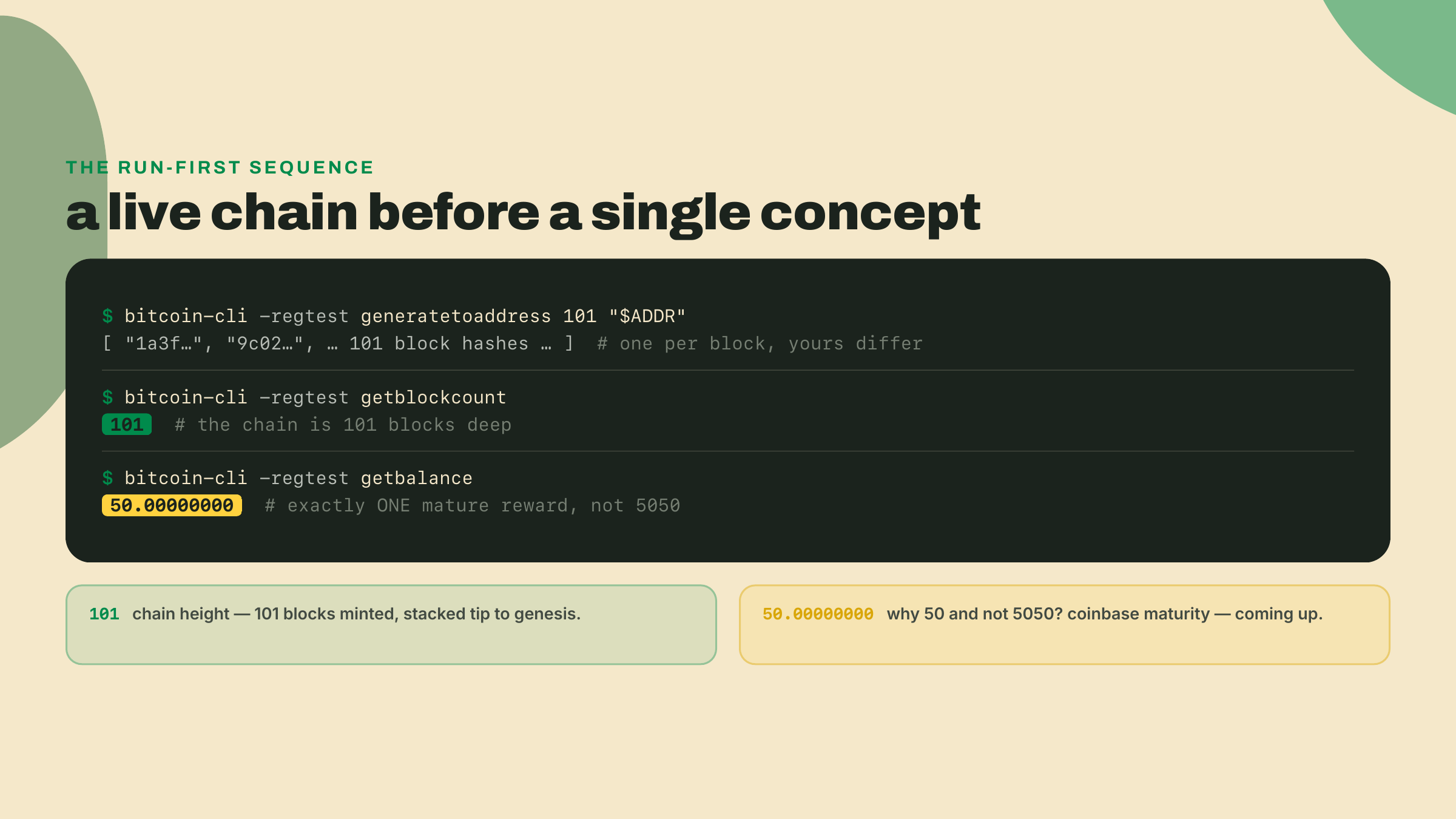
Take the command apart, because every flag is load-bearing.
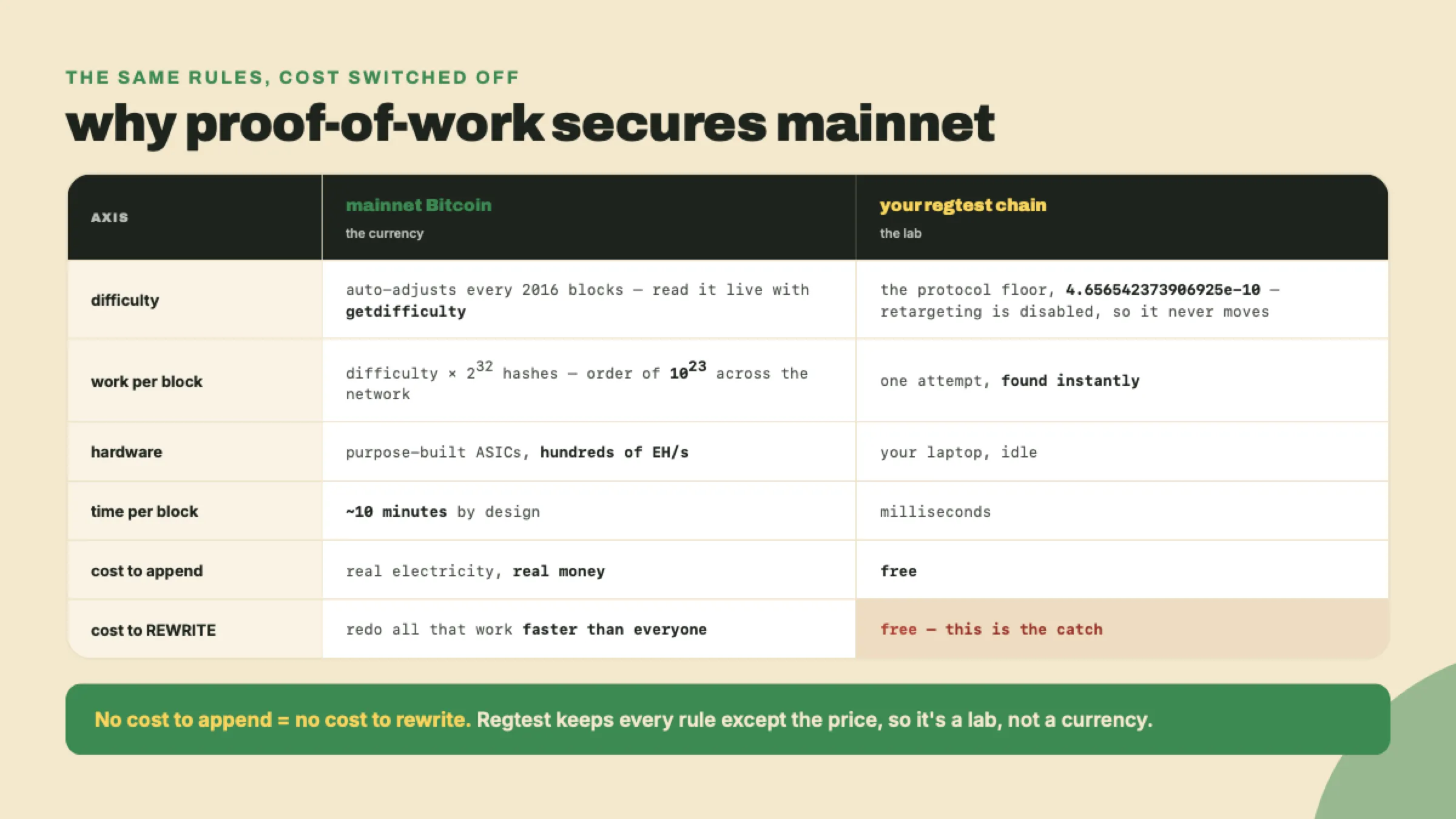
-regtest put you in regression-test mode: a private Bitcoin network, identical to the real one in every rule that matters, except that you alone run it and the mining difficulty is on the floor. Regtest exists because Bitcoin Core's own developers needed a chain where mining costs nothing, so their test suites could mine blocks on demand instead of waiting on a global race. Ask your node how far down that floor is:
bitcoin-cli -regtest getdifficulty
4.656542373906925e-10
Not one. Roughly four ten-billionths of one, which is the smallest number the encoding allows, and it does not move: regtest is the one network where Bitcoin's difficulty adjustment is switched off entirely, a detail we come back to when we meet the adjustment itself. You are borrowing the developers' test harness. Everything it touches lives in its own datadir, the directory where the node keeps the chain and your wallet, walled off from any real Bitcoin config.
createwallet made a keypair store: the same signing primitive from last lesson, the one your keytool already builds, only here the node keeps the keys for you. getnewaddress derived one address to receive coins.
One thing about that wallet will trip you up the first time you stop the node, so meet it now rather than at 1am. Bitcoin Core does not open wallets by itself. listwallets tells you which ones are currently open, loadwallet <name> opens one, and unloadwallet <name> closes it. The load_on_startup=true you passed just puts lab on the list the node opens for you, so a restart lands you back where you were:
bitcoin-cli -regtest listwallets     # ["lab"]
bitcoin-cli -regtest loadwallet lab  # if you ever see "No wallet is loaded"
The failure mode is unmistakable once you have seen it. Restart a node with no wallet open and every wallet command answers error code: -18 / No wallet is loaded. Load a wallet using loadwallet or create a new one with createwallet. Open two wallets and the same commands answer error code: -19, because now the node does not know which one you meant. The fix for the first is loadwallet; the fix for the second is the -rpcwallet flag you meet in the exercise at the bottom of this lesson.
And generatetoaddress, the current regtest mining command, did the interesting part. It built 101 blocks and paid each block's reward to that address.
A block is a batch of transactions plus a small header, and the header carries one field that changes everything: the digest of the block before it. That field is called previousblockhash, and it holds the SHA-256 fingerprint of the previous block. Read that twice, because you have seen it before. A block committing to the block before it is the exact hash chain from the hashing lesson, where editing any record broke its link to the record after it and forced a re-seal of everything above. Bitcoin is that chain one level up, with whole blocks sitting where single records sat. The genesis block, block 0, is the anchor at the bottom, hardcoded into every copy of the software so that no two honest nodes can disagree about where the chain starts. On regtest, its hash is the same on your machine as on mine: 0f9188f13cb7b2c71f2a335e3a4fc328bf5beb436012afca590b1a11466e2206.
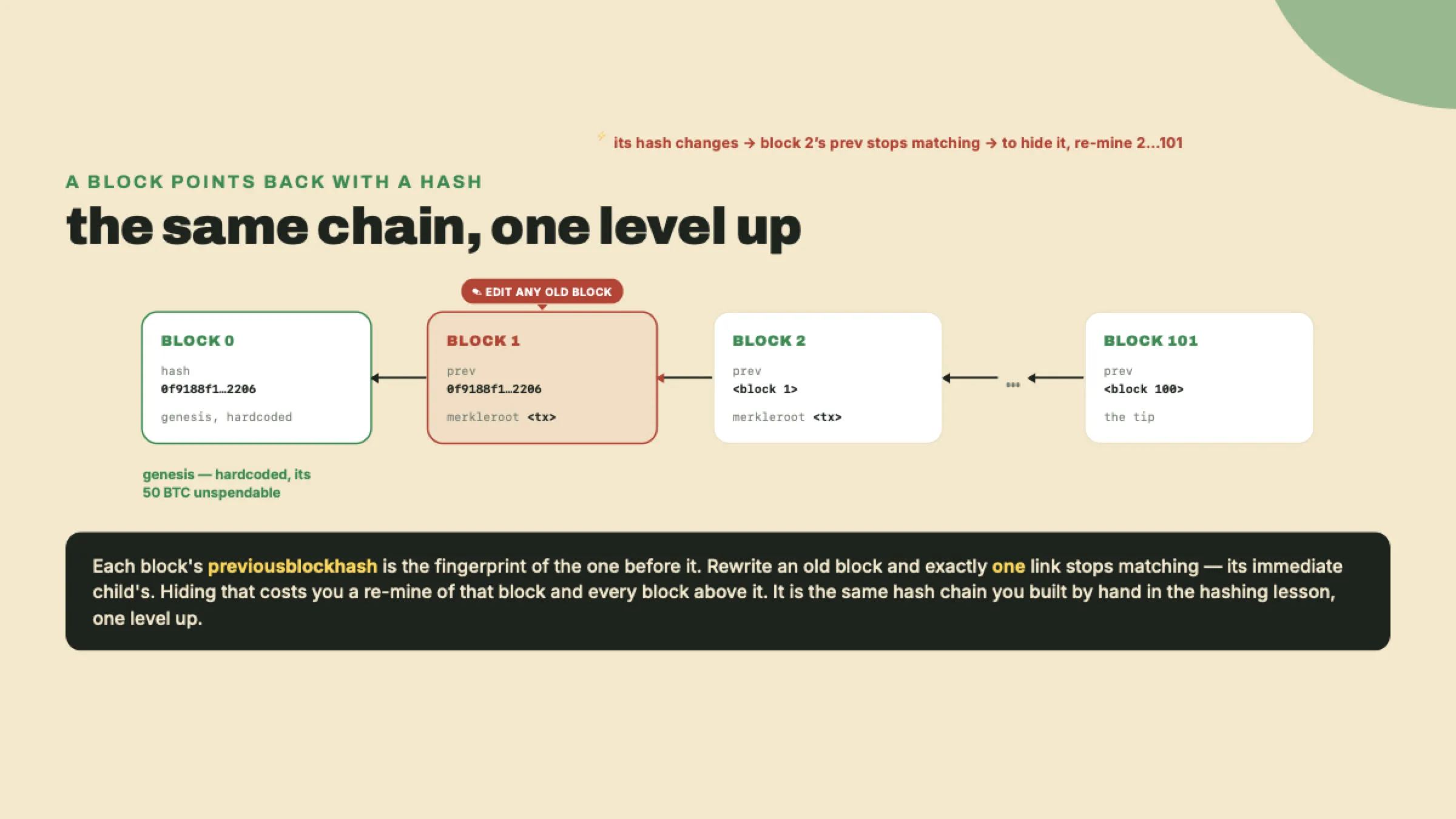
Do not take my word that the field is there. Pull block 1 off the chain and look:
bitcoin-cli -regtest getblock $(bitcoin-cli -regtest getblockhash 1)
The inner call turns a height into a block hash, and getblock returns the block. Walk the fields that carry weight. previousblockhash is the genesis hash you just saw, so block 1 is literally bolted to block 0. tx is a list with a single entry, because your empty regtest blocks hold exactly one transaction each: the coinbase, the special transaction that mints the block reward out of nothing and has no sender. merkleroot is the single digest that commits to every transaction in the block; with only one transaction here, the root just equals that transaction's own digest, the same Merkle-root shape you built by hand in the hashing lesson, collapsed to its simplest case. And bits reads 207fffff, the encoded difficulty target: regtest's easiest-possible setting.
The rest of the fields fill in the block's identity, and none of them are decoration. height is 1, its position counted up from genesis. nonce holds whatever number satisfied the target, which on regtest was almost certainly the first one the node tried. time is the Unix timestamp the block claims to have been mined at, and version plus nTx record the block format and the transaction count, one, matching that single-entry tx list. A real node on the real network checks every one of these before it will accept the block from a peer, and any that fails to add up gets the block rejected on sight.
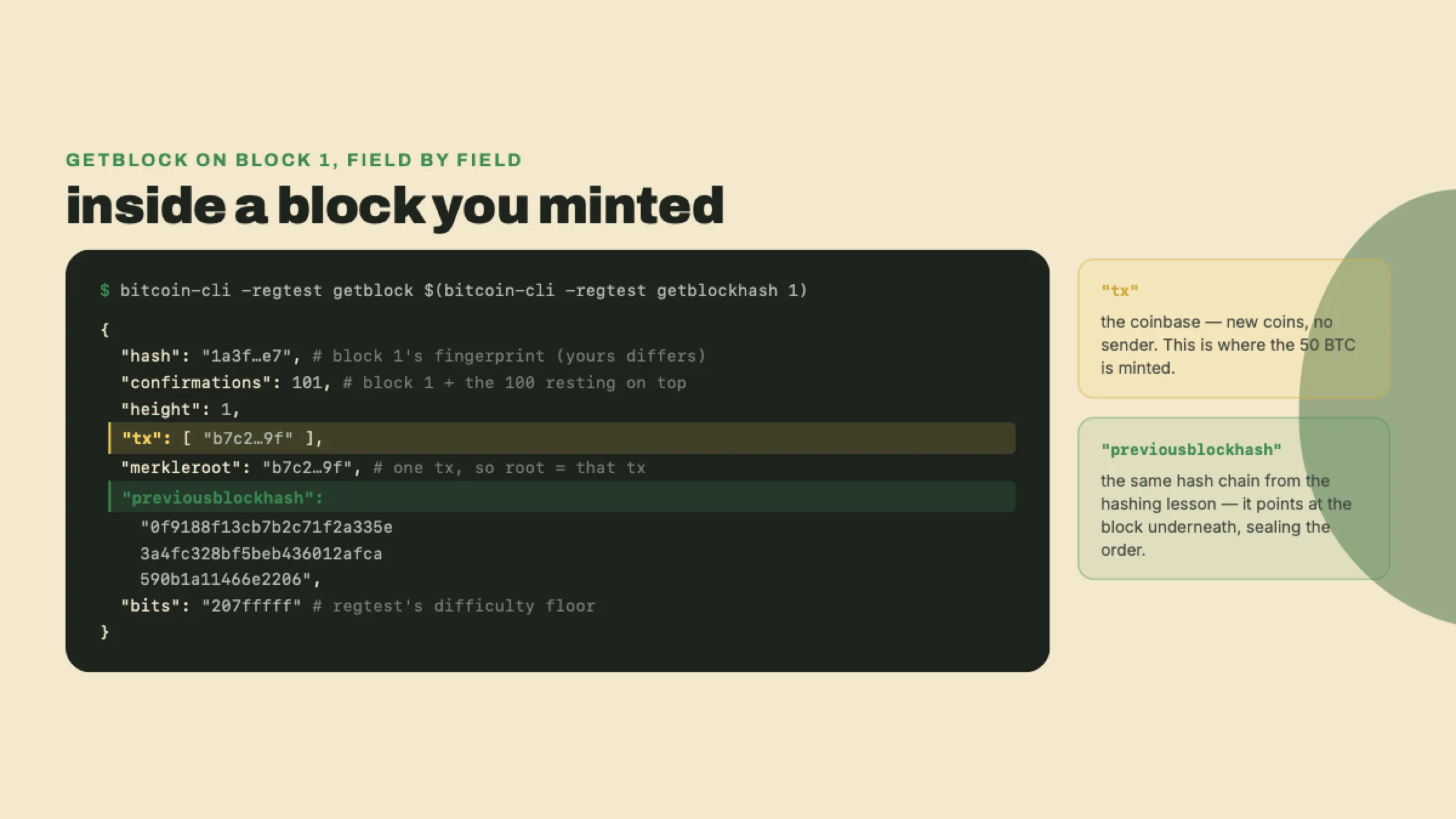
That confirmations: 101 is worth a beat, because the number carries the answer to your opening puzzle. It counts block 1 plus every block resting on top of it: one for itself, one hundred more piled above. Confirmations are the depth of a block, not a stamp of approval. Keep that reading; the balance mystery turns on it.
Prove the link closes rather than trusting the diagram. Ask the chain for block 2 and read one field out of it:
bitcoin-cli -regtest getblock $(bitcoin-cli -regtest getblockhash 2) | grep previousblockhash
The value it prints is block 1's own hash, the one your own getblock printed a moment ago, which is unique to your chain and will not match mine. Compare the two strings character by character; they are the same 64 characters. Block 2 names block 1 as its parent, block 1 names genesis as its parent, and you could walk that thread all the way to the tip without ever finding a gap. That is the hash chain from the hashing lesson, made of blocks, and you just read one of its links off a live chain instead of taking it on faith.
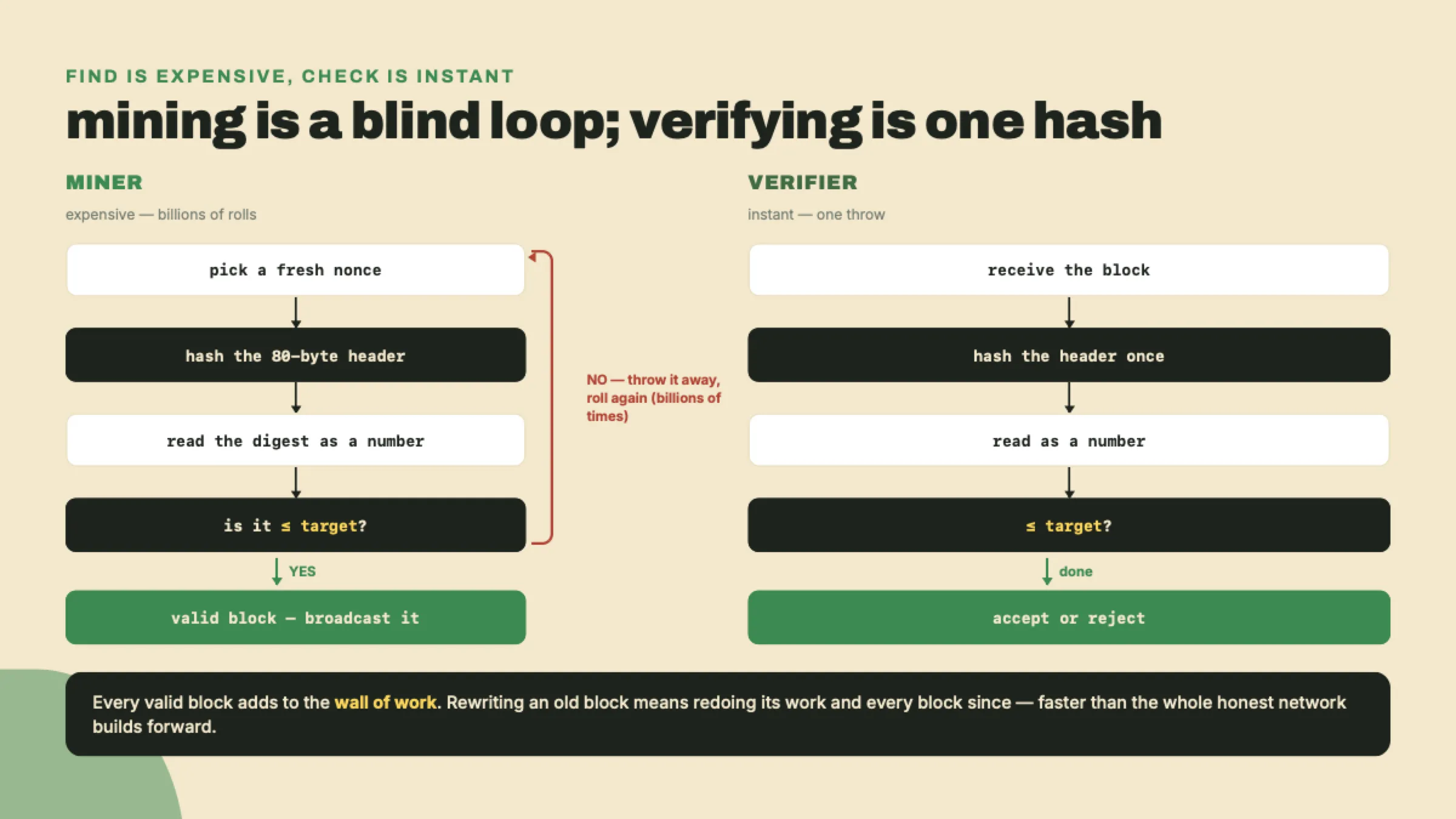
Now the field that regtest quietly switched off. On the real network, you cannot just append a block because you feel like it. You have to earn the right, and the toll is proof-of-work: the requirement to find a number, the nonce, that makes the whole block's hash fall below a target so low that the only way to hit it is to try again, and again, billions of times, until one guess lands. Finding it is expensive. Checking it is instant, one hash. That asymmetry is the entire mechanism, and it is the same one-way trapdoor you metered in the hashing lesson, now pointed at a different job: turning electricity into an unforgeable ticket to add one block.
It helps to make the target concrete, because "below a target" is doing quiet work. Read a block's 64-character hash not as text but as a single enormous number, 256 bits wide, sitting somewhere between zero and roughly 1.16 times ten to the seventy-seventh. The target is just another number in that same range, and the rule is blunt: your block's hash, read as a number, must come out less than or equal to it. Set the target near the top of the range and almost every hash qualifies. Push the target down toward zero and the band of winning hashes narrows to a sliver, so the fraction of random guesses that fall inside it shrinks in exact proportion. Difficulty is nothing more elaborate than how far down that target has been dragged.
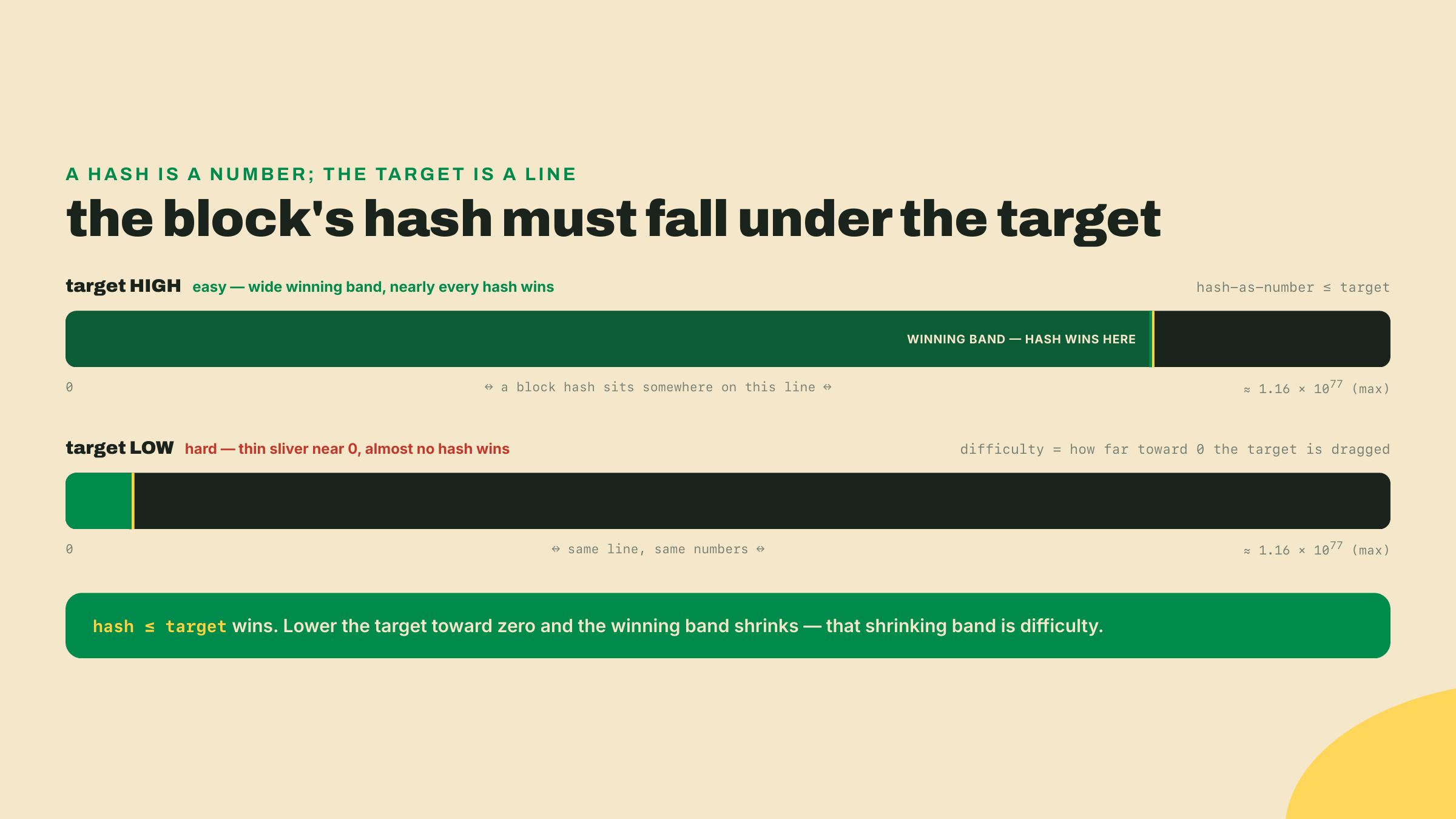
The nonce is the one field in the header you are free to spin. Change it and you have changed the header's bytes, which means the whole thing rehashes into a completely unrelated 64 characters, the avalanche effect from the hashing lesson doing exactly what it did to your file: one flipped bit, a totally scrambled digest. There is no way to nudge a hash gently toward a smaller number. Each new nonce is a fresh, blind dice roll across that 256-bit range, and the only strategy anyone has ever found is to roll again. That is why finding a valid block is a matter of raw volume, billions of rolls, while checking one is a single throw: hash the header once, read it as a number, compare it to the target, done. Anyone on Earth can verify a winning block in the time it takes to hash 80 bytes, even though the winner had to try astronomically many times to produce it.
On mainnet that instant command of yours is a planet-spanning race. Purpose-built machines, hundreds of exahashes per second across the network, burn real gigawatts guessing for the roughly ten minutes it takes the honest crowd to land one valid block. The network mints new coins to whoever wins, so the machines keep guessing, so the wall of work keeps rising. That wall is what makes Bitcoin's history hard to rewrite: to erase an old block you would have to redo its proof-of-work and every block since, faster than the entire honest network builds forward. Nobody has that much electricity lying around.
The ten-minute cadence is not a happy accident; it is enforced. Every 2016 blocks, roughly every two weeks, each node independently checks how long that stretch actually took against the fortnight it was supposed to take, and rescales the target to compensate. If hashing power flooded in and the 2016 blocks arrived early, the target drops and the next stretch gets harder. If miners left and blocks came slowly, the target rises and mining gets easier. The rule runs on every node from the same block data, so there is no committee and no vote; the difficulty simply tracks the total work the world is throwing at the chain, holding block time near ten minutes whether the network is ten laptops or ten million machines. Your regtest node is the one place this does not happen: regtest ships with retargeting disabled outright, so the difficulty you read a moment ago is pinned there forever. Prove it rather than believing it, since 2000 blocks cost you nothing here:
A=$(bitcoin-cli -regtest getnewaddress)
bitcoin-cli -regtest generatetoaddress 2000 "$A" > /dev/null
bitcoin-cli -regtest getblockcount   # 2101, well past the 2016-block boundary
bitcoin-cli -regtest getdifficulty   # 4.656542373906925e-10, unchanged
You mined straight through a retarget boundary at a wildly faster-than-target pace, and the difficulty did not budge. On mainnet that pace would have made the next stretch dramatically harder. Regtest is not simulating the adjustment cheaply; it has the adjustment turned off, which is one more reason it is a lab and not a currency. (If you ran that, your chain is now at 2101 and you have far more mature coins than the rest of this lesson assumes. The reset script you write in a minute puts it back.)
Regtest deletes the wall. The 207fffff target is the loosest the protocol allows, a bits value that decodes to a target sitting almost at the very top of that 256-bit range, so the first nonce your node tries already clears it and a block appears in milliseconds. That is why generatetoaddress 101 returned before you could blink: there was no race to win, only a formality to stamp 101 times.
Back to the gap. You minted 101 blocks, each paying a 50 BTC reward, and getbalance insists on 50. It is not lying, and no coins went missing. The other rewards exist; they are just locked.
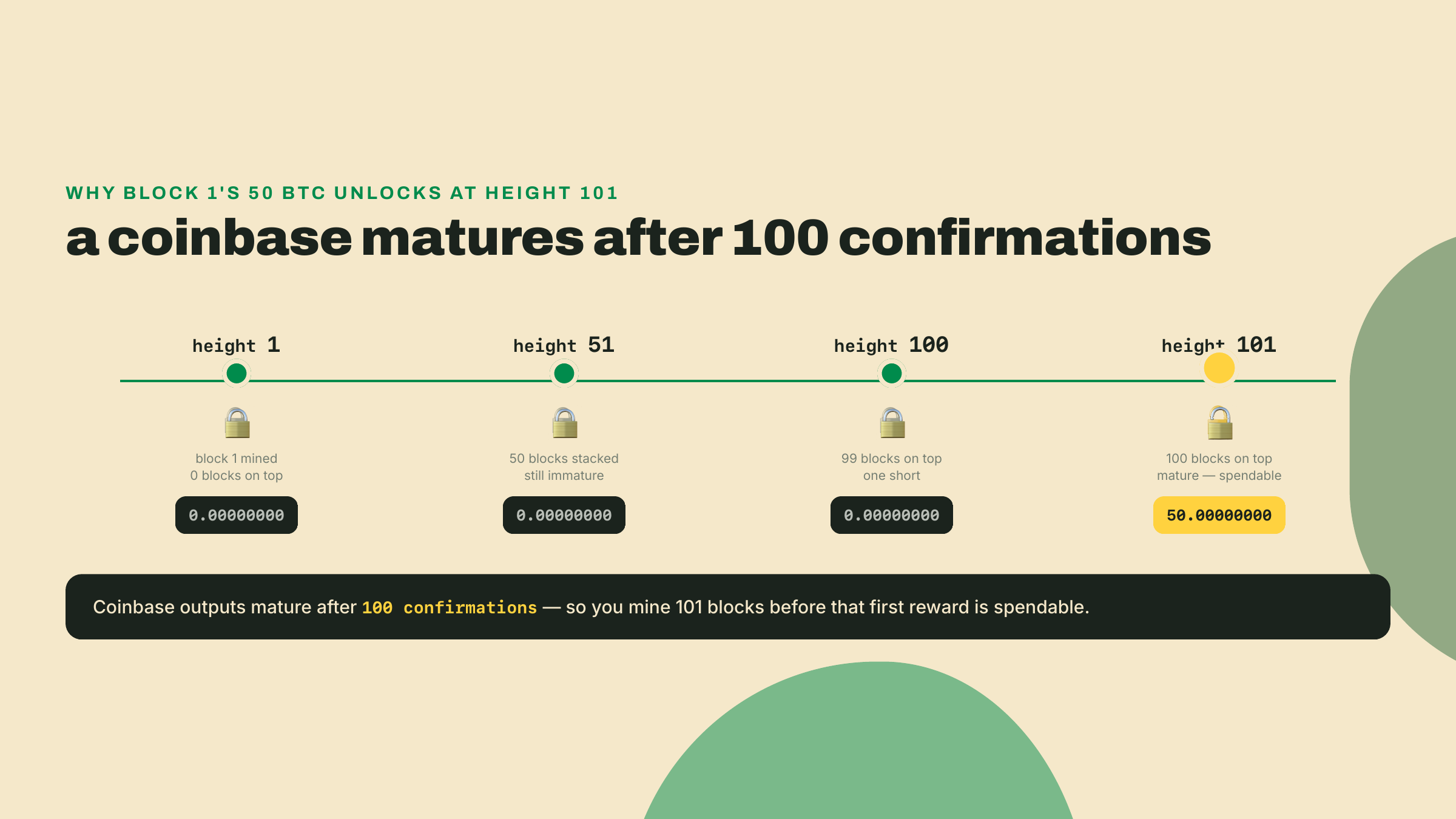
Coinbase outputs mature 100 blocks deep. A freshly minted reward cannot be spent until 100 more blocks are stacked on top of the block that created it, which is 101 confirmations by the counting rule you just met, since a block counts itself. The one-block answer to why it is 101 and not 1 is that a brand-new reward is provisional. Blocks at the very tip can still be undone by a reorganization, where a longer competing chain arrives and orphans the last few blocks, and any reward inside an orphaned block evaporates.
Watch how that plays out on the real network, because it is not a rare edge case. Suppose you mine block 101 and pocket its reward, and at nearly the same moment a miner on the other side of the planet mines a different block 101, one your node has never seen. For a few seconds the chain has two tips of equal height, a temporary fork, and different nodes believe different blocks. The tie breaks the instant someone mines block 102 on top of one of them. Say it lands on the stranger's 101. Now that fork is longer, every honest node switches to it because the rule is to follow the most-work chain, and your block 101 becomes an orphan: still valid-looking, still sitting on your disk, but no longer part of the history anyone else recognizes. The 50 BTC it paid you never happened on the winning chain. Any ordinary transactions your block carried slide back into the pool of unconfirmed transactions to be mined again, but a coinbase has no such second life; it is minted by the block itself, so when the block dies the coins die with it.
Forcing a 100-block wait means that by the time you spend a reward, the network has effectively committed to the block that minted it, so you are never spending money that might vanish from under a merchant. That is the whole reason for the delay: it protects the person you pay, not you. Reorganizations 100 blocks deep do not happen on a healthy network; rewriting that much history would cost more work than the entire honest crowd can muster, which is the same wall of proof-of-work you just met, seen from the other side.
Run the arithmetic against your chain. Block 1 minted 50 BTC. To make it spendable, 100 blocks must sit on top of it, which puts the tip at height 101. That is why you mined 101 blocks before spending, and it is why exactly one reward matured: block 1 has its 100 blocks on top, but block 2 has only 99, block 3 only 98, and so on down to the tip, all still locked. One mature reward, 50 BTC, and a hundred more waiting their turn.
There is a coinbase out there that never matures, no matter how long you wait. The genesis block's 50 BTC coinbase is unspendable, a quirk of the original client that Satoshi never fixed: block 0's reward was simply never written into the database of spendable outputs the way every later reward is. Fifty perfectly real bitcoin, permanently frozen at the bottom of the chain, on mainnet and on your regtest chain alike. It is a fitting monument. The very first coins the system ever created are the one batch it will never let move.
You now hold the lesson's artifact: private-regtest-chain, a running node with 101 mined blocks and a funded wallet. It joins the toolkit repo next to hashit and keytool, and like everything in this course it will get reused, not thrown away. But a lab you cannot reset is a lab you are afraid to break, so the artifact ships with one more piece: a script that wipes the chain and rebuilds it from block 0.
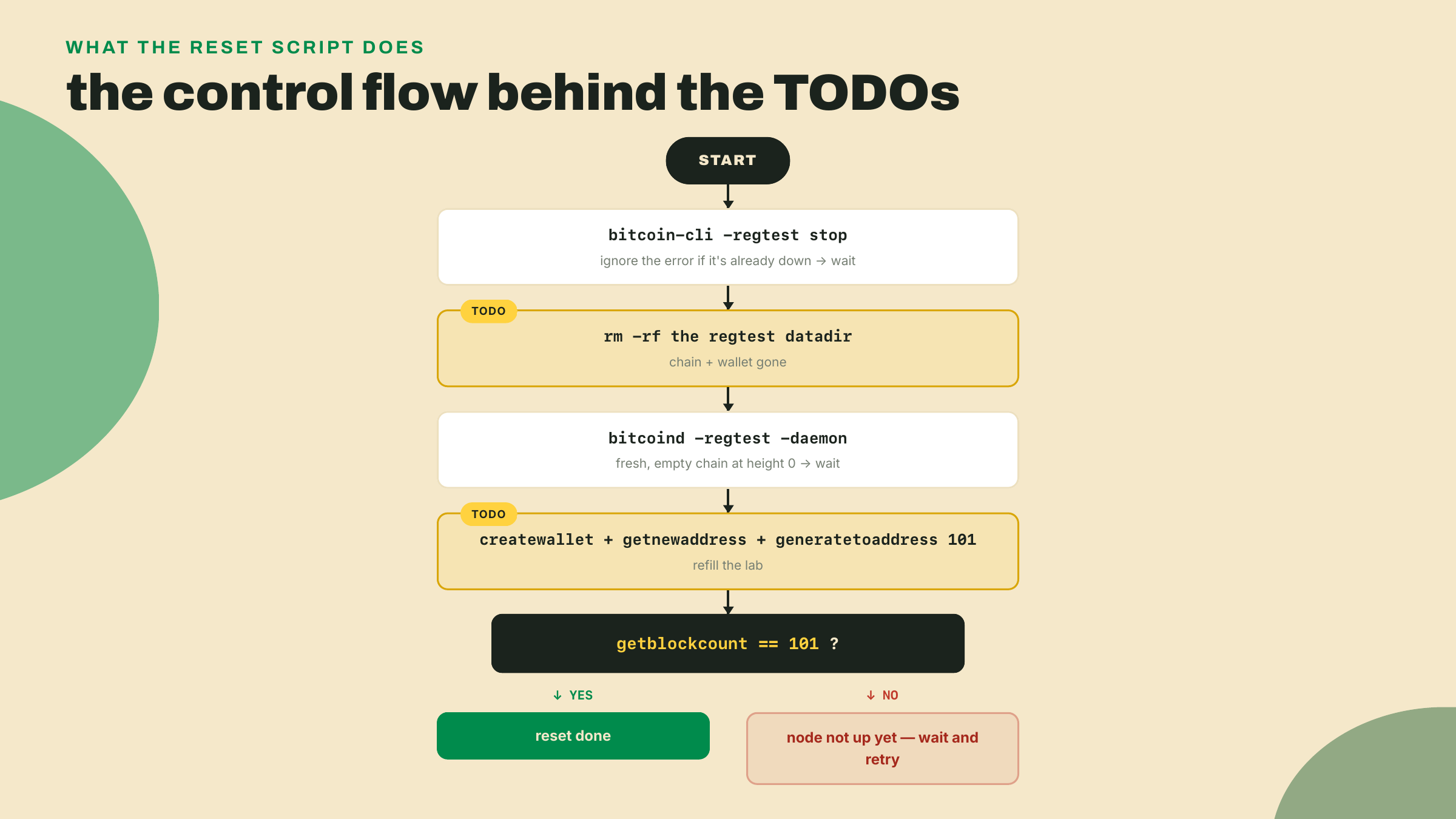
The flow is four moves. Stop the node so nothing is writing to the datadir. Delete the datadir, which erases the chain and the wallet together. Start a fresh node, which comes up at height 0 with only genesis. Recreate the wallet and re-mine 101 blocks. Here is the skeleton, with the two interesting moves left for you to fill in:
#!/usr/bin/env bash
# reset-chain.sh - wipe the private regtest chain and re-mine from block 0
set -euo pipefail

# 1. stop the node (ignore the error if it is already down)
bitcoin-cli -regtest stop 2>/dev/null || true
sleep 1

# 2. TODO(you): wipe the regtest datadir so the chain starts empty.
#    Linux default is below; on macOS it is "~/Library/Application Support/Bitcoin/regtest".
DATADIR="$HOME/.bitcoin/regtest"
# rm -rf "$DATADIR"        # <- fill this in

# 3. restart the node on a now-empty chain (same flags you booted it with)
bitcoind -regtest -daemon -fallbackfee=0.0002
sleep 2

# 4. TODO(you): recreate the wallet and re-mine 101 blocks to a fresh address
# bitcoin-cli -regtest -named createwallet wallet_name=lab load_on_startup=true
# ADDR=$(bitcoin-cli -regtest getnewaddress)
# bitcoin-cli -regtest generatetoaddress 101 "$ADDR"

bitcoin-cli -regtest getblockcount   # expect: 101
The reason a wipe-and-rebuild is safe to lean on, and worth scripting at all, is that regtest is deterministic where it counts. Genesis never changes: every fresh chain you spin up starts from the identical 0f9188f1...2206 anchor, so "reset" really does return you to the same starting line rather than some subtly different one. What does change is everything you generated, and that is the point of deleting the whole datadir rather than just the blocks. The datadir holds your wallet too, so wiping it discards the old keys and addresses along with the chain; the rebuilt lab hands you a brand-new identity funded from scratch, with none of the previous run's state lurking to confuse a later experiment. The set -euo pipefail line at the top enforces the discipline: the script aborts the moment any command fails, so you never end up half-reset, staring at a node that is up but empty and wondering which step silently died.
The routine moves are already written for you. The two TODO lines are the point: uncomment the wipe, then reproduce the exact three commands you ran at the top of this lesson. Run the finished script and the final line should print 101 again, a clean chain rebuilt in seconds. That last check is your acceptance test, and it is deliberately unforgiving. Either the height is 101 or your reset did not work; there is no partial credit on a block count.
Every design in this course gets its cost named out loud, and this one's cost is the sharpest yet, because you did not add a feature. You subtracted a bill.
Proof-of-work buys permissionless append-rights with electricity. Anyone, with no permission from anyone, can spend real energy for the right to add the next block, and that spent energy is exactly what makes the history behind it expensive to rewrite. Regtest hides that cost by setting difficulty to the floor, which is precisely why your private chain is a lab and not a currency. With no cost to append, there is no cost to rewrite. A second person with a laptop could mine a longer competing chain in seconds and orphan your entire history, and nothing in the math would stop them, because the thing that stops them on mainnet was never in the code. It was in the electricity bill. You are holding a working blockchain with its one security guarantee unplugged, on purpose, so you can study the machine without paying to run it.
It is worth being precise about which guarantee got unplugged, because the cryptography is all still running. The hash chain is intact on regtest: edit an old block and every previousblockhash downstream still stops matching, exactly as it would on mainnet, so tampering stays instantly detectable. What regtest removes is not detection but deterrence. On mainnet the two work as a pair, cryptography making a rewrite visible and proof-of-work making it ruinously expensive, and it is the second half that turns "I can tell you cheated" into "you cannot afford to cheat." Strip the cost away and detection alone is toothless, because the attacker simply mines an alternative history that is internally perfect, every hash valid, every link intact, and offers it up as the longer chain. Nakamoto consensus, the rule that nodes follow the chain with the most accumulated work, has nothing to weigh that against when work is free. That is the exact sense in which Bitcoin's security is economic rather than mathematical: the math tells you what happened, and the money is what makes the honest version the one that survives.
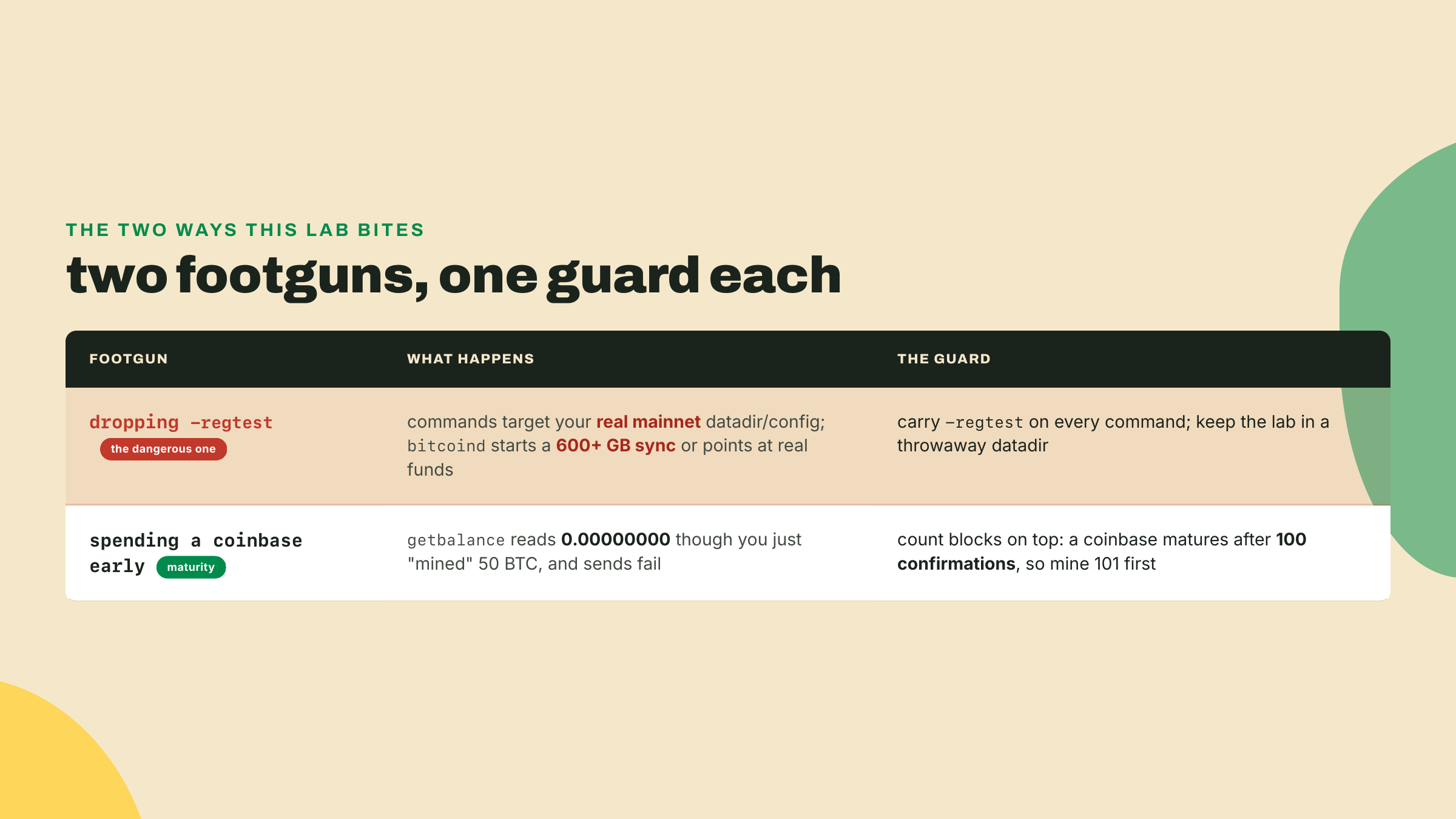
Both footguns here come from a switch being in the wrong position, and the first one is genuinely dangerous.
Drop -regtest and every command aims at your real mainnet configuration instead of your sandbox. On a fresh machine that just kicks off a 600-plus-gigabyte download you did not want. On a machine with a funded wallet, you are now pointing live commands at real money, in a mode where mistakes do not reset. The guard is boring and non-negotiable: carry -regtest on every single command, and keep the lab in a throwaway datadir so there is nothing real for a slipped flag to touch.
The second footgun I walked into myself. Early on I mined a single block, tried to send its 50 BTC, and watched getbalance sit stubbornly at 0.00000000. I spent a solid twenty minutes convinced my wallet was broken and re-reading the send syntax before I counted the blocks on top and remembered the number. One. A coinbase needs a hundred. The wallet was right the whole time; I was trying to spend money the network had not committed to yet.
Try to hand a second wallet ten spendable BTC by mining, and watch the maturity rule refuse.
Create a second wallet, take an address from it, and mine ten blocks straight to that address. Your chain climbs from height 101 to height 111. Now check the new wallet's balance:
bitcoin-cli -regtest createwallet "wallet2"
A2=$(bitcoin-cli -regtest -rpcwallet=wallet2 getnewaddress)
bitcoin-cli -regtest generatetoaddress 10 "$A2"
bitcoin-cli -regtest -rpcwallet=wallet2 getbalance   # 0.00000000
bitcoin-cli -regtest -rpcwallet=lab getbalance       # 550.00000000
Ten fresh blocks, 500 BTC minted to wallet2, and its spendable balance is 0.00000000. Maturity blocked you at block 111, exactly as designed. The proof is in the depth: wallet2's first reward sits in block 102, which at height 111 has only 9 blocks on top, far short of 100. Work out where it finally unlocks. Block 102 needs 100 blocks above it, so the tip has to reach height 202 before that first reward is spendable, and the tenth reward waits even longer.
Now read lab's number, because it is the same rule pointed the other way and it is easy to misread as a bug. lab did not stay at 50. Mining those ten blocks pushed the tip from 101 to 111, and every block above an old coinbase counts toward its maturity, so lab's rewards from blocks 2 through 11 all crossed the 100-confirmation line at once. Eleven mature rewards, 550.00000000. Your acceptance check is the two balances above: wallet2 at 0.00000000, because its coins are nine deep, and lab at 550.00000000, because yours are now a hundred deep or more. Confirm the shape with bitcoin-cli -regtest -rpcwallet=lab listunspent, which lists eleven separate 50 BTC outputs, a detail the next lesson cares about a great deal.
The -rpcwallet flag is how you aim a command at one named wallet when several are loaded, and now that wallet2 is open you need it on every wallet call. Forget it with two wallets loaded and the node answers error code: -19 rather than guessing which balance you meant.
Run it, then say it. Two commands confirm the artifact is real:
bitcoin-cli -regtest getblockchaininfo             # "chain": "regtest", "blocks": 111
bitcoin-cli -regtest -rpcwallet=lab getbalance     # 550.00000000
Those are the numbers after the exercise above, and the height is the giveaway: you mined 101 blocks and then ten more, so the chain reads 111 and lab reads 550. If you skipped the exercise, or ran reset-chain.sh since, you will see 101 and 50 instead, and both readings are correct; the pair simply has to agree with each other. The one-line verifier is bitcoin-cli -regtest getblockcount. Note the -rpcwallet=lab on the balance call: with wallet2 also loaded, the bare form now errors instead of answering. Now close the terminal and explain, out loud, in two sentences and no notes: what is the previousblockhash field doing?
A good answer says the field stores the digest of the block right before it, so the 101 blocks form the exact hash chain the hashing lesson described. And it lands on the consequence: change any old block and its digest changes, so the very next block's previousblockhash stops matching. That one broken link is enough, because the only way to repair it is to re-mine that block and every block above it, which is why nobody can quietly rewrite the history you just mined.
You own 550 regtest BTC (50 if you skipped the exercise), and the chain says so. But where, exactly, does it say so? Not in an account, and not in any field called balance anywhere in those blocks; getbalance is a question your wallet answers, not a number the chain stores. Next lesson you go hunting for your money inside the chain itself and find the balance does not exist as a stored figure at all. It has to be reassembled, from scratch, every single time, out of the leftovers of transactions that nobody ever deleted.
Enroll to take the quiz
The quiz is part of the course — enroll to answer it, track your progress, and earn XP.