Loading...

 BetaBeta
Stamp has a program with three instructions and a test suite. Nobody at the till can use it yet. This lesson three agents build the parts people touch: a web page for the customer's card, a phone app, and a service that gives the shop a dashboard. The web part runs on Node alone, so everyone follows at the keyboard. Around twenty minutes.
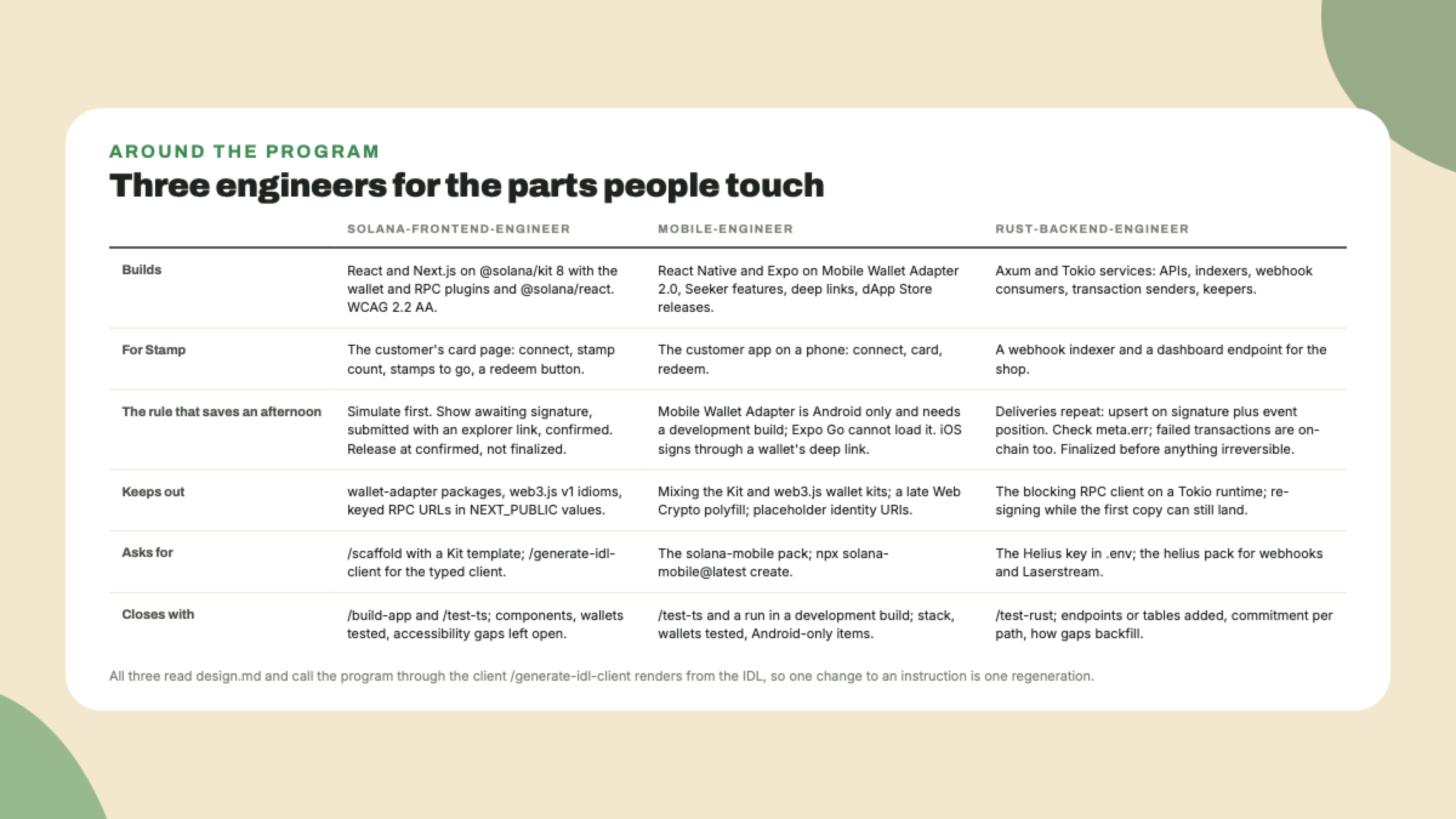
The program is a small part of a product, and the kit knows it: six of the fifteen agents work around the program. Three of them are in this lesson. solana-frontend-engineer builds React and Next.js on @solana/kit, with wallet connection through Wallet Standard and a fixed list of transaction UX rules. mobile-engineer builds React Native and Expo apps on Mobile Wallet Adapter. rust-backend-engineer builds the services that read the chain and keep a database honest under retries and forks. Each one's file carries the mistakes older habits get wrong, and those lists are the real value, because they are the bugs you would otherwise ship.
/scaffold stamp-web, frontend only, with a Kit template that has no program
The command runs create-solana-dapp with a Kit template, makes the folder a git repository and installs the kit into it with the same installer you ran in lesson 1. The security plugin prompts on that piped install, so expect one question. Open Claude Code there when it finishes.
Use the solana-frontend-engineer agent. Build the customer page for Stamp: connect a wallet, show the customer's card for one shop with the stamp count and how many stamps remain until a free coffee, and a redeem button. Read the card from the Stamp program's card PDA on devnet. Until the program is deployed, read from a fixture file so the page works today. Follow your transaction UX rules for the redeem flow and run /build-app and /test-ts before you hand back.
Expect it to read the frontend reference in the solana-dev pack first, then build on @solana/kit 8 with the wallet and RPC plugins and @solana/react, with the legacy wallet-adapter packages kept out. The redeem flow should follow the rules in its file: simulate before asking for a signature, show awaiting signature, then submitted with the signature and an explorer link, then confirmed, and release the UI at confirmed rather than finalized. A rejected signature is a normal outcome, not an error. It closes by running /build-app and /test-ts and reporting components changed, wallets tested and accessibility gaps left open, because its bar is WCAG 2.2 AA.
/generate-idl-client
It builds the IDL and renders a typed TypeScript client with Codama, so the page calls redeem through a function with real types, and program errors decode into messages. Hand-built instructions are the thing this command exists to replace.
Use the mobile-engineer agent. Plan the Stamp customer app in Expo: connect through Mobile Wallet Adapter, show the card, redeem. Tell me which skill pack you need, what works on iOS, and what needs a development build. Plan only for now.
Its answer will ask for the solana-mobile pack and tell you three things from its own file that save an afternoon: Mobile Wallet Adapter is Android only, so iOS signs through a wallet's deep-link protocol or SDK. It needs a development build, because Expo Go cannot load it. And the Web Crypto polyfill must load first or signing fails before the wallet opens, in a way that looks like a wallet bug.
Use the rust-backend-engineer agent. Design a small Axum service for Stamp: consume Helius webhooks for the program's stamp and redeem events, keep a Postgres table of stamps per customer per shop, and serve the shop a dashboard endpoint. Tell me how you keep the table correct when a webhook is redelivered. Design only.
The answer should contain the rules its file calls the hard part: deliveries repeat, so upsert on the signature plus the event's position in the transaction. Failed transactions are on-chain too, so check the error field before applying effects. Confirmed is fine for display and finalized for anything irreversible. Store the slot on every row and backfill through the same idempotent path. It will ask for the helius pack for webhooks, and the key that pack's calls need lives in .env, which /setup-mcp sets.
stamp-web builds and shows a card from the fixture with a wallet connected on devnet.NEXT_PUBLIC_* and EXPO_PUBLIC_* are visible to every user, so a keyed RPC URL goes behind a server route.Three engineers build the parts people touch, each with a list of the traps in its own file: confirmed not finalized on the web, Android-only wallet adapter on mobile, idempotent upserts in the indexer. The generated client is what keeps all three talking to the same program.
Next lesson Stamp's stamps become a token, a customer pays with any coin, and the card turns into a game, which is the token engineer, the DeFi engineer and the two game agents. Mostly reading and prompts, no toolchain needed.
Enroll to take the quiz
The quiz is part of the course — enroll to answer it, track your progress, and earn XP.