Loading...

 BetaBeta
Last lesson you read the record: two seasons of side tracks, and the four hackathons Unruggable entered before it won one, read off its card on colosseum.com/hackathon. This lesson writes the file that says what that record is worth to you.
Colosseum reviews your repository, and its hackathon page, as of the 2026 World's Fair season, says in its own words that the review is not looking at your language, your framework, your patterns or your code quality. Read that twice. The same page says that Colosseum hackathons are startup competitions. That is the one idea: the judging criteria tell you exactly what gets scored, and what gets scored is a company, not the code.
I always like giving the example of an in-person hackathon I won in Dubai, with an idea I thought too simple to place and no planned demo. It matched exactly what the organizers were looking for and the pitch sold it, and none of that was about the code. Luck is not a plan you can hand to a teammate. The brief is.
Colosseum judging factors, colosseum.com/hackathon, read 2026-09-06
Founder + Market Fit
Insight
Product + Execution
Potential Market Size
Founder Communication
Viability
Traction
If the live page shows different names, the page wins, and write down what changed. Look closely at Viability: notes carrying some other word in that slot are from another season. The list also moves by page, since Colosseum's Eternal page lists six factors without Traction, read the same day. Copy the one on the page you are entering.
Founder + Market Fit asks whether the team has the right skills and experience and why it is motivated. Insight asks for a unique insight, or a new technology or trend. Product + Execution asks how well the product works, how it stacks up against the competition and how fast the team ships. Potential Market Size asks how big the TAM is, the total market the product could address, and whether it is large, or small but growing rapidly. Founder Communication asks whether the founders communicate the vision clearly. Viability asks whether this can become a scalable, sustainable business. Traction asks whether the product already has demand or revenue, and how durable that is.
Count the ones a judge could answer by opening your code: one, and only part of that one.
repo review, colosseum.com/hackathon, read 2026-09-06
looks for:      significant work during the hackathon window
                work by the team, not by a third party
                features prioritized strategically
not looking at: language, framework, patterns, code quality
Prioritized strategically tells you exactly what your slice has to show: they want to see that you left things out on purpose, and a commit history shows that more honestly than a deck can.
is the problem real:     Insight, Potential Market Size, Viability (asked with money attached)
does the thing work:     Product + Execution (the competition and ship speed are the same question over time)
does the story land:     Founder Communication (written answers, video, 15-minute interview)
can this team carry it:  Founder + Market Fit, the repo review (work by the team), the interview
Traction is not a new question. It is the first two answered with evidence instead of argument: people already use it, so the problem is real, and it holds up, so the thing works. Viability and Traction are the two lines a startup competition adds. Next to each question, note what your project can already say and write "open" where it cannot. Fiado's Viability line reads "who pays for the tab: still open", and its Traction line is a target, "five shops running real tabs by the deadline, and how many come back", never a claim, because a number made up on day 0 is worse than a blank.
Traction is the factor teams underestimate most, and it is the one a month can still move. A judge cannot value the technology if nobody uses the product built on it. Traction means people using the product, counted, and it does not wait for mainnet: shops running real tabs while the payments settle on devnet is traction, and a mainnet deploy nobody opens is not. The course builds toward that count from week 1.
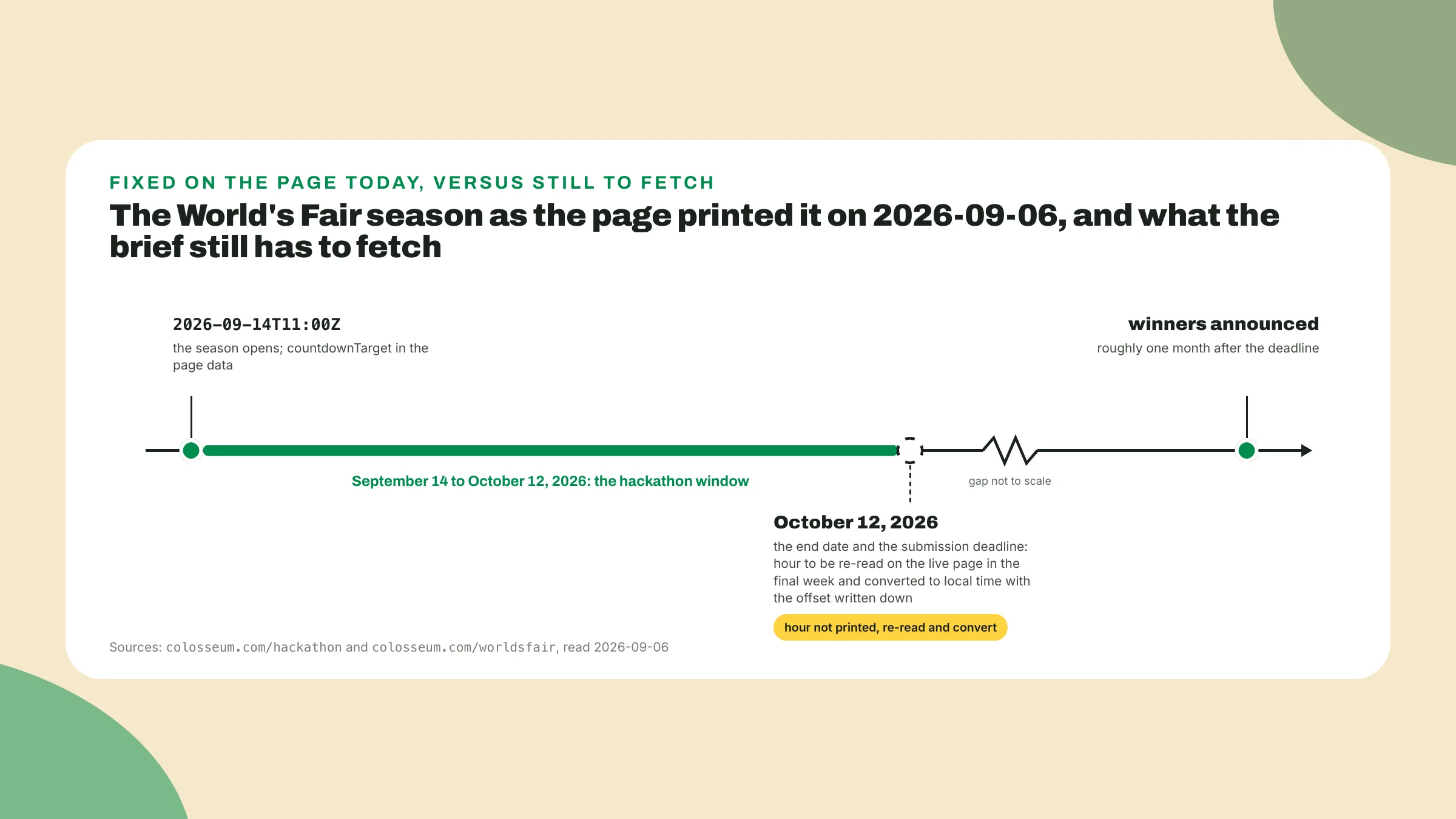
python3 -c "from datetime import datetime; print(datetime.fromisoformat('2026-09-14T11:00Z').astimezone())"
That prints the moment in your machine's time zone with the offset attached. Python 3.11 or newer reads the trailing Z on its own, on an older one replace the Z with +00:00, and verify the behaviour against the datetime docs for your version. When the deadline hour appears on the page, paste it in place of that string and store the result with the UTC original beside it, so a teammate in another zone can redo the sum.
disqualifies, colosseum.com/hackathon, read 2026-09-06
one product submission per team, and so one per individual: nobody enters a second project on the side
the team leader completes the submission before the deadline: the brief names who holds that role
misrepresenting the development history, or failing to disclose pre-existing code: disqualifies, bans, revokes a prize
The page adds that a Code of Conduct violation can disqualify as well, a fourth line you copy without commentary. If you build with an agent team and pull in your own older code, the third line is yours: write down what existed before the window opened and say so in the submission, because a commit history that starts the day before the season reads like the thing the page bans.
<hackathon>, <url>, read <date>
asks:         <the criteria as named on the page>, each tagged with one of the four questions
disqualifies: <the page's own lines>
Not a table: three lines is enough to decide whether to enter and what to adapt.
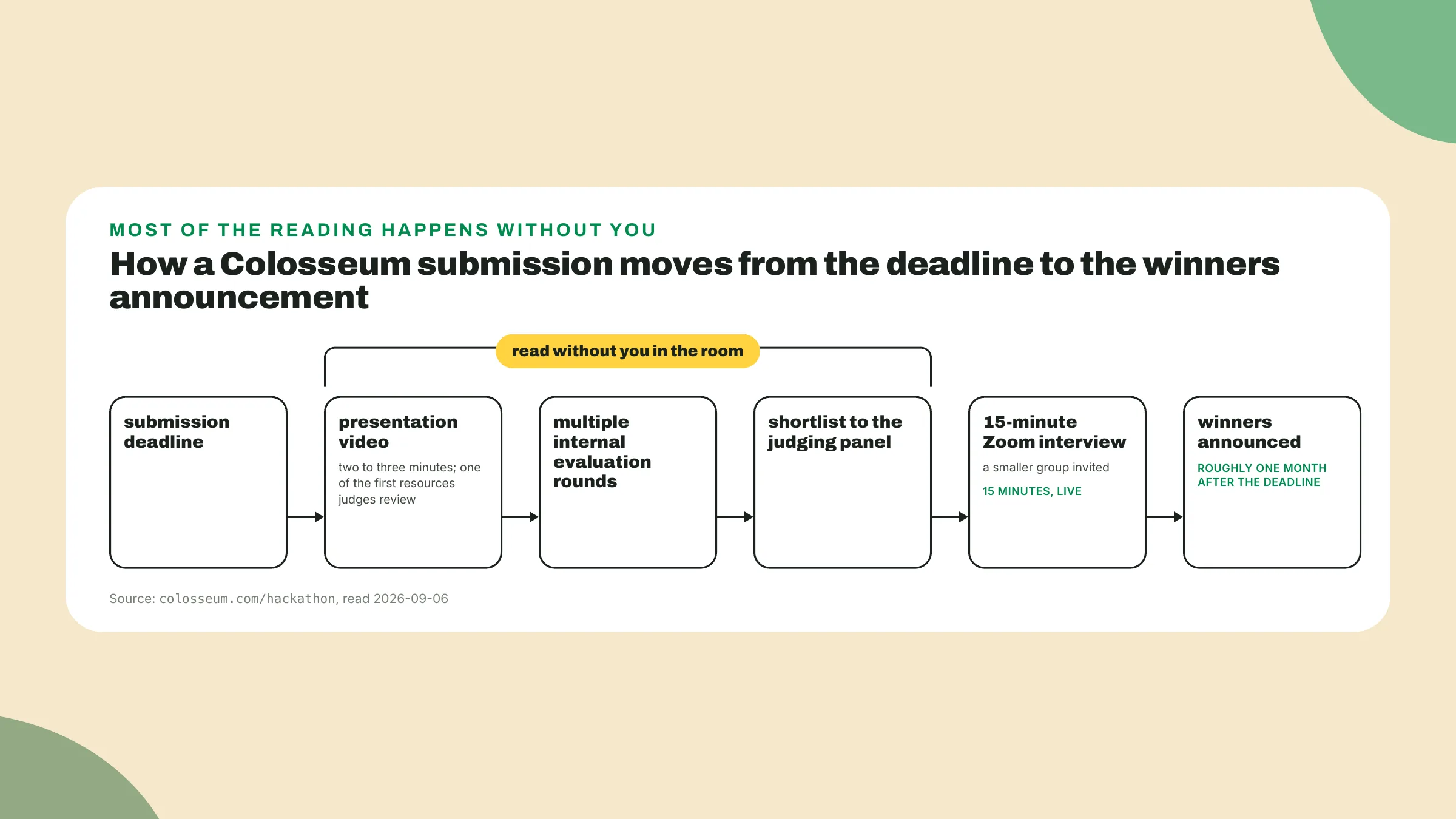
Colosseum scores a company, not the code: the seven factors sort into four questions, real problem, it works, the story lands, this team, with Viability and Traction asking two of them with money and evidence attached. The code lives in one line of the seven, and a judge meets your project first through a two-to-three-minute video, without you in the room. Every piece you build from here is checked against those four questions before it moves on.
Next lesson the clock has not started yet and you already have a pitch. One sentence, written on day 0, before there is a team card or a month plan. You will hate it, which is the point, because the four questions you just sorted are the questions that sentence has to survive.
Enroll to take the quiz
The quiz is part of the course — enroll to answer it, track your progress, and earn XP.