Loading...

 BetaBeta
Last lesson you wrote the GTM one-pager, argued why-Solana for the track and for the accelerator, and logged one partner reply. Keep the one-pager open, and open the narrative log and competitor-map-sizing.md beside it, because those three files are the deck already, in the wrong shape.
Your package is one tab among many and a judge gives it about three minutes. In those minutes the judge has to understand a real problem and come to believe this is the team that will solve it. The winners I watched had the most compelling presentation in the room, and some had less code than the teams that placed under them, because a problem that needs solving sold the right way beats features.
So the deck is built from the problem outwards, and the first thing to build is the order. Open a new file called deck-judge.md, put the date on the first line, and write seven headings under it, one per line. Everything else today goes under those seven lines.
deck-judge.md, Fiado, Colosseum World's Fair season, started 2026-10-05
1 cover        the problem in one sentence, the product name small
2 problem      the notebook by the till, and how many tills
3 demo         the tab on devnet, the transaction a judge can open, the traction line
4 what is new  what the slice does that the notebook and the bank app do not
5 why Solana   for the track and for the accelerator
6 this team    who we are, why this problem, and who pays
7 next steps   what is not built yet, and the ask
One decision is made: the product's name does not show up until the problem has been said.
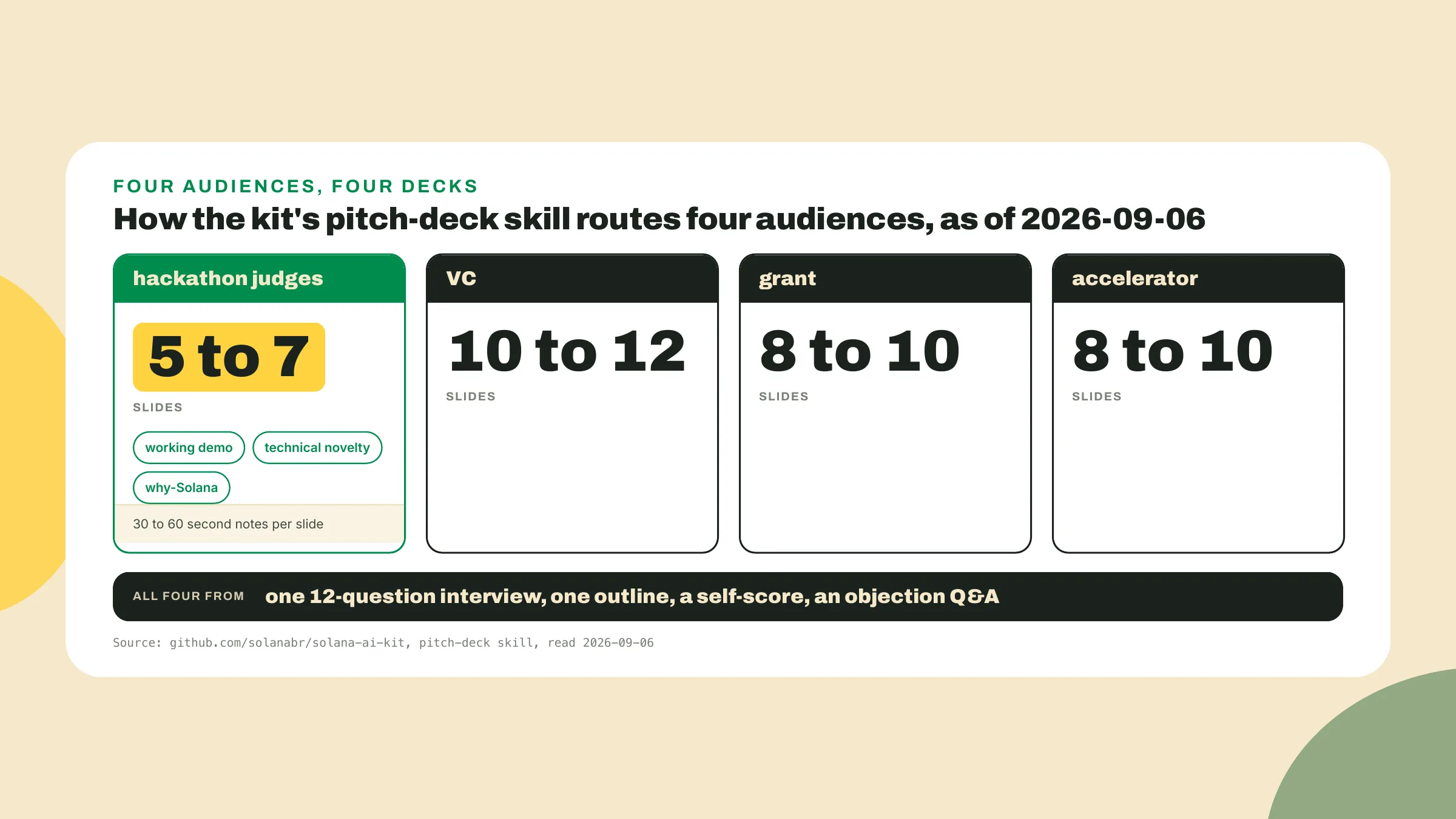
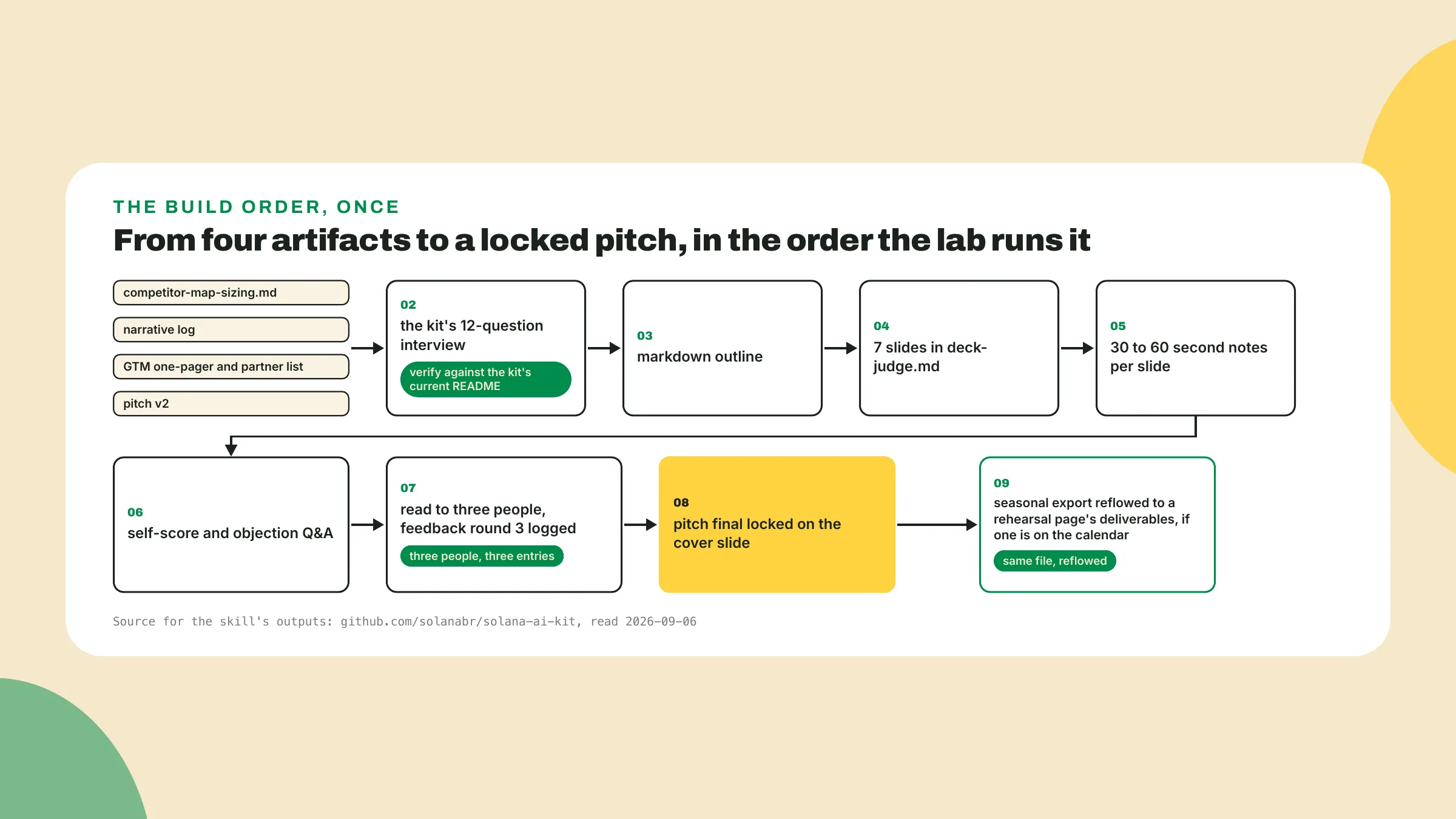
Then write the one-liner, which is a different object from the cover sentence: the answer to what is this? in five words or fewer, for the tagline on the submission form, the corner of the cover next to the name, and the first words of a post. Three rules, in order. Unambiguous first, since ten people reading it should picture the same product, and if they picture ten products the line failed. Exciting second, because nobody gets excited about a product they did not understand. Truthful enough third, meaning it paints the right picture and the details come after it.
Use the words your mother would use over coffee. No jargon, and none of the lego, building-block, layer or glue metaphors. Two shapes work: the analogue, something everyone knows plus your twist, and the plain description, a verb and an object and a context. Write four candidates and pick one, with the reason beside it. Fiado's:
one-liner candidates, Fiado, 2026-10-05
loans for corner shops              wrong: a tab is not a loan, nobody lends anything
self-repaying tabs                  ambiguous: ten readers, ten products
the credit notebook, on two phones  clear, the analogue shape, six words
shop credit both sides see          chosen: five words, one picture, true today
The problem slide gets the most time: three short lines on what happens, for Fiado the notebook by the till, it gets wet or lost or a regular moves away with a balance open, and the owner chases forty small debts herself. Under those lines, one line of numbers: the three sizing numbers from competitor-map-sizing.md, each with its source and the date it was read. On the judge deck the market lives here and nowhere else.
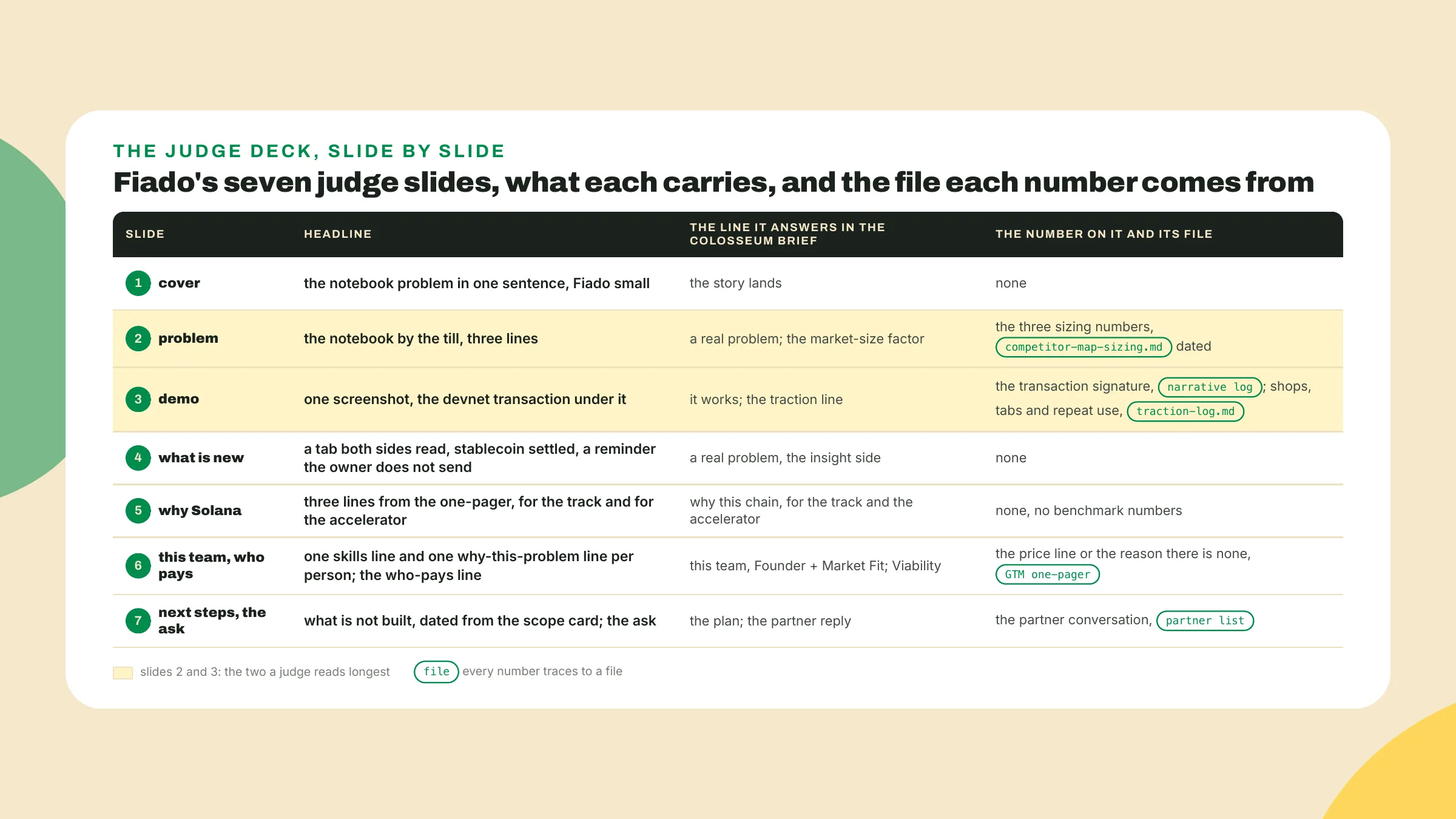
The team slide answers Founder + Market Fit. On the Colosseum page read on 2026-09-06 that factor asks whether the team has the right skills and experience for this market and why it is motivated to solve this problem, so each person gets one line of what they can do and one line of why this problem. For Fiado the second line is the person who has stood behind that till and watched the notebook get wet. Under the team, one line: who pays, copied from the one-pager, or the reason there is no price yet. That is the Viability answer.
Then the ask in one line: for Fiado the accelerator, and one introduction to a second cooperative, named, with the partner reply from last lesson as proof there is a first one. Read the seven out loud with a timer and write the time on the file's first line.
Write the notes, 30 to 60 seconds a slide, as spoken sentences. A note that is a bullet list gets read in the flat voice people use for lists, and the problem slide dies in that voice. Fiado's problem-slide note runs about thirty seconds: the notebook by the till, about forty names with a running total, the day it got wet, and the three numbers on the screen with the pages they came from. The kit's draft is usually longer, so cutting is most of the work.
Write the objection Q&A: the questions a judge is going to ask, each with a one-line answer, written before anyone asks. Four is enough for a first list. Fiado's, on 2026-10-05, reads:
objections.md, Fiado, 2026-10-05
why not the bank's own app          the bank does not know the regular, the shop does, and the tab is between those two
what if the owner loses the phone   the tab is not on the phone, a new phone reads the same tab
who pays                            the who-pays line from the one-pager, said in one breath
why a chain at all                  the why-Solana line from slide 5, without the word fast in it
Write yours before the feedback round, because the three people are going to ask two of these anyway.
After the read, ask each to say the problem in one sentence and write down the sentence they said, not the one you meant. Then ask what the product is in five words and write that down too, because a one-liner two readers hear differently is ambiguous, not clever. Log three entries: who, what they said, what changed. If two of the three land close to the cover, the pitch is final. If not, rewrite the problem slide and read it again the same day, and it is still round 3, with more than three entries.
pitch final, Fiado, week 4, locked 2026-10-06, final
A shop owner who loses the credit notebook loses forty small debts with it, so Fiado
keeps the tab on her phone, shows each regular the same balance, takes part of it in
USDC, and sends the reminder for her.

round 3, said back in one sentence:
Lucia   "the shop that loses its notebook"           landed on the cover
Marcos  "paying a shop tab from your phone"          landed on the product half
Jorge   "the one where the owner stops chasing you"  landed on the cover
changed: nothing; two of three landed; final
I have watched a pitch worse than its product lose, and lose on the pitch, with the better product going home, which is why this course rewrites the pitch four times before a judge sees it.
Reflow the same file into the seasonal export, if a rehearsal is on your calendar. A seasonal hackathon or a side track will have its own page with its own deliverables and deadline, so read that page the day you decide to enter and reuse the package you already have. Nothing new gets written: the seven slides reflow into that page's sections, and the notes keep their words. If the page asks for a market slide, build it from competitor-map-sizing.md only, the three numbers, each with its source and the date it was read. The case for small and clickable over big and unsourced was made in the market-research lesson, and the slide does not reopen it. I would hedge that to most judges, but the one scoring a market-size factor is asking whether the number is real.
Now yours. Fiado's deck, copied into your toolkit repo, is missing the problem slide and the next-steps slide, and you write both from the narrative log: the problem slide from the log's first dated screenshot and the decision entry that named the user, the next-steps slide from the decisions that cut scope in week 2, each with its date. Then your own deck-judge.md, filled from the interview and the four files, then the notes, the objections, the read to three people, the cover sentence marked final, and the seasonal export from the same file if a rehearsal is on the calendar. If three people is three calendars, read to one today and two tomorrow and keep the entries. The round is the entries, not the day.
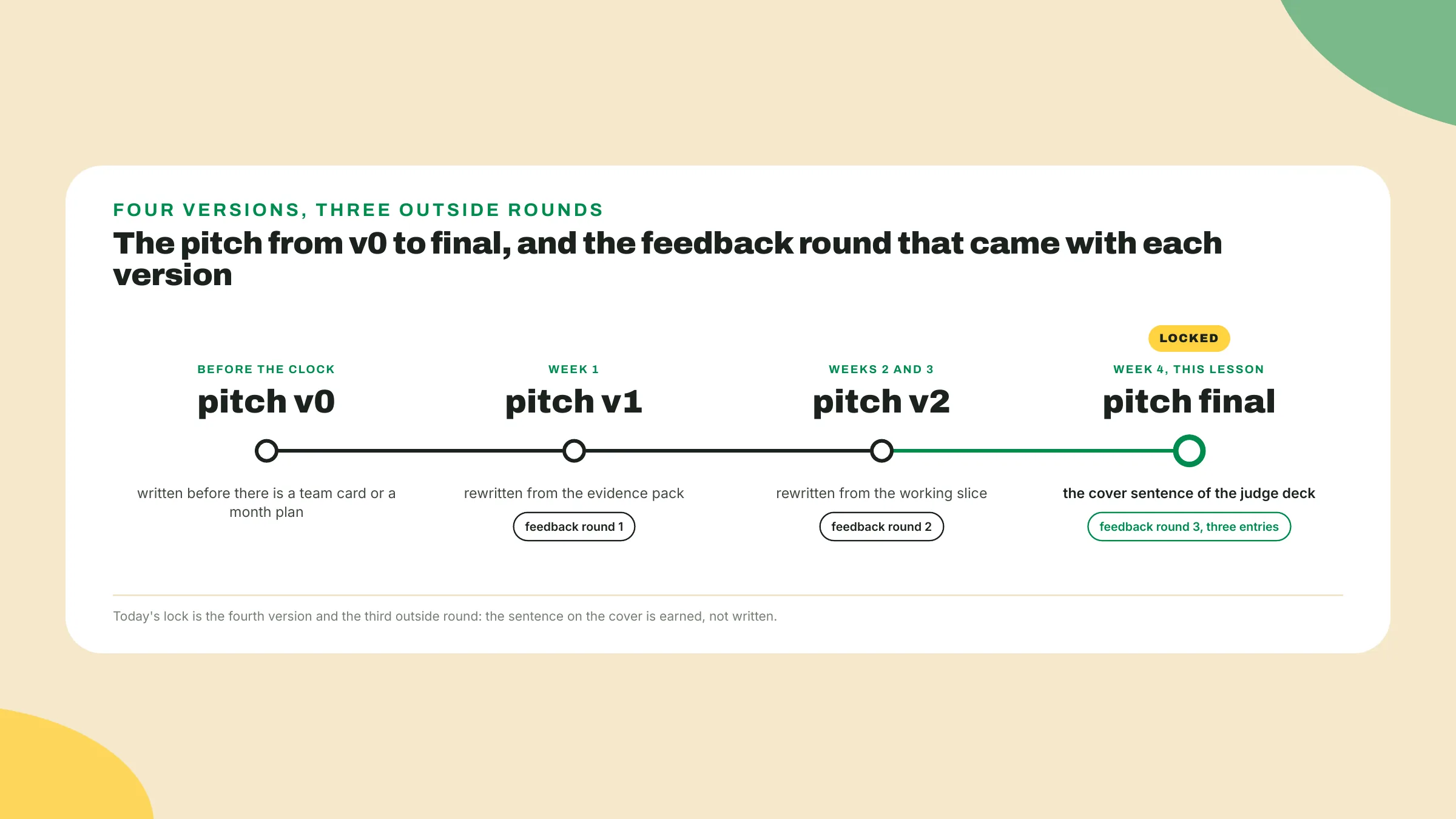
The judge deck is a different object from the investor deck: seven slides built from the problem outwards, a spoken note under each, and every number pointing at a file you already wrote. The cover sentence is the fourth version of the pitch, and it was read to three strangers before it was marked final. If a stranger who saw only slide 2 can say your problem in one sentence, the deck works.
Next lesson the deck becomes two videos, and the first action is writing the first twenty seconds of the presentation script from the problem slide you just locked, because those twenty seconds decide whether a judge watches the rest. Bring the notes, they are the script's long form, and bring the objection list for the demo video, where a judge is thinking those questions while the transaction confirms.
Enroll to take the quiz
The quiz is part of the course — enroll to answer it, track your progress, and earn XP.