Cargando...

 BetaBeta
Este curso aún no está disponible en Espanol, así que estás leyendo el original en English.
Last lesson you wrote your own chain of agents. Fourteen of the fifteen have been introduced, and the fifteenth is the one for the weeks after the workshop, when you are alone with a program you half understand. This lesson is the guide agent, the command that explains code, the researcher as a habit, and how the kit updates itself, then a quiz over the whole course. Around ten minutes.
The kit will build faster than you learn, and that gap is the one I would watch. solana-guide exists for the gap. Its file says it teaches so that the learner can solve the next problem without it: it checks your level first and asks rather than assumes, gives a plain definition and the problem the concept solves, then a minimal example, then the mistake beginners make, and it checks that you can predict before it moves on. It teaches current tooling and points it out when the tutorial you brought predates it. Production code goes to the engineers, and that split is deliberate.
Use the solana-guide agent. I built Stamp with the kit and I do not really understand why the card account is a PDA instead of a normal account. I know JavaScript and a little Rust.
Expect it to confirm your level, define a PDA in plain words with the problem it solves, draw a Mermaid diagram of shop, card and customer, show the derivation, name the beginner's mistake, and then ask you to predict something, what happens if someone passes a different card account, before it goes on. If it skips the question, ask for it. Over several sessions it can run a track from the incubator curriculum in the solana-new pack, concept, working code, exercise, line-by-line review, until you build unaided and it hands you to the engineers.
/explain-code programs/stamp/src/lib.rs
The command scales its depth to the code, and a whole program gets the full shape: an overview in two or three sentences, a Mermaid diagram of instruction flow or account relationships, a walkthrough of the significant sections with the reasons behind the non-obvious choices, the Solana concepts used, security notes on the checks the code performs and the ones it seems to miss, and for learners two or three what happens if questions. Run it on the anchor-engineer's output from lesson 3 and you will understand your own program better than when it was written.
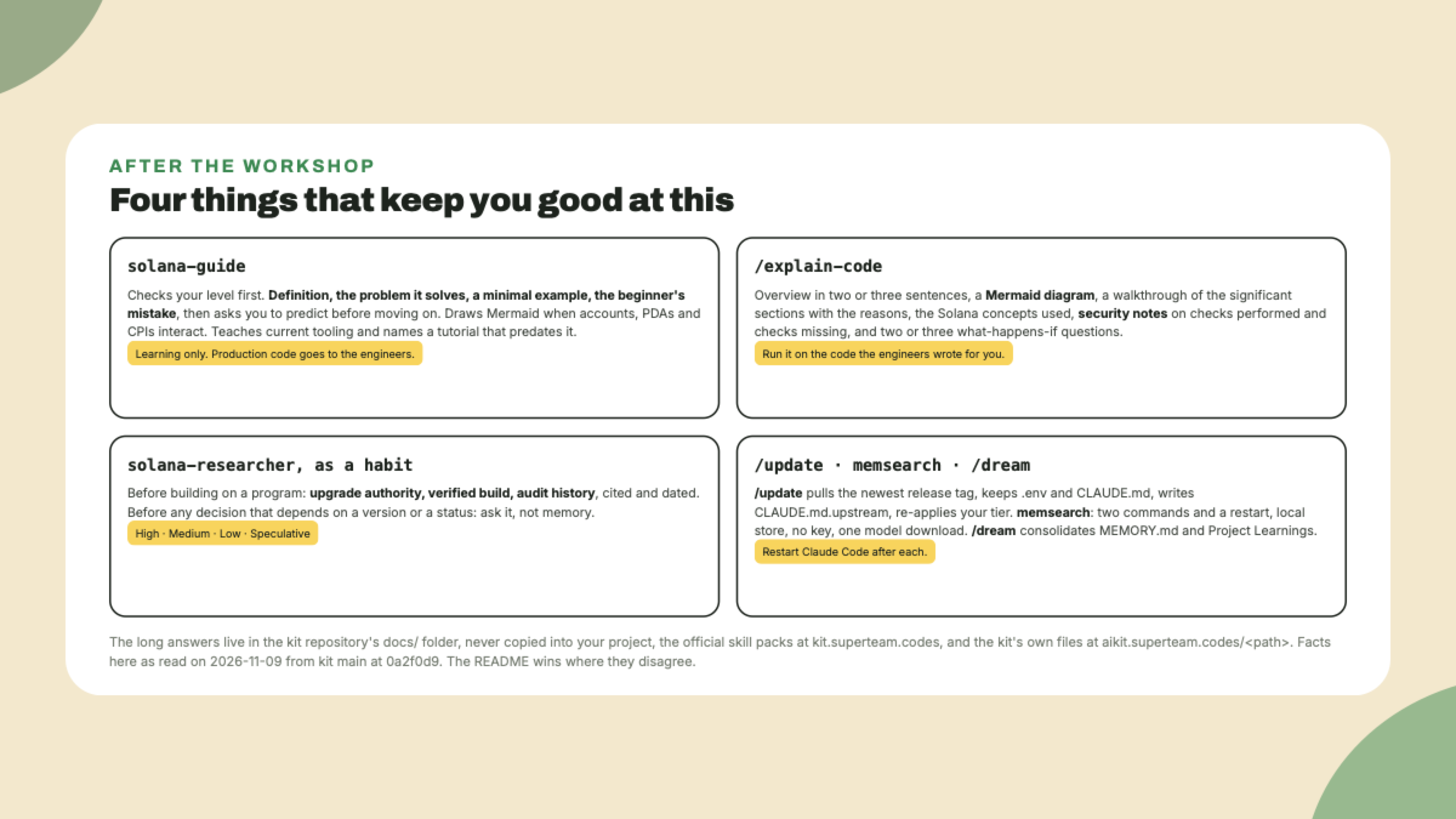
Use the solana-researcher agent. Before I build on <program>, check its upgrade authority on mainnet, whether the deployed binary is a verified build, and its audit history. Cite and date everything.
That is its own pre-recommendation check, and the three answers are what you want before trusting a program with a shop's money.
/update
It pulls the newest kit release tag, or main while no tag newer than v2.4.0 exists, and overwrites the agents, commands, skills and scripts the kit ships, including any you edited. It keeps .env, your settings, .mcp.json and the memory files, leaves your CLAUDE.md in place and writes the kit's version beside it as CLAUDE.md.upstream whenever the two differ, keeps the extensions you installed, and re-applies your firewall tier. Restart Claude Code afterwards. The agents you read in this course are kit files, so an update can change them, and /add-skill with no id lists every pack with whether it is installed and when to install it.
/plugin marketplace add zilliztech/memsearch
/plugin install memsearch
It is a plugin, not an MCP server, with a local store and a local embedder, so no key and no account, at the cost of a model download of around 558 MB on first launch. After a few sessions, daily markdown files appear under .memsearch/memory/, and that is where the program id you deployed and the design decision you rejected stop being re-derived. /dream consolidates a different store, MEMORY.md and the Project Learnings section of CLAUDE.md, when they grow stale, and asks before it touches the instruction file.
docs/ folder is never copied into your project. agents-and-commands.md has all fifteen agents and all 54 commands, firewall.md the tiers and their limits, skill-packs.md the pinned packs, configuration.md the MCP servers and plugins with what each costs per session. The official skill packs are hosted as markdown at kit.superteam.codes, where any agent can read them without the kit, and the kit's own files are served at aikit.superteam.codes/<path>./explain-code gave you a diagram and a security note on your own program./update. Plugins activate on restart, and permission rules are read at session start.main branch at commit 0a2f0d9, which is what the installer fetches until a release newer than v2.4.0 is tagged. The v2.4.0 tag holds 32 commands and none of the workflow chain, so the lessons on /crew, /ship and /inspect-mint describe main. When the kit's README and this lesson disagree, the README is right.One agent teaches at your level and makes you predict, one command explains code with a diagram and security notes, and the researcher checks authority, verified build and audits before you trust a program. The kit updates itself and keeps your files, and the memory plugin keeps it from re-deriving what you already decided.
The quiz below runs over the whole course. After it, build something small with the kit this week, and tell the people who ran your workshop which agent surprised you and which one let you down.
Inscríbete para hacer el quiz
El quiz es parte del curso: inscríbete para responderlo, seguir tu progreso y ganar XP.