Cargando...

 BetaBeta
Este curso aún no está disponible en Espanol, así que estás leyendo el original en English.
Stamp has a program, tests, an audit report, a web page, and from last lesson a token proposal, a swap design and a game plan. This lesson puts it on devnet with the kit's approval stop, gives it a pipeline, writes the docs a stranger needs, and lets a reviewer meet the app cold. Around fifteen minutes, and the deploy needs the Solana CLI from lesson 3.
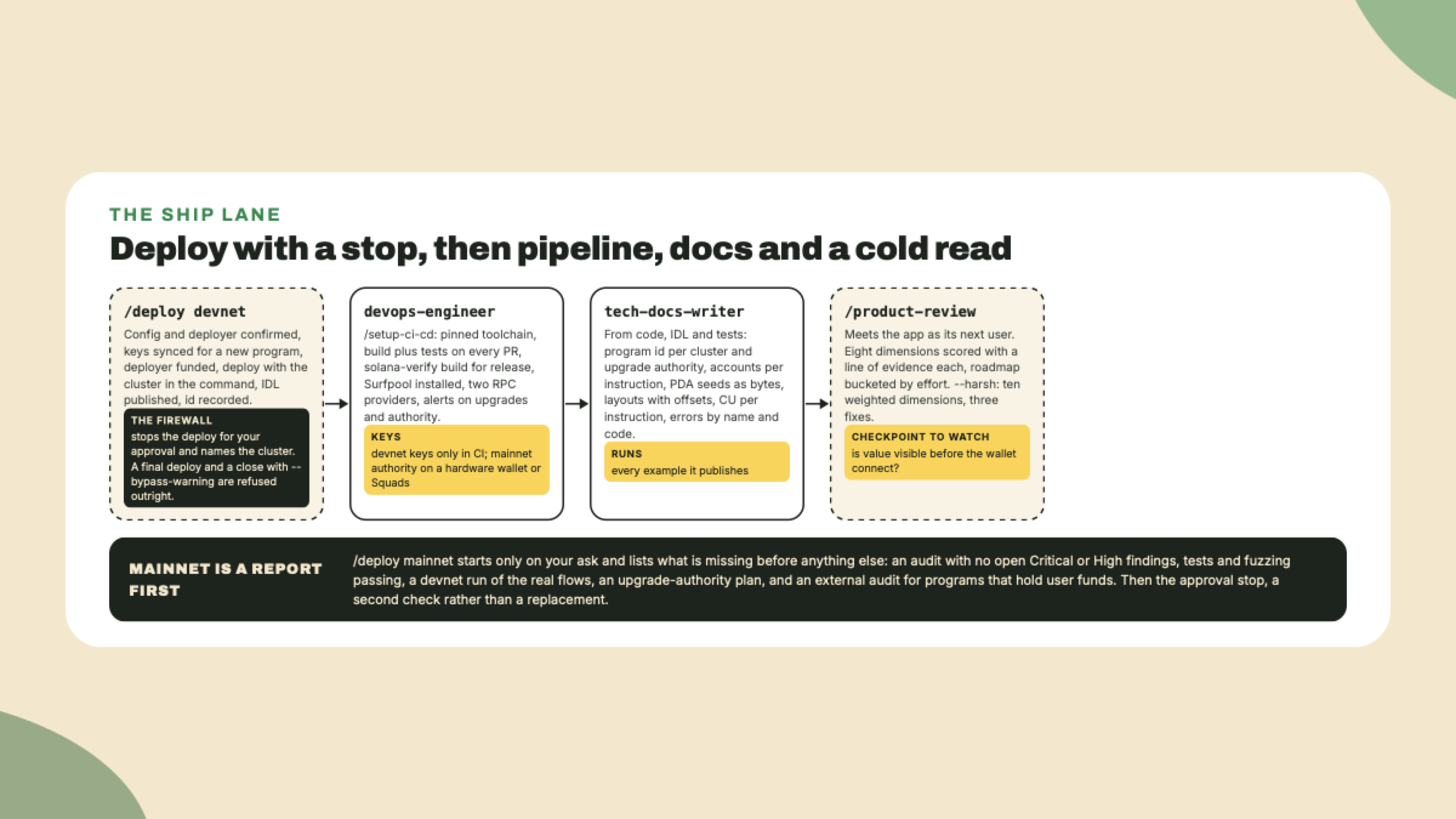
Shipping is where money and keys appear, so it is where the kit's firewall matters most. The firewall is a set of permission and sandbox rules generated from one tier, named in .claude/security.json, plus guard hooks that run before a command, plus the safe-ai-skill plugin. The default tier, Relaxed, lets the toolchain work and stops program deploys, upgrades, authority changes and transfers for your approval, naming the cluster, except on a local validator. Four irreversible actions are refused outright at every tier, a final deploy, program close --bypass-warning, program-v4 finalize and disabling a token authority, and the agent hands you the command to run yourself. Two agents work in this lane: devops-engineer for CI, toolchain pinning, RPC infrastructure and monitoring, and tech-docs-writer for the documentation that takes every fact from the code rather than from memory.
/deploy devnet
The command's own steps: confirm the RPC and the deployer with solana config get, run anchor keys sync for a never-deployed program so declare_id matches the keypair, fund the deployer with an airdrop or the web faucet, then deploy with the cluster in the command, so the approval prompt shows which cluster it resolved. That prompt is the firewall. Say yes, and the command publishes the IDL to Program Metadata, checks the program with solana program show, and records the id in .program-id-devnet and your app env. Mainnet is a separate step: the command starts it only when you ask, and first reports what is missing, an audit with no open Critical or High findings, tests and fuzzing passing, a devnet run of the real flows, an upgrade-authority plan, and an external audit for programs that hold user funds.
/firewall
It reports the declared and enforced tier and the rule count. Off turns the sandbox off for a machine you already isolated, Medium is for reading code you did not write, High denies mainnet writes outright and is the only tier that stops the agent editing the kit's own configuration, and a switch applies in the next session. Ask Claude to read .env once to see the security plugin refuse it. That refusal is the plugin's, so if the installer skipped safe-ai-skill, Relaxed leaves .env readable and the read goes through. The kit's way to know which keys are set is bash .claude/bin/env-keys.sh, which prints names and set or empty, never a value.
Use the devops-engineer agent. Set up CI for Stamp with /setup-ci-cd: build, tests and the audit lints on every pull request, a verifiable build for release, and a devnet deploy on tags. Tell me where the keys live and which versions you pinned.
Its file carries the Solana CI facts a generic pipeline gets wrong: pin the toolchain (Anchor 1.1.x with Solana CLI 3.1.10, host Rust 1.89 or newer, GLIBC 2.39 or newer), gate merges on build plus tests, build the release artifact with solana-verify build so the on-chain program can be verified, install Surfpool because anchor test runs on it, and only devnet keys belong in CI. The mainnet upgrade authority stays on a hardware wallet or a Squads multisig, and CI may write the buffer and hand it to the multisig, which executes the upgrade. It closes with /audit-infra, the infrastructure audit, and with /doctor when the toolchain changed, and reports pipelines, secret names without values, pinned versions and the alert list.
Use the tech-docs-writer agent to write Stamp's README for frontend and indexer developers, from the code, the IDL and the tests.
Its file says what program docs must state: the program id per cluster and the upgrade authority, checked with solana program show, each instruction's accounts with signer and writable flags, PDA seeds as exact bytes and whether the bump is stored, account layouts with offsets because indexers filter on them, compute units per instruction, and errors by name, decimal and hex, so 0x1770 is findable. It takes examples from the tests or the generated client and runs them before publishing.
/product-review
It asks for the product, the target user, the one core action and the stage, then walks the app as that user and scores eight dimensions with evidence: onboarding, core loop, empty states, error states, performance, trust signals, mobile, docs. A score comes with the line that earned it, and the roadmap is bucketed by effort. --harsh turns it into a stress test with ten weighted dimensions and exactly three fixes. For Stamp the checkpoint to watch is whether value is visible before the wallet connect, and for a loyalty card the answer should be yes.
/quick-commit formats, lints and commits with a conventional message and no attribution trailer, proposing a dated branch first when you are on main. /pr-description writes a pull request body a reviewer can verify, from the diff, the log and test output that actually ran, and leaves out any number nobody ran..program-id-devnet holds Stamp's id and solana program show on it names you as the upgrade authority.Deploys stop for your approval and name the cluster, mainnet starts with a precondition report, CI holds devnet keys only, and the docs state the id, the authority, the seeds and the error codes from the code. The firewall sits at the deploy because that is where the money is.
Next lesson is yours: three idea threads laid out as agent chains, from the first research prompt to a weekend's output, and a template to write your own. Bring an idea, even a bad one.
Inscríbete para hacer el quiz
El quiz es parte del curso: inscríbete para responderlo, seguir tu progreso y ganar XP.