Cargando...

 BetaBeta
En la lección pasada armaste deck-judge.md bajo siete encabezados, escribiste las notas de 30 a 60 segundos por diapositiva, pusiste cuatro objeciones en objections.md, se lo leíste a tres personas en la ronda 3 y marcaste la oración de portada como final. Deja las notas abiertas. Son la forma larga de todo lo que grabas hoy.
Las demos que recuerdo abrían con una persona y un problema: una billetera vaciada de la noche a la mañana, alguien al teléfono con un estafador sin saberlo todavía, una firma que ya no se podía deshacer, y después la sensación de estar ahí parado sin poder hacer nada, y recién después de eso el producto. Eso son los primeros veinte segundos de tu video de presentación.
La única idea que esta lección agrega es que estás haciendo dos cosas distintas. La presentación cuenta la historia, la demo muestra el recorte, y el error que la mayoría de los equipos comete en la semana 4 es tratarlas como una sola grabación cortada de dos maneras. Lo que se sacrifica es la hora: un video hermoso de una demo que se traba en la toma 6 pierde contra una grabación de pantalla sencilla de una que no se traba, así que el tiempo de producción va al guion y a la toma, no a los efectos.
presentation-script.md, tu proyecto, temporada World's Fair de Colosseum, empezado 2026-09-06
0:00 a 0:20   el problema: una persona, lo que pasó, la sensación; todavía sin nombre del producto
0:20 a 0:50   qué hace el producto, con las palabras de la oración de portada
0:50 a 1:20   el recorte en devnet, una pantalla, la transacción que un jurado puede abrir, la línea de tracción
1:20 a 1:45   qué es nuevo, y por qué Solana, tres líneas de las diapositivas 4 y 5
1:45 a 2:15   este equipo, y quién paga
2:15 a 2:45   qué no está construido todavía, y la petición
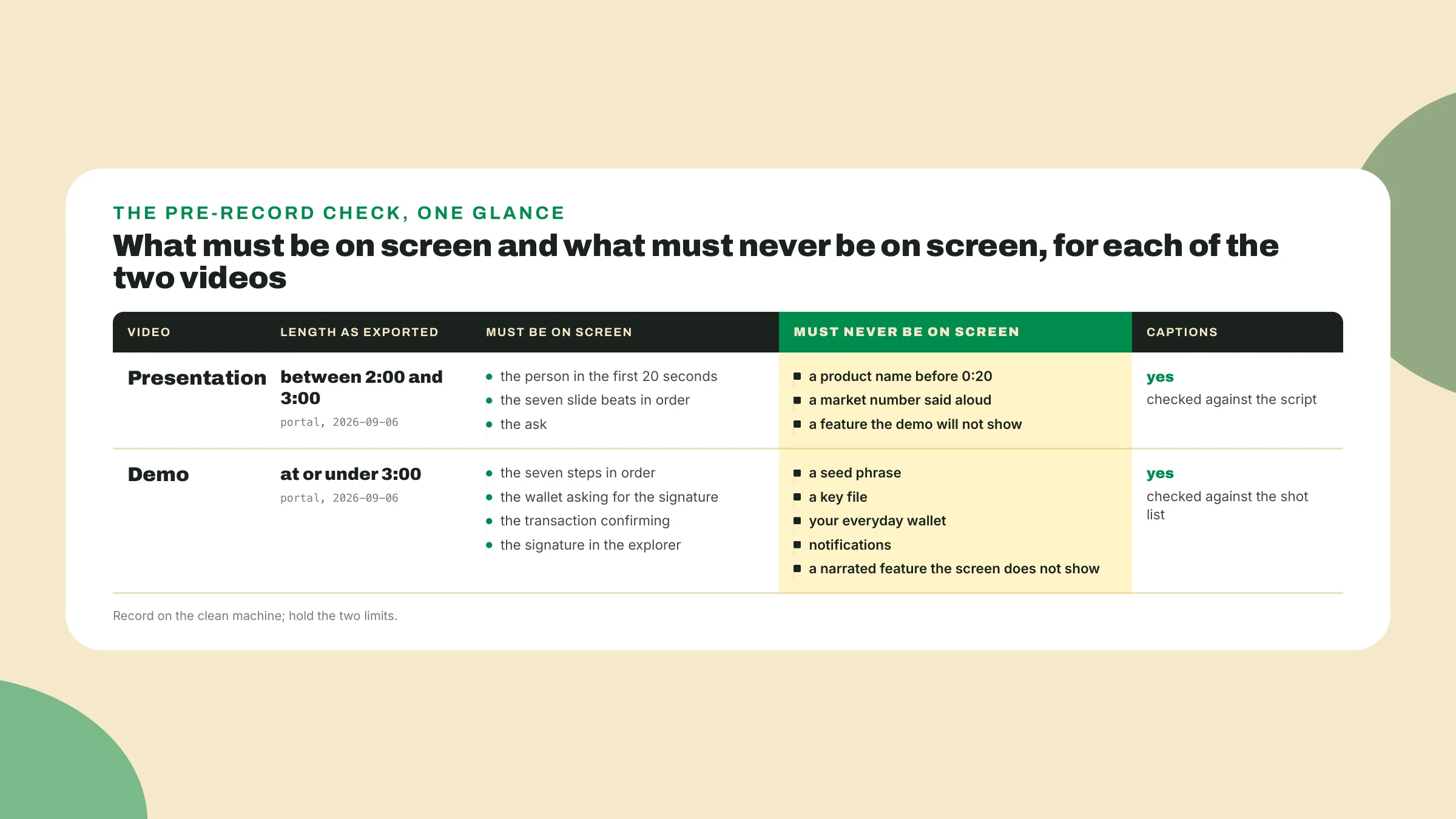
Llena solo el primer bloque. Toma la nota que escribiste para la diapositiva del problema, quítale la línea de dimensionamiento, empieza por la persona y no por la libreta, y termina en lo que ella sintió cuando la libreta ya no estaba. Los veinte segundos tienen una persona, algo que le pasó a esa persona y lo que sintió después, en ese orden: sin nombre del producto, sin número de mercado, sin equipo. Si el paquete de evidencias de la semana 1 tiene una frase real de una de esas conversaciones, úsala.
Para Fiado la persona es la dueña de la tienda que perdió la libreta: unos cuarenta nombres, cada uno con su total acumulado al lado, el día que se mojó, y ella preguntándole a cada cliente habitual cuánto debía y creyéndole, y la versión de veinte segundos termina en lo que es estar detrás de una caja sabiendo que el dinero está en algún lugar de la memoria de cuarenta personas.
Lee el primer bloque en voz alta con el cronómetro corriendo. Si pasa de veinte segundos, quita una oración y vuelve a leerlo hasta que quepa. Veinte segundos a ritmo normal de habla son menos palabras de las que crees, y solo el cronómetro decide. Prefiero que entregues una versión de quince segundos que pegue a una de treinta que sea buena.
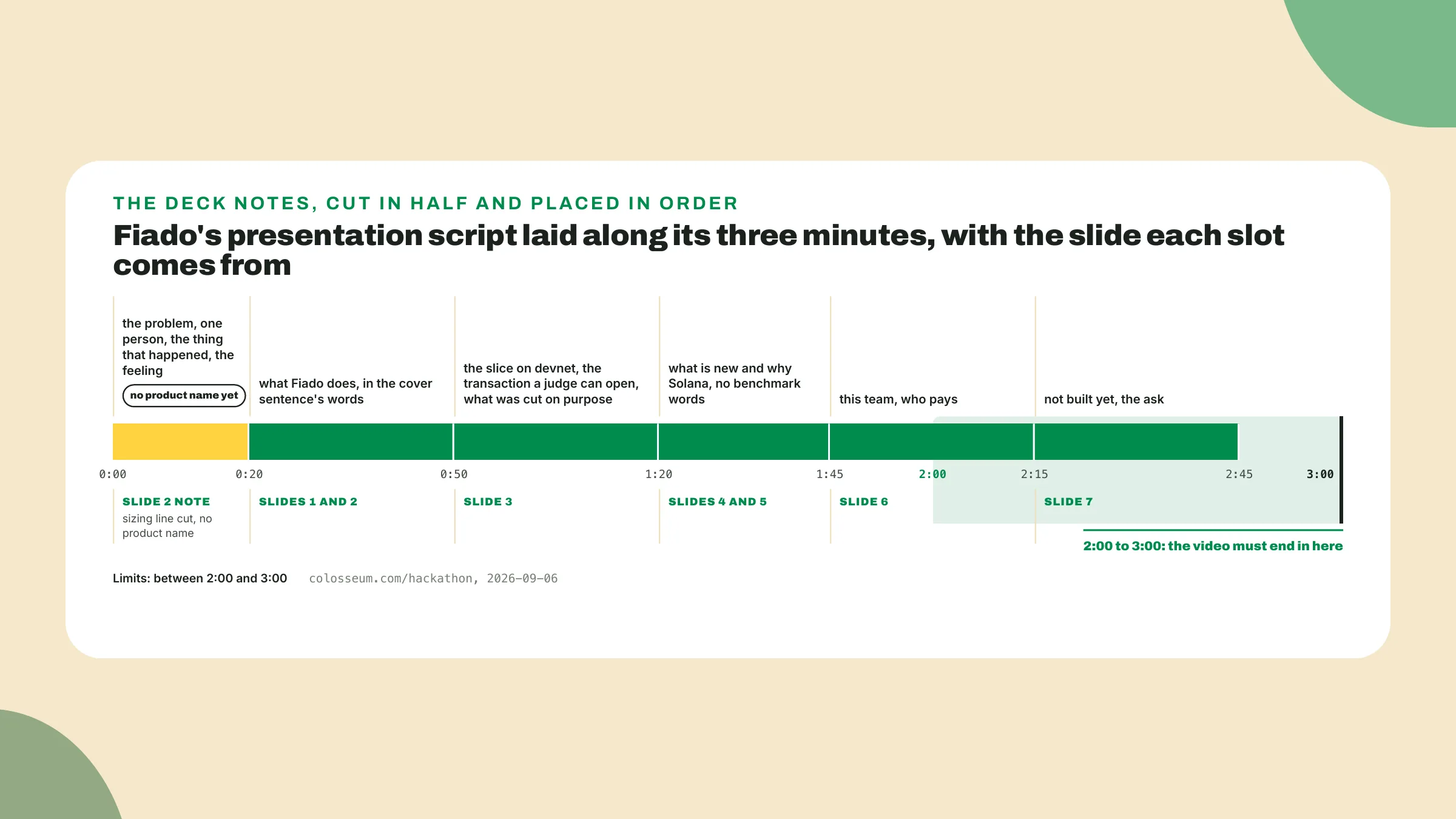
Llena los bloques que faltan a partir de las notas del deck, recortadas más o menos a la mitad. Desde la temporada World's Fair 2026, la página de Colosseum pide 'a two-to-three-minute presentation video' (un video de presentación de dos a tres minutos) y lo llama 'one of the first resources judges review' (uno de los primeros recursos que revisan los jurados) (colosseum.com/hackathon, 2026-09-06). Por eso este video recibe el tratamiento de los primeros veinte segundos y la demo no. Siete diapositivas, aun en el extremo corto de 30 segundos cada una, ya son tres minutos y medio, y el video tiene que quedar entre 2:00 y 3:00, así que cada nota pierde más o menos la mitad de sus palabras y el orden de las diapositivas se mantiene. El de Fiado dice así del segundo bloque en adelante:
presentation-script.md, Fiado, temporada World's Fair de Colosseum, 2026-10-05
0:00 a 0:20   el problema: la dueña de la tienda y la libreta (te toca escribirlo)
0:20 a 0:50   Fiado convierte esa libreta en un fiado que los dos lados pueden leer. La dueña
              abre un fiado para un cliente habitual y agrega lo que se llevó, el cliente ve el
              mismo saldo en su propio celular, y cuando vence, sale un recordatorio que la
              dueña nunca tuvo que mandar. El cliente paga una parte en una stablecoin desde
              ese mismo celular, y los dos ven moverse el saldo.
0:50 a 1:20   Esto corre en devnet hoy. Esta es la pantalla del fiado, y debajo está la
              firma de una transacción real que puedes abrir. Cuatro tiendas ya llevan
              fiados reales aquí, y tres volvieron sin que nadie les pidiera nada. Construimos el fiado,
              el pago parcial y el recordatorio en dos semanas, y dejamos fuera a propósito el
              programa del fiado, los rieles de fiat y el onboarding de billeteras. Están en
              la última diapositiva.
1:20 a 1:45   La app del banco no conoce al cliente habitual. La tienda sí. Fiado guarda el
              crédito entre esas dos personas y pone los pagos on-chain, cada uno una
              transferencia de stablecoin desde un celular con el nombre del fiado, para que
              los dos puedan leer el registro sin confiar en nosotros. Esa es la transacción
              que acabas de ver.
1:45 a 2:15   Somos dos. Uno de nosotros estuvo detrás de esa caja. Nadie paga todavía. La
              tienda va a pagar, cuando diez tiendas hayan llevado un fiado durante un mes. El
              cliente nunca le paga a Fiado.
2:15 a 2:45   Falta construir: el programa del fiado, los rieles de fiat, el onboarding
              de billeteras, después el despliegue con la cooperativa, en ese orden. Una
              cooperativa ya respondió. Queremos la aceleradora, y una presentación con una
              segunda cooperativa.
Lee el guion completo desde 0:00 con el cronómetro corriendo y escribe el total en la primera línea. El bloque de la demo, en 0:50, dice que la transacción es real y apunta a una firma, y hasta ahí llega la presentación.
El guion no dice rápido, por la razón que dio la lección pasada. No dice el número de mercado en voz alta, porque el número está en la diapositiva detrás de la voz y un jurado que lo quiera va a pausar. Y en 0:50 no dice nada que el video de la demo no vaya a mostrar, así que los dos videos nunca se contradicen. Si el total no queda entre 2:00 y 3:00 sin apurarte, el problema está en un bloque posterior, no en el primero.
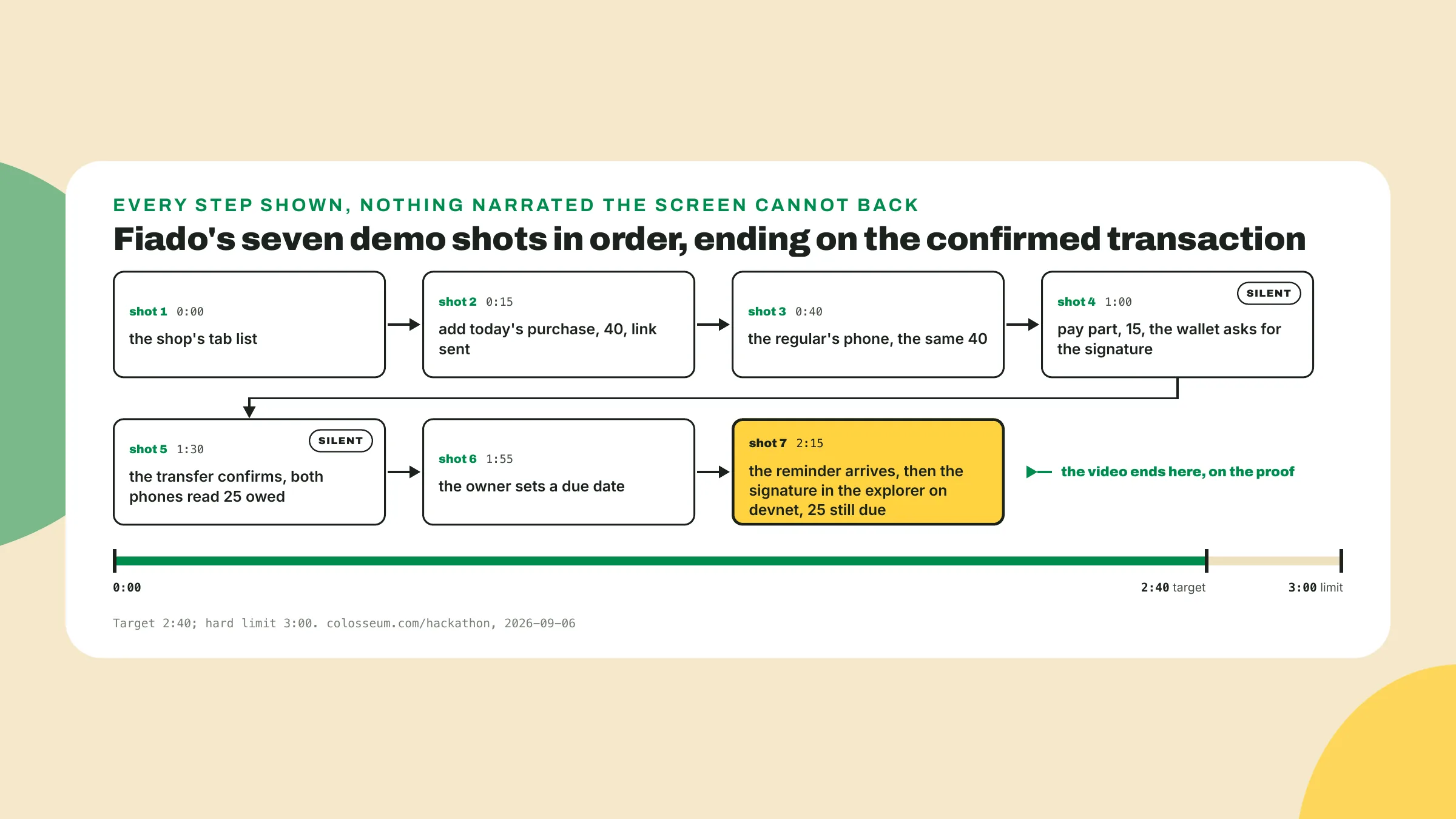
demo-shots.md, Fiado, 2026-10-05, objetivo 2:40, límite duro 3:00
toma 1   0:00   la lista de fiados de la tienda en el celular de la dueña, dos nombres          dicho: este es el lado de la tienda
toma 2   0:15   abrir el fiado del cliente habitual, agregar la compra de hoy, 40, enlace enviado   dicho: el monto, nada más
toma 3   0:40   el celular del cliente, el mismo 40, sin instalar nada, sin login               dicho: mismo fiado, otro lado
toma 4   1:00   él toca pagar parte, escribe 15, la billetera pide la firma                     dicho: nada
toma 5   1:30   la transferencia se confirma, los dos celulares muestran 25 pendientes, aparece el enlace   dicho: nada, deja que se vea
toma 6   1:55   la dueña pone una fecha de vencimiento para los 25                              dicho: una fecha, decisión de ella
toma 7   2:15   el recordatorio llega al celular del cliente, luego la firma                    dicho: ese es todo el recorte
                abierta en el explorer en devnet, 25 todavía pendientes
Marca las tomas 4 y 5 como silenciosas, y déjalas así. Una billetera pidiendo una firma y una transferencia confirmándose con dos celulares que coinciden en 25: un jurado que construye en Solana lee esas pantallas más rápido de lo que tú puedes describirlas, y un jurado que no construye está viendo cómo pasa.
La regla de la narración es corta. Si no está en pantalla en ese segundo, no lo digas. El programa del fiado, los rieles de fiat y el despliegue con la cooperativa se quedan en la diapositiva de próximos pasos y en el video de presentación. La toma 7 termina en la firma en el explorer con 25 todavía pendientes, y el video termina ahí también, en la prueba. El objetivo de 2:40 en la primera línea es el margen que te dejas para una confirmación lenta de devnet.
Prepara la máquina limpia antes de cualquiera de las dos tomas. Es decir: un perfil de navegador nuevo sin más extensión que la billetera, una billetera creada solo para la grabación con apenas los fondos de devnet que la demo necesita, notificaciones apagadas, todas las pestañas cerradas menos la de la demo, y el historial de la terminal borrado si va a haber una terminal en pantalla. La firma que se confirma en la toma 5 es pública por diseño y no hay problema en mostrarla. Una frase semilla, un archivo de llave en un listado de carpeta, el saldo de la billetera que usas de verdad, o un mensaje de alguien que salta en 1:30, no pueden estar en pantalla.
Graba la demo solo cuando el recorte corra de principio a fin en la máquina limpia dos veces seguidas sin que toques nada, y después mírala una vez con una sola pregunta en la cabeza: qué hay en pantalla que no debería estar. Graba la presentación desde el mismo perfil, sobre tu cara o sobre las diapositivas, lo que puedas hacer en una sola toma sin parar, porque una sola toma un poco tosca suena a persona y seis tomas pegadas suenan a producto. Lee del guion. A nadie le molesta.
Subtitula los dos videos y revisa los subtítulos contra el guion y la lista de tomas. Una demo subtitulada con el sonido apagado sigue mostrando el monto que se escribe y la transacción que se confirma, pero un subtítulo con el monto equivocado sobre la toma 2 es un error justo donde un jurado está leyendo. Después revisa la duración en el archivo exportado, el que vas a subir, no en el contador de la app de grabación, porque las exportaciones suman un segundo por aquí y por allá en los bordes.
Algo que tienes que saber si hay un ensayo en el calendario: un hackathon de temporada o un side track (el track regional) va a tener su propia página, con sus propios entregables y su fecha límite, así que lee esa página el día que decidas entrar y reutiliza las exportaciones que ya tienes, sin grabar nada nuevo.
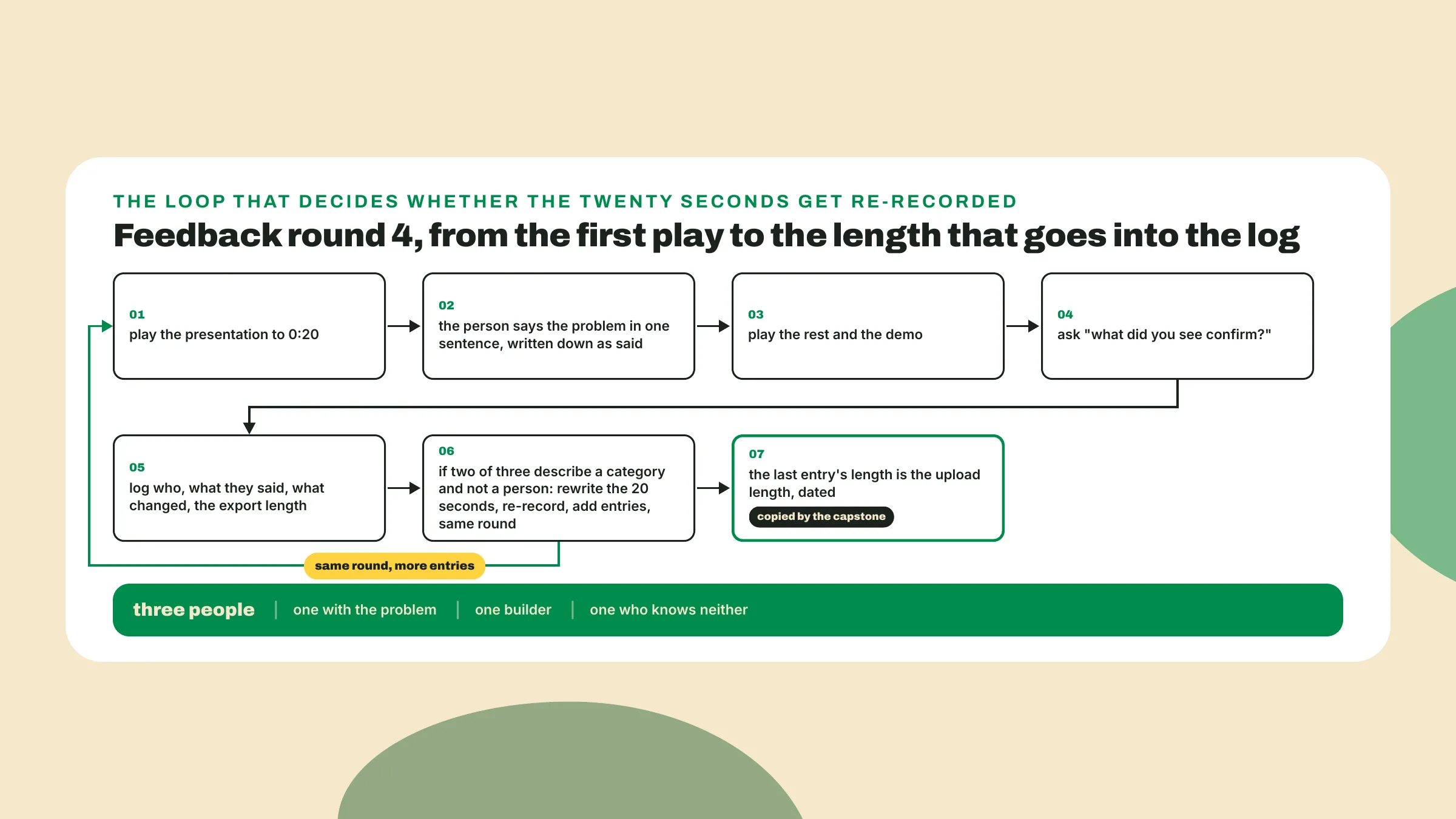
Muéstrales los dos videos a tres personas que no los han visto, los mismos tres perfiles de la ronda pasada: una que tiene el problema, un builder y una persona que no sabe nada de ninguna de las dos cosas. Reproduce la presentación y detenla en 0:20. Pídele a la persona que diga cuál es el problema, en una oración, y anota la oración que dijo. Después reproduce el resto y la demo, y haz una sola pregunta: ¿qué viste confirmarse? Si la respuesta es el pago, o la transacción, o el fiado bajando a cero, la demo lo mostró. Si la respuesta es una descripción de la app, la demo lo narró.
Escribe tres entradas en el registro con quién, qué dijo, qué cambió y la duración exportada del archivo que vio cada persona, porque una regrabación la cambia. Si la persona dice algo parecido a "eso me pasó a mí", o nombra a alguien a quien le pasó, los veinte segundos funcionan. Si dos de las tres describen la categoría en lugar de una persona, reescribe los veinte segundos y regraba el mismo día. La ronda conserva su número y recibe más de tres entradas. La última entrada del registro es la duración del video que vas a subir, con fecha. La ronda de Fiado, con las mismas tres personas de todas las rondas anteriores:
registro de feedback, ronda 4, Fiado, 2026-10-08
1  Lucia, la dueña de la tienda   en 0:20: "una tienda como la mía perdiendo la libreta"
                                  después de la demo: "los 15 entrando, y los 25 que quedan"
                                  cambió: nada; presentación 2:38, demo 2:41
2  Jorge, un cliente habitual     en 0:20: "tiendas que dan fiado y pierden la cuenta"
   que lleva un fiado             después de la demo: "el pago, y un enlace que yo mismo podía abrir"
                                  cambió: nada; mismas exportaciones
3  Marcos, entró a un             en 0:20: "apps de crédito"; después de la demo: "la transacción"
   hackathon una vez              cambió: los primeros veinte segundos, porque la historia de la libreta
                                  tardó demasiado en llegarle; la página mojada ahora pega
                                  en el segundo diez; regrabado, presentación 2:34, demo 2:41
Uno de tres falló, y la regla no obliga a regrabar por eso, pero el storyteller regrabó igual, porque el fallo venía con una razón sobre la que podía actuar esa misma tarde. Las duraciones de la última entrada, 2:34 y 2:41, son los números que el capstone copia sin volver a medir. Con tres agendas distintas, muéstrale los videos a una persona hoy y a dos mañana, y si los veinte segundos se regrabaron entre medio, la segunda persona ve la versión nueva y eso va en el registro como lo que cambió.
Estás haciendo dos cosas distintas. La presentación cuenta la historia y abre con una persona durante veinte segundos antes de cualquier palabra de producto, para que un desconocido diga "eso me pasó a mí". La demo muestra el recorte y termina en la transacción confirmada, narrando solo lo que la pantalla respalda. Las dos se cronometran en el archivo exportado, porque un video que se pasa del límite quizá nadie lo vea.
La próxima lección es la que hace perder a más equipos que cualquier criterio de evaluación, y no tiene ni un video. Vas a enviar, y después vas a enviar otra vez, porque un envío que existe temprano se puede corregir y un envío que existe a las 23:50 no. Su primera acción es un archivo que lista cada entregable que construiste, con su ruta y su fecha, antes de abrir el portal. Trae las duraciones exportadas, van en el formulario.
Inscríbete para hacer el quiz
El quiz es parte del curso: inscríbete para responderlo, seguir tu progreso y ganar XP.