Carregando...

 BetaBeta
Este curso ainda não está disponível em Portugues (BR), então você está lendo o original em English.
Last lesson three engineers built the card page, planned the phone app and designed the shop's indexer. This lesson asks three questions a real shop would ask next: can the stamps be a token in the customer's wallet, can the customer pay in any coin, and can the card be a game? Each question has an agent, and each agent's file carries the rule that stops the obvious mistake. Prompts and reading, no toolchain. Around fifteen minutes.
These four agents cover the parts of the ecosystem that change often, and where a model's memory is often out of date: token extensions that were new last year, a swap API that moved to a new version, a game SDK with platform limits. token-engineer builds mints, Token-2022 extensions, transfer-hook programs, NFT collections and launch plans. defi-engineer integrates Jupiter, Kamino, Marginfi, Raydium, Orca, Meteora and the oracles, through SDK, API or CPI. game-architect and unity-engineer design and build Solana games. All four read protocol skills that the kit pins and installs on demand, and the DeFi engineer's file says it outright: build from the protocol's skill, not from memory.
Use the token-engineer agent. Stamp's stamps should appear in the customer's wallet as a token they cannot sell. Propose the mint for devnet: token program, the extension set, who holds each authority, and what a wallet will show. Fewest extensions that do the job.
The phrase fewest extensions is the agent's own first rule, quoted back. Its file explains why: mint extensions are fixed at creation, and every extension narrows where the token can trade, because many pools, wallets and aggregators reject hooks, permanent delegates and default-frozen accounts. For stamps, expect a Token-2022 mint with the non-transferable extension and the metadata extension, the shop as mint authority, and a note that a free coffee is a burn. Expect the gotcha too: the associated token account derives from the Token-2022 program id, and the classic id gives the wrong address.
If you ever launch a token people can trade, the same agent carries the pre-launch checks: allocations documented, team tokens vesting on-chain, every remaining authority on a Squads multisig or revoked, and revoking is permanent, so it asks you first. /inspect-mint decodes any mint's extensions and live authorities from raw bytes, which is how you check someone else's token before integrating it.
Use the defi-engineer agent. A customer wants to pay for coffee with whatever token they hold, and the shop wants USDC. Design the swap step with Jupiter: which API, how the shop is protected from a bad rate, and how you would test it. Design only.
Its file names the current API, swap v2 with an API key, and three checks that a quick integration skips: enforce a minimum output on-chain, then reload the destination account after the swap and check the balance delta rather than the quote. Price from an oracle with a feed id and a maximum age, never from a pool's spot reserves that a flash loan can move. And test on a Surfpool mainnet fork, so the real protocol accounts load. It will ask for the jupiter pack, and for sendai if lending or oracles come up.
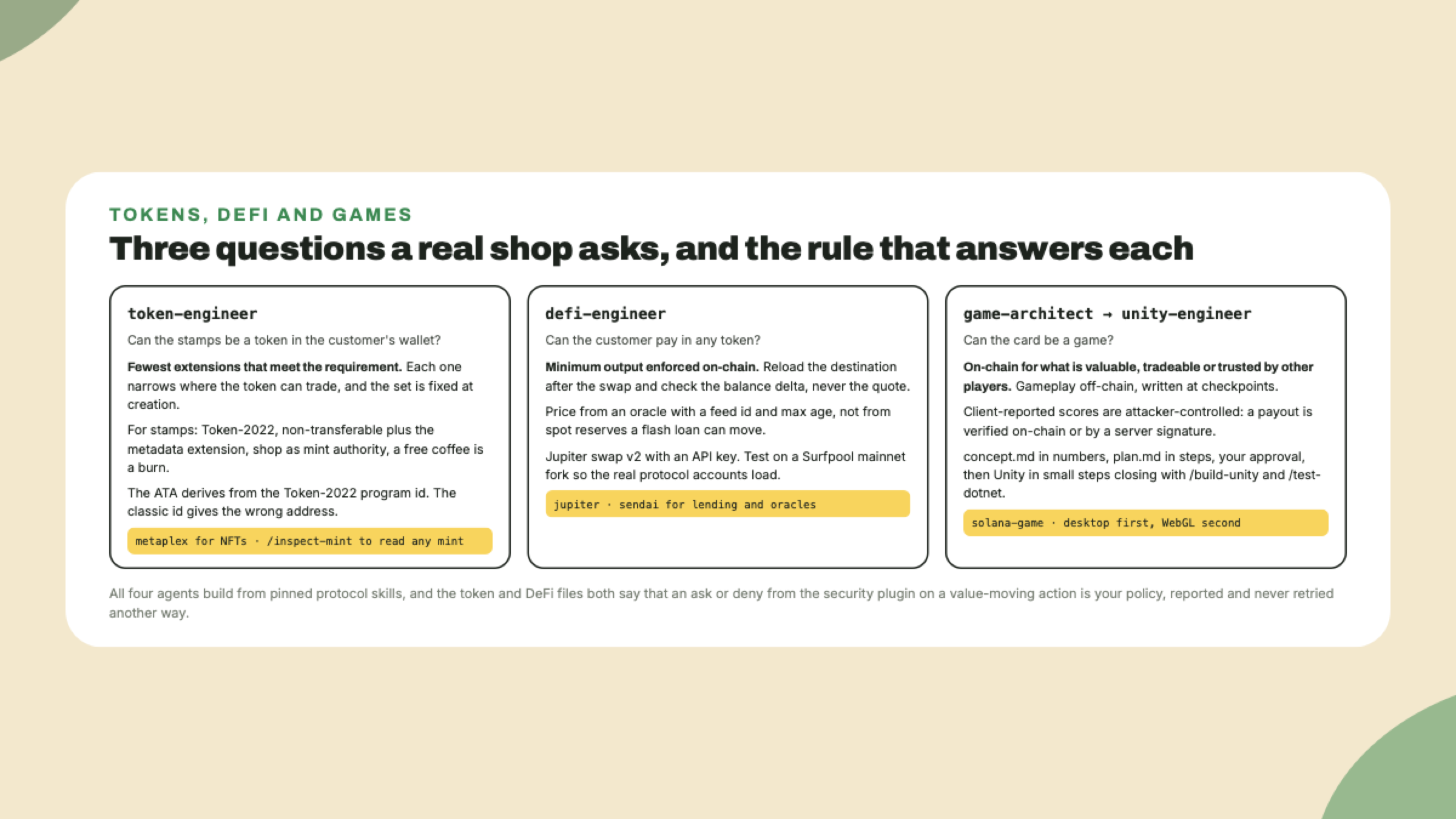
Use the game-architect agent. Stamp wants a small game: after each coffee the customer plays a ten-second round in the shop's app and a good score earns a bonus stamp. Decide what lives on-chain and what does not, pick the platform, and write concept.md and plan.md. Ask me what you need to know first.
The agent's file makes it ask about gameplay, platform and what must be on-chain before it writes anything, and then gives it the split: on-chain for what is valuable, tradeable or trusted by other players, off-chain for per-frame gameplay and session state, writes at checkpoints rather than per action. The sentence to look for in its answer is this one: client-reported scores are attacker-controlled, so the bonus stamp is paid only against a check the client cannot forge. It writes concept.md with numbers rather than adjectives and plan.md with numbered steps, and waits for your approval. unity-engineer then builds from those two files in small steps, edit, build, test, and runs /build-unity and /test-dotnet before it hands back, and its file carries the Unity traps: main-thread-only objects, no C# threads on WebGL, textures that never get collected.
design.md, with the agent that owns it.concept.md and plan.md exist for the mini-game, with the on-chain split written down.metaplex, jupiter, sendai, solana-game. The hub prints the install command, /add-skill <id> runs it, and /update keeps it.Four agents for four fast-moving parts of the ecosystem, and each file carries the one rule that stops the obvious mistake: fewest extensions, minimum output on-chain, oracle not spot, verify what pays out. They build from pinned protocol skills and ask for the pack they need.
Next lesson Stamp ships: a devnet deploy with the approval stop, a CI pipeline, docs that state the program id and every account layout, and a product review by someone who meets the app for the first time. The firewall shows up where it matters, at the deploy.
Inscreva-se para fazer o quiz
O quiz faz parte do curso — inscreva-se para respondê-lo, acompanhar seu progresso e ganhar XP.