Carregando...

 BetaBeta
Este curso ainda não está disponível em Portugues (BR), então você está lendo o original em English.
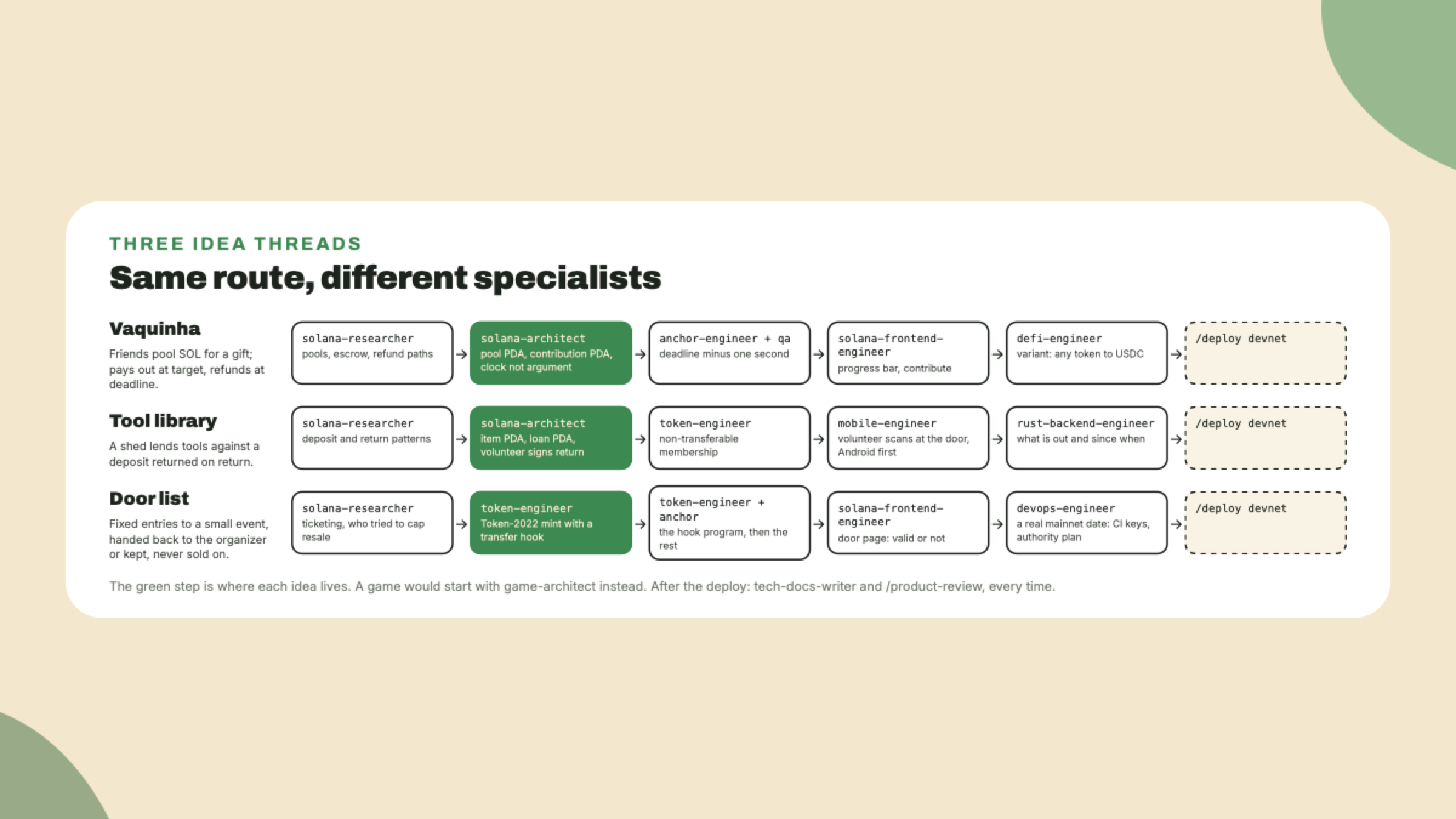
Stamp went from three lines to a devnet deploy through thirteen of the fifteen agents. This lesson shows the same route on three other ideas, each as a chain of agents with its first prompt, and ends with a template for yours. Reading and one piece of writing. Around ten minutes.
The order Stamp followed is the kit's shape for any idea: research, design, plan, build, test, audit, the parts people touch, deploy, docs, review. What changes between ideas is which agents get a turn and which pack they ask for. Once you can write that chain for an idea in ten lines, you can start building the next morning, and the agents will tell you when you picked the wrong one, because every file carries a Handoffs section.
1. idea.md, three lines: a person, what they cannot do today, what your thing does
2. solana-researcher: what exists, cited, dated, labelled
3. solana-architect (game-architect for a game): accounts, instructions, invariants, authority, risks → design.md
4. /plan-feature: phases, risks, tests, open questions → answer them in design.md
5. anchor-engineer: build from design.md, closes with /build-program, /test-rust, /audit-solana
6. solana-qa-engineer: coverage bar, negative tests, slop pass
7. the parts people touch: solana-frontend-engineer, mobile-engineer, rust-backend-engineer
8. the specialists an idea needs: token-engineer, defi-engineer, unity-engineer
9. /deploy devnet, with the approval stop
10. devops-engineer for CI, tech-docs-writer for the README, /product-review for a cold read
Friends pool SOL for a gift. The pool pays the organizer when the target is reached, or refunds everyone at a deadline.
First prompt to paste:
Use the solana-researcher agent. What exists on Solana for group payment pools or crowdfunding escrow, how does each handle refunds after a deadline, and which ones shut down? Cite, date and label every finding.
A shed lends drills and ladders. A borrower locks a deposit, and it comes back when the tool does.
First prompt to paste:
Use the solana-architect agent. Design a tool-lending program: items, loans with a locked deposit, return confirmed by a volunteer, and a deposit claim after a grace period. Every account with owner, seeds, size and rent payer, every instruction with its signers, the invariants, the authority model, the open risks. Anchor unless measured otherwise. Write design.md.
A small event sells a fixed number of entries that cannot be resold, only handed back to the organizer, who sells them again at face value.
First prompt to paste:
Use the token-engineer agent. Tickets for a 200-person event as a Token-2022 mint that holders can hand back to the organizer and transfer nowhere else. Propose the extension set, the transfer-hook rule, who holds each authority, and what a wallet shows the holder. Fewest extensions that do the job, and say which venues will reject the mint.
Copy the block and fill it. Keep the three idea lines honest, and put a name on every step, because an agent asked by name does the job its file describes, and an unnamed request goes wherever the description match lands.
<name>
<a person>, <what they cannot do today>, <what your thing does about it>

1. solana-researcher: <the one question you need answered first>
2. <architect>: <the two or three accounts you expect, in words>
3. anchor-engineer, solana-qa-engineer: <the boundary case a test must hit>
4. <the people-facing agent>: <the one screen that must exist>
5. <the specialist, if any>: <the pack it will ask for>
6. /deploy devnet, then tech-docs-writer and /product-review
When a backlog is real and you have a day to watch it, the kit also chains the steps for you: /intake reads issues into a work list, /research, /decide and /plan-work settle the plan, /implement, /review-round and /fix-wave build and check it, and /crew runs those seven and stops at your gates, always at the plan and always before shipping. /ship is the one step of that chain /crew never runs for you. I would start with the chain above by hand, and reach for /crew on the second project.
One route, ten steps, a named agent at each one, and the only thing that changes between ideas is which specialists get a turn. Write the chain before you write the prompt.
The final lesson is about staying good at this after the workshop: the guide agent that teaches at your level, the command that explains code you did not write, and how the kit updates itself. It ends with a quiz over the whole course.
Write your own thread in the template's shape: the idea in three lines, the agents in order with one line each on what they owe you, and the exact first prompt you will paste into Claude Code.
0/250
Inscreva-se para fazer o quiz
O quiz faz parte do curso — inscreva-se para respondê-lo, acompanhar seu progresso e ganhar XP.