Carregando...

 BetaBeta
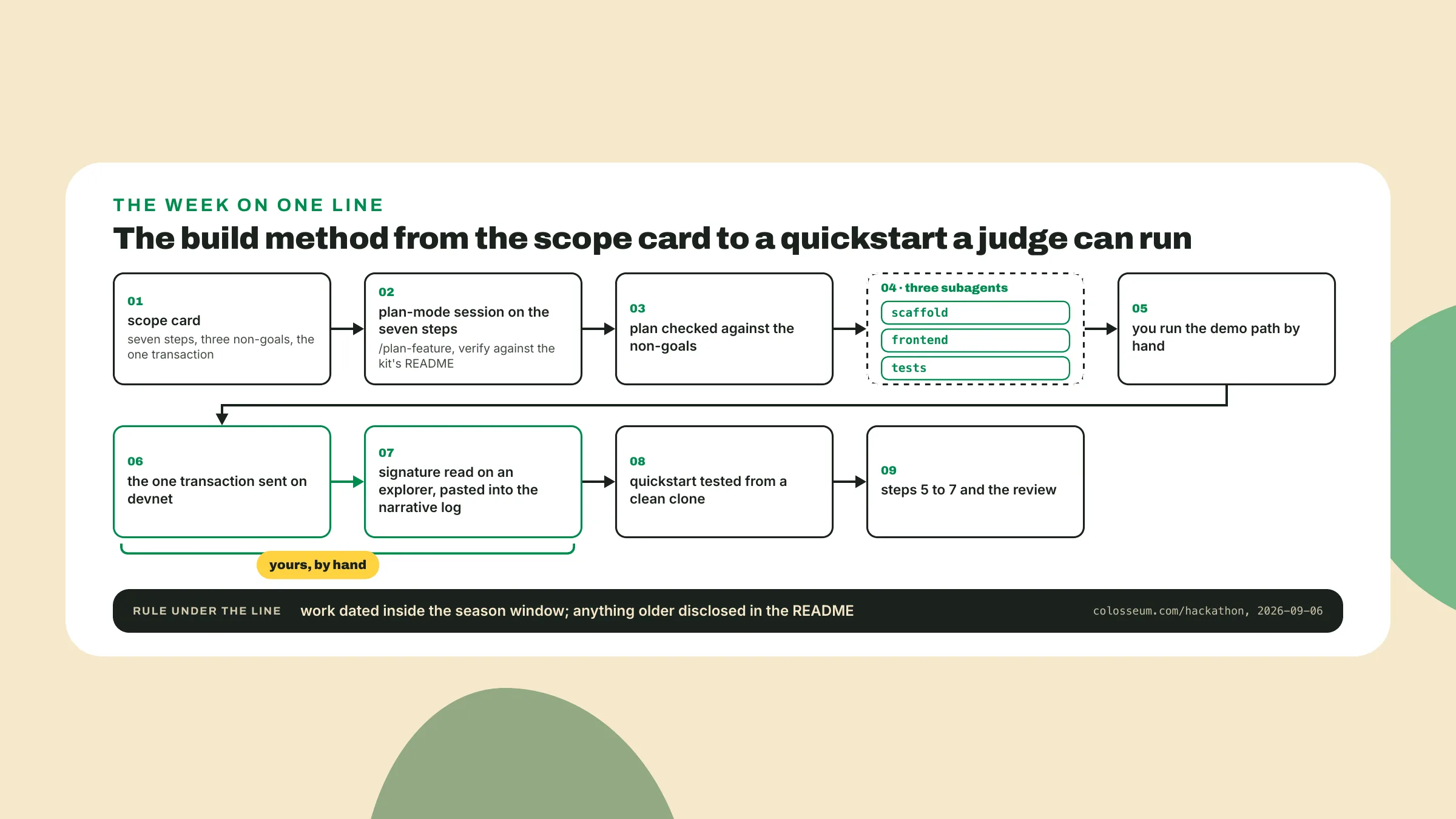
Na última lição você escreveu o roteiro da demo v0 com as quatro marcas de tempo e reduziu o build a um cartão de escopo: uma tarefa, sete passos, sete não-metas e a única transação, um freguês pagando 15 de um fiado de 40 em USDC na devnet. Deixe os dois arquivos abertos, porque todo prompt e toda revisão desta semana saem deles.
O FAQ da própria Colosseum, na temporada da World's Fair de 2026, diz com todas as letras: 'We have backed non-technical founders in our Accelerator who built MVPs entirely with AI coding tools' (já apoiamos no nosso Accelerator fundadores não técnicos que construíram MVPs inteiramente com ferramentas de código com IA) (colosseum.com/hackathon, 2026-09-06). Os jurados não ligam se foi um agente que escreveu o código. Eles ligam se o produto funciona, se o trabalho aconteceu entre a data de início e a de fim da temporada, e se eles conseguem rodar a partir do seu README.
A semana tem uma ideia só: o time de agentes constrói os passos, e você guarda para si o caminho da demo, a única transação e o clone limpo. As ferramentas são o Claude Code e o plugin Solana AI Kit desde o dia 0, e a árvore do próprio kit é a primeira coisa que você lê. Clone o kit ao lado do seu repositório do toolkit:
git clone https://github.com/solanabr/solana-ai-kit
cat solana-ai-kit/.gitmodules
ls -l solana-ai-kit/plugin/skills
Conte as entradas de submódulo na primeira saída e os symlinks na última. Lido em 2026-09-06, com o último commit de 2026-08-20, a primeira saída tinha 18 entradas, entre elas colosseum, que aponta para ColosseumOrg/colosseum-copilot, solana-new, que aponta para sendaifun/solana-new, e helius, solana-dev, sendai, metaplex e jupiter. A última saída tinha três, hackathon, idea-sprint e pitch-deck, cada uma um symlink para dentro de .claude/skills, onde a skill wrapper mora.
Abra uma das três skills wrapper e leia o cabeçalho. Cada uma diz que foi adaptada de sendaifun/solana-new, MIT 2026 SendAI e Superteam, telemetria removida, e é por isso que o wrapper é a versão que você roda sempre que os dois existem.
Os wrappers são a primeira camada do kit. A segunda são os comandos e agentes do próprio kit, e os quatro em que esta semana se apoia são /plan-feature, /scaffold, /build-app e /diff-review.
A terceira é a ext, que só vem com a instalação completa descrita no README, e ext/solana-new guarda as três skills que uma semana de build busca quando um wrapper não cobre alguma coisa: scaffold-project, build-with-claude e debug-program. As skills upstream de lá têm no topo um preâmbulo bash que manda dados para fora antes de a skill rodar, e a página hub do kit avisa para nunca executar esses blocos de preâmbulo. Abra o arquivo da skill primeiro, pule o bloco do topo, e só depois rode a skill. ext/colosseum é o Colosseum Copilot e ainda precisa do PAT da semana 1.
Todo nome de comando, skill e modo desta página foi lido em 2026-09-06 contra o main de solanabr/solana-ai-kit e contra a documentação do Claude Code, e os dois mudam a cada release, então se a sua saída for diferente, a sua saída vence, e confira cada nome no README atual do kit antes de digitar.
Crie um repositório vazio chamado fiado-warmup ao lado do toolkit. A Colosseum, na página lida em 2026-09-06, julga os times só pelo trabalho concluído entre as datas de início e fim da competição, código que já existia precisa ser declarado, e mentir sobre qualquer um dos dois pode desclassificar o time, bani-lo e revogar um prêmio. Um agente não pensa duas vezes antes de trazer um template que você escreveu ano passado, então o repositório começa vazio no primeiro dia da semana 2, e qualquer coisa mais antiga é nomeada no README.
Abra o Claude Code dentro do repositório e comece a sessão de planejamento com /plan-feature. Plan mode (modo de planejamento) é o modo do Claude Code em que o agente lê o repositório e escreve um plano, e não edita nada até você aprovar. Cole a transcrição abaixo como está. É o cartão de escopo do Fiado da última lição no formato de prompt do kit, e quando você voltar para o seu próprio recorte, o seu cartão entra no lugar destas linhas:
/plan-feature
Construa o recorte da demo abaixo. Só o plano. Não escreva arquivos ainda.
Tarefa única: um freguês paga parte do fiado do próprio celular.
Passo 1: a dona abre o Fiado no celular dela e abre um fiado para um freguês: o primeiro nome dele e o telefone dele.
Passo 2: ela adiciona a compra de hoje, 40, e o fiado marca 40 devidos; um link vai para o celular dele.
Passo 3: o freguês abre o link e vê os mesmos 40 no celular dele, sem instalar, sem login.
Passo 4: ele toca em "pagar parte", digita 15, e a carteira dele pede para aprovar uma transferência de USDC na devnet, com um memo nomeando o fiado. Esta é a única transação real.
Passo 5: a transferência confirma, os dois celulares marcam 25 devidos, e um link embaixo do saldo abre a assinatura num explorer.
Passo 6: a dona define uma data de vencimento para os 25.
Passo 7: o lembrete chega no celular do freguês com os 25 e o link.
O saldo é derivado do histórico de transferências do fiado; o app guarda só o diretório de clientes, o valor de abertura, a data de vencimento e o lembrete.
Não-metas: contas, login, cadastro, um perfil do mercadinho, uma tela de configurações; colocar o freguês numa carteira, ou colocar fundos nela; reais entrando ou saindo; pagar um fiado inteiro, ou fechar um; mercadinhos se cadastrando sozinhos, um segundo dono por mercadinho; o registro de fornecedores e os selos de fidelidade; um programa próprio do Fiado para o fiado.
Ordene o plano para que o passo 4 seja construído e rodado antes de os passos 5 a 7 começarem.
Terceiro, o formato da transação: o plano tem que dizer USDC, devnet, e uma transferência real da carteira do freguês para a do mercadinho. Se disser mock, stub ou simulate em qualquer lugar perto do passo 4, é o plano te avisando que pretende construir uma demo que um jurado não consegue verificar. O cartão do Fiado não tem programa próprio, então se o plano propõe um, ele passou por cima do cartão. Aprove só quando as três verificações passarem, salve o plano como arquivo com a data na primeira linha, e faça commit, porque um jurado lendo o repositório consegue ver que ele foi escrito dentro da janela.
git add plan.md
git commit -m "plan approved, 2026-09-22"
O subagente de scaffold roda o comando /scaffold do kit contra o plano aprovado e para quando o repositório tem um README com uma seção de quickstart vazia, um arquivo de dependências e uma pasta por passo. O subagente de frontend constrói as telas com /build-app, e a spec dele são as linhas dos passos mais as marcas de 0:00 e 0:30 do roteiro da demo. O subagente de testes escreve um teste por passo, descrevendo o que uma pessoa vê quando o passo está pronto, e o teste que confere o saldo depois do passo 4 tem que existir antes do passo 4, para o passo ter em que falhar.
Rode o scaffold primeiro, depois o frontend só para o passo 1, depois o passo 2, depois o passo 3, um passo por rodada, e leia o repositório entre as rodadas. Eu acho que a aceleração não é igual para todo tipo de trabalho: o scaffold sai em minutos, o passo da transação leva uma tarde, e a tarde é a parte que um jurado consegue checar.
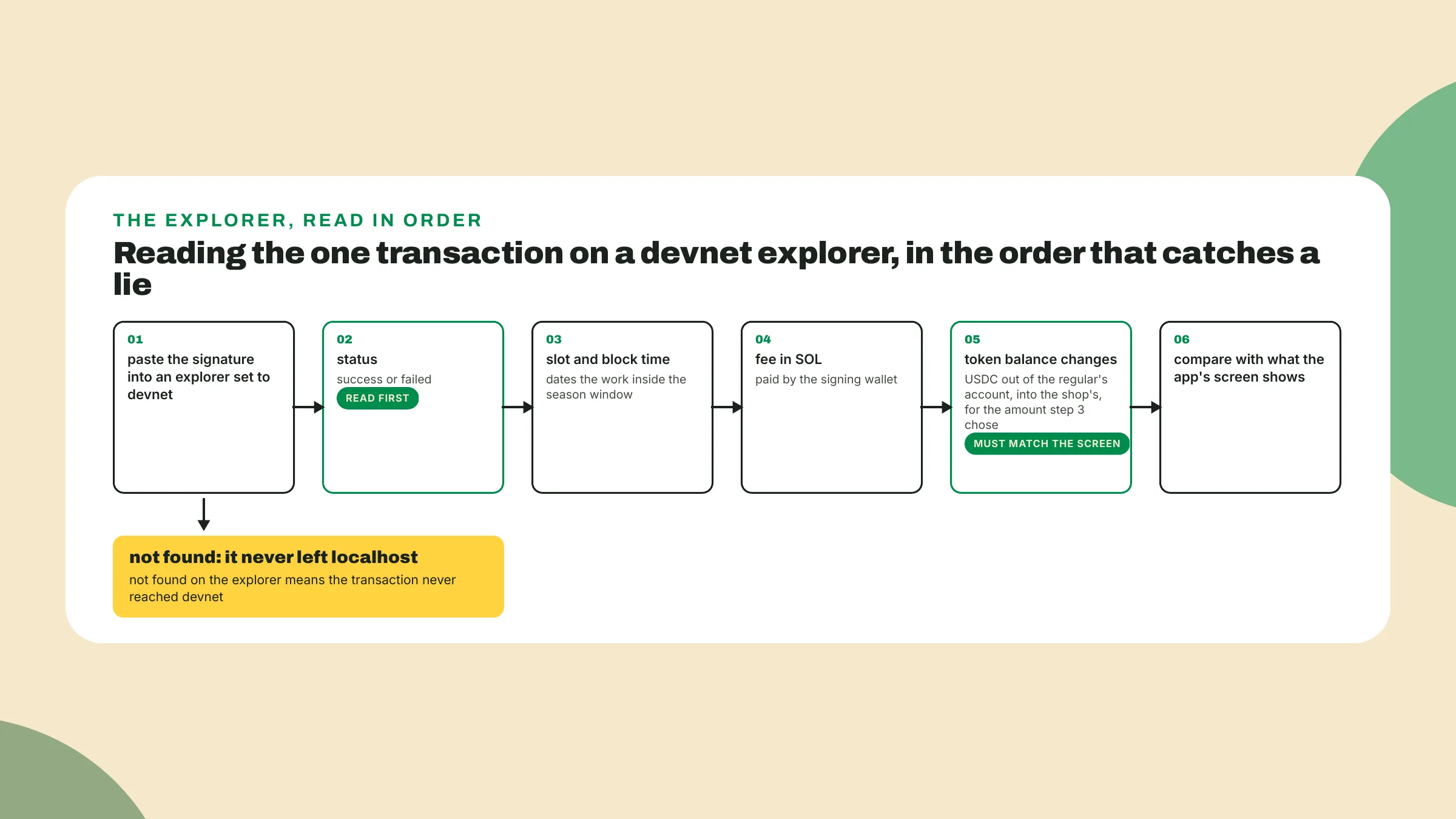
Copie a assinatura, abra qualquer explorer, mude para devnet e cole. Leia a linha de status primeiro, porque uma transação pode ser enviada e mesmo assim falhar. Depois o slot e o horário do bloco, que datam o trabalho dentro da janela da temporada de um jeito que nenhuma mensagem de commit consegue. Depois a taxa, paga em SOL pela carteira que assinou. Depois as mudanças de saldo de token, USDC saindo da conta do freguês e entrando na do mercadinho, nos 15 que o passo 3 escolheu. Depois o memo, que nomeia o fiado. Se o valor no explorer não é o valor na tela, a tela está mentindo, e o explorer não.
data        o dia em que o passo 4 rodou, escrito como 2026-09-22
evento      passo 4 rodou na devnet
assinatura  a assinatura completa, colada
explorer    o link do explorer, em devnet
valor       o valor em USDC que o passo 3 escolheu
visto       status, slot, taxa e a mudança de saldo de token, tudo lido no explorer
Esse arquivo cresce ao longo da passada de polimento, e o deck e os dois vídeos são cortados dele, mas esta primeira entrada é a linha em que um jurado pode clicar.
git clone <your-repo-url> fiado-clean
cd fiado-clean
Depois faça exatamente o que o README diz, e nada que ele não diz. Se ele esqueceu o arquivo de ambiente, a configuração da carteira ou o USDC de devnet, você para, escreve a linha que falta no README e clona de novo numa pasta nova. Repita até um clone que começa do zero chegar à tela do passo 1, e cronometre a última rodada, porque esse número vai para o README também.
O agente escreveu um primeiro quickstart durante o scaffold, e ele vai parecer bom, porque foi escrito de dentro de uma sessão que tinha o arquivo de ambiente que o clone não tem. Trabalho escrito por IA pode parecer certo e estar errado, e o clone limpo é o instrumento mais barato que você tem para pegar isso: custa uma pasta e dez minutos.
Depois escreva as duas linhas de declaração do README embaixo do quickstart: o que no repositório é anterior à temporada, se houver alguma coisa, e de onde veio, ou a data em que o repositório foi criado, se não houver nada. As mesmas duas linhas vão para as respostas do portal no dia da submissão.
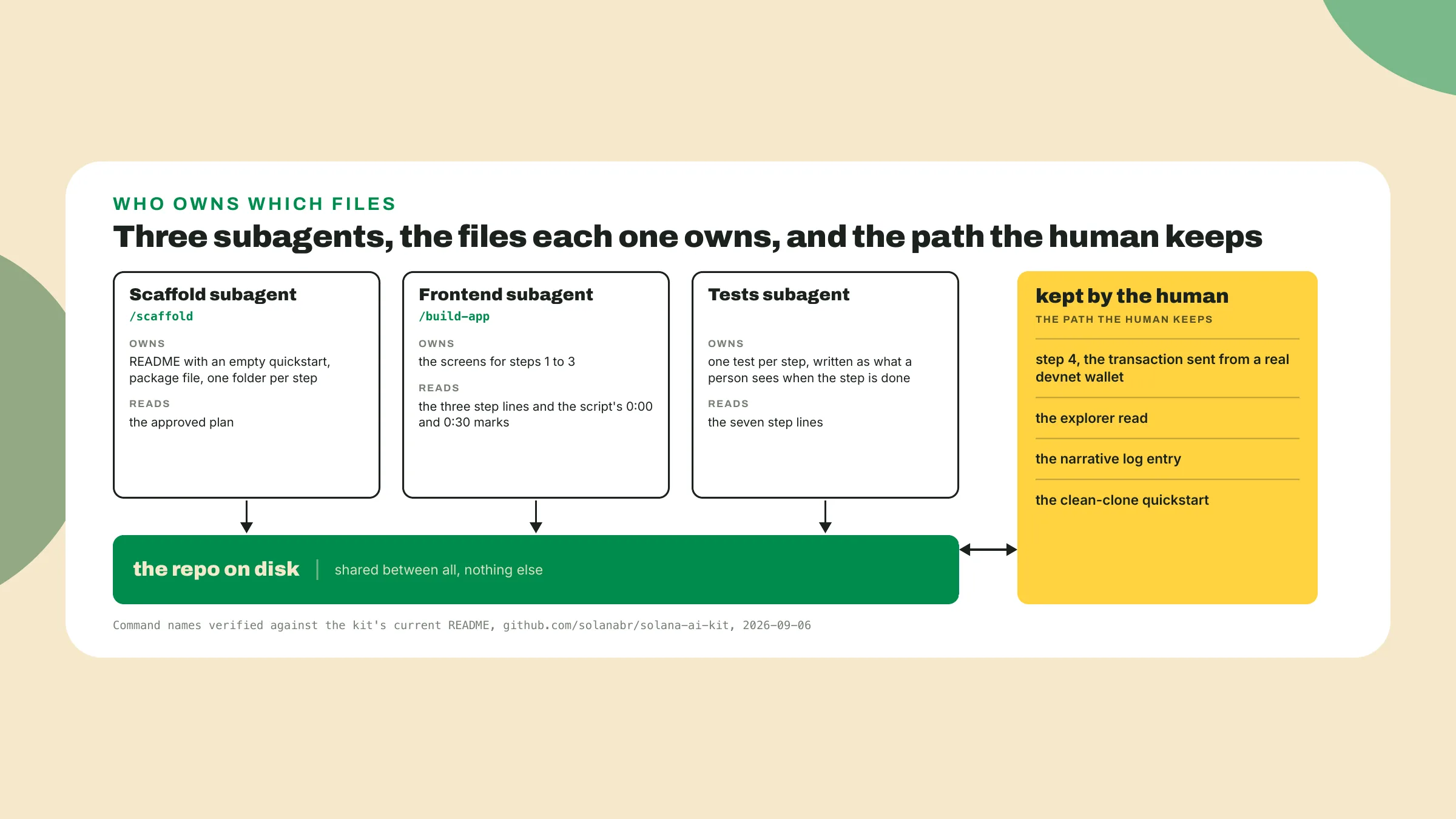
Os passos 5 a 7 vão para os mesmos subagentes com o mesmo tipo de spec, um passo por rodada. No cartão do Fiado o subagente de frontend recebe o passo 5 e o passo 7, a tela que marca 25 devidos com o link do explorer embaixo e o lembrete chegando no celular do freguês, e o subagente de testes recebe o passo 6, porque data de vencimento é fácil de falsificar, e um teste que dispara o lembrete contra uma data fixa pega a falsificação. Leia o repositório entre cada rodada, depois pare de construir.
Rode o /diff-review do kit em tudo que os subagentes escreveram desde que o plano foi aprovado, trate a saída como uma lista de lugares para olhar e nunca como aprovação, e depois leia o caminho da demo você mesmo, à mão, da marca de 0:00 até a de 2:45 do roteiro, com o explorer aberto numa segunda tela.
No Fiado a leitura à mão encontra isto: o passo 5 mostra 25 devidos, o teste passa, e o número é os 15 do formulário de pagar parte subtraídos dos 40, com a transação confirmada nunca lida. Ou seja, a tela mostraria o mesmo número se a transação tivesse falhado. Nada no diff parece errado, o teste foi escrito a partir da mesma suposição, e um jurado que paga um valor diferente na entrevista vê o app mentir. A correção é pequena, o app passa a ler o valor da transação confirmada e mostrar esse valor, e encontrar isso levou mais tempo do que construir o passo.
A minha posição é que código escrito por IA precisa de uma revisão diferente e mais longa do que código que uma pessoa escreveu, porque quem escreveu não está na sala para te dizer o que supôs, e os times subestimam esse tempo. Coloque a revisão no calendário como um bloco do mesmo tamanho do bloco de build, e quando ela terminar antes, pegue o tempo de volta.
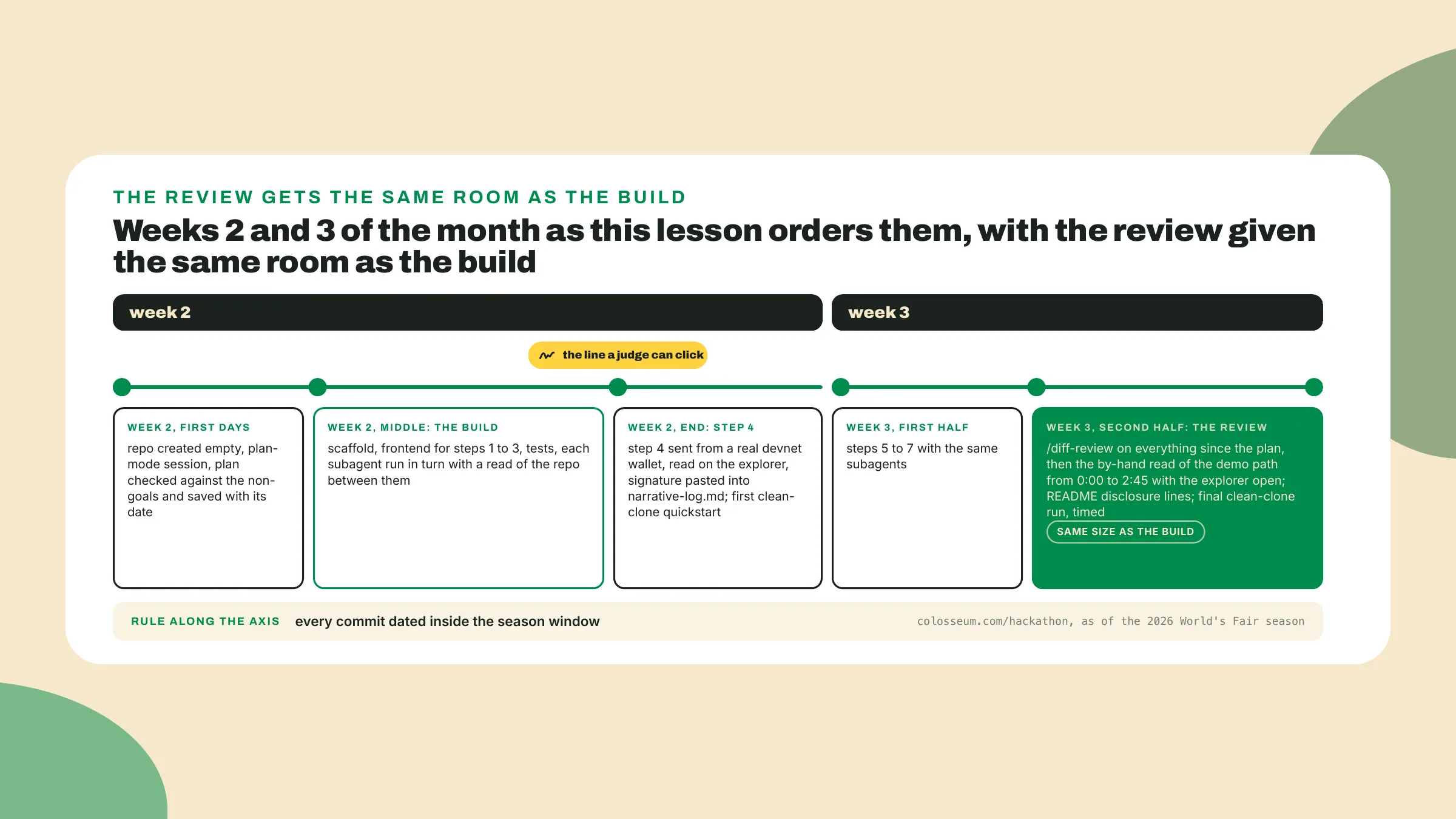
O time de agentes constrói os passos, e você guarda para si o caminho da demo, a única transação e o clone limpo. O que a semana de build produz é uma assinatura que um jurado pode abrir e um README que um jurado pode rodar, e a revisão que pega o passo plausível mas errado leva tanto tempo quanto o build. Se a semana saiu como uma lista de funcionalidades, leia de novo a primeira entrada de narrative-log.md.
Na próxima lição você faz o recorte parecer real, que é um trabalho diferente de deixar ele mais bonito. A primeira ação é abrir a tela do passo 1 que o subagente de frontend construiu, tirar um screenshot dela hoje, com a data, e colocar em narrative-log.md embaixo da assinatura, porque um frontend que um jurado reconhece num segundo como feito por agente custa mais pontos do que uma funcionalidade faltando. Deixe a aba do explorer aberta.
Inscreva-se para fazer o quiz
O quiz faz parte do curso — inscreva-se para respondê-lo, acompanhar seu progresso e ganhar XP.