Carregando...

 BetaBeta
Na lição passada você gravou os dois vídeos dentro dos limites, a apresentação entre dois e três minutos e a demo em três ou menos com a transação confirmando na tela, e registrou a rodada de feedback 4. Deixe os dois links à mão. Este é o capstone: termina com o material de submissão enviado e uma captura de tela com data, e nada é gravado hoje.
Toda temporada, times com produto funcionando perdem no formulário. Um prazo convertido na direção errada. Uma segunda submissão de um integrante que quebra a regra de uma por pessoa. Um vídeo de demo que nunca chegou ao campo dele. Um repositório privado a que ninguém deu acesso ao revisor. Nada disso está nos critérios de julgamento. Tudo isso está nas regras, na mesma página dos sete fatores, alguns parágrafos abaixo, onde menos gente lê.
A pessoa que abre a sua submissão primeiro não está pontuando Founder + Market Fit (encaixe entre fundador e mercado). Ela está conferindo se o vídeo está lá, se o repositório abre, se o time tem nome. Completude é a única linha dessa página inteira que o time controla por completo. Por isso hoje você lê as regras do jeito que leu os critérios de julgamento na lição 2, como a lista exata do que é conferido, e submete como faria um release, contra um checklist escrito antes de o trabalho começar.
submission-package.md, aberto em 2026-10-05
brief da Colosseum (os sete fatores, linha do prazo, desclassificadores)              caminho, data
cartão do time, plano do mês, pitch v0                                                caminho, data
memorando de ideia, mapa de concorrentes, pacote de evidências, memorando de decisão  caminho, data
design partners, log de tração                                                        caminho, data
cartão de escopo, roteiro da demo, recorte na devnet, log narrativo                   caminho, data
one-pager de GTM, lista de parceiros                                                  caminho, data
deck, as duas exportações                                                             caminho, data
vídeo de apresentação (2 a 3 min), vídeo de demo (3 min ou menos)                     link, duração cronometrada
respostas do portal                                                                   este arquivo, abaixo
Se uma linha não tem caminho, essa entrega está faltando, e hoje é o dia de terminar essa entrega, não o dia de submeter. Tudo abaixo assume que cada linha está preenchida.
campos do portal, colosseum.com/hackathon, lido em 2026-09-06
1  product name and brief description (nome do produto e descrição breve)
2  blockchains and tools used (blockchains e ferramentas usadas)
3  all teammates with backgrounds and previous experience (todos os integrantes com formação e experiência anterior)
4  team location (localização do time)
5  a product logo or graphic (um logo ou imagem do produto)
6  GitHub repository link (link do repositório no GitHub; privado permitido se o acesso for concedido a hackathon@colosseum.com)
7  a two-to-three-minute presentation video (um vídeo de apresentação de dois a três minutos)
8  a product-demo video of no more than three minutes (um vídeo de demo do produto de no máximo três minutos)
9  go-to-market strategy, demand validation and distribution plans (estratégia de go-to-market, validação de demanda e planos de distribuição)
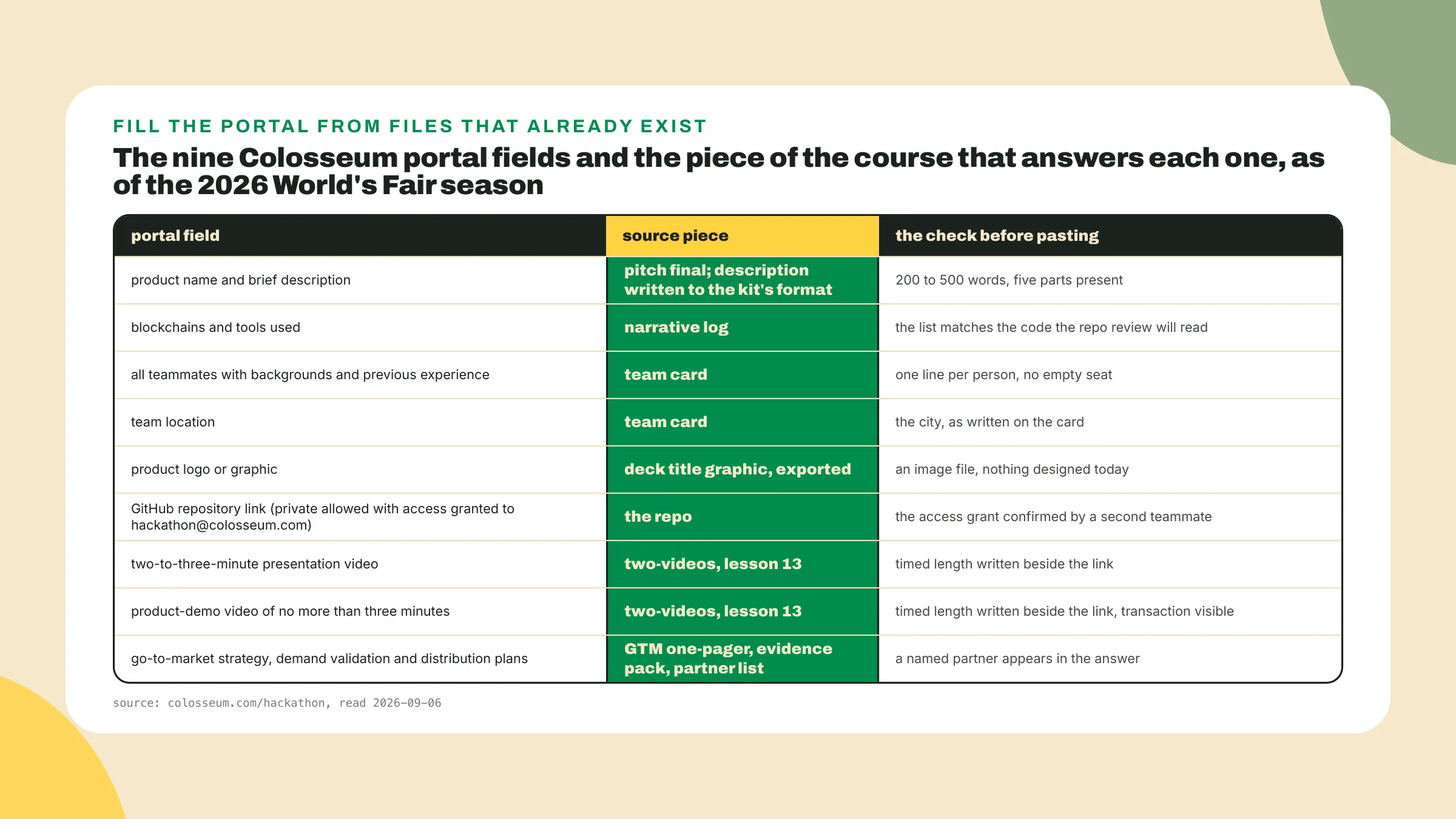
Se a página ao vivo mostrar uma lista diferente no dia em que você copiar, a página vence, e anote o que mudou. Cada campo é alimentado por uma entrega que você já construiu. O nome do produto é a única palavra de produto no pitch final, a que vem depois do problema. Blockchains e ferramentas vêm do log narrativo, com os nomes exatamente como o log escreve e nada que o build não usou, porque a revisão do repositório lê o código, e as duas listas têm que bater. Os integrantes vêm do cartão do time, uma linha para cada um com formação e experiência anterior, e nenhuma cadeira vazia. A localização é a cidade do cartão do time.
O logo é a imagem de título do deck exportada como imagem, e nada é desenhado hoje. O link do repositório é o campo que tem uma segunda pessoa dentro: se o repositório é privado, um integrante dá acesso para hackathon@colosseum.com e outro confirma lendo a lista de acesso do repositório. O vídeo de apresentação é o arquivo de 2 a 3 minutos da lição passada, o vídeo de demo é o de 3 minutos ou menos, e os dois entram como link, com a duração cronometrada escrita ao lado.
O último campo é três perguntas numa caixa só. Estratégia de go-to-market é o one-pager. Validação de demanda é o pacote de evidências, as conversas da semana 1, e a linha mais recente do log de tração, com data. Planos de distribuição são os parceiros nomeados na lista de parceiros, e um parceiro que respondeu, mesmo que tenha dito não, é uma linha melhor do que uma categoria de parceiro. Para o Fiado, a linha de ferramentas diz Solana, devnet, a ferramenta de agente e as skills do kit, como o log narrativo escreve, e a descrição e a resposta de GTM são os dois campos deixados em branco para você escrever no mesmo formato.
A descrição é escrita num formato, e slide colado não lê bem. A skill de hackathon do kit traz um: tagline, problema, a novidade em negrito, uma parte chamada 'What works today' (o que funciona hoje) e o por-que-Solana, em 200 a 500 palavras, pontuada contra o judging-criteria.md do próprio kit. Era isso que a skill dizia em github.com/solanabr/solana-ai-kit em 2026-09-06. Confira no README atual do kit antes de usar, porque arquivo de skill muda mais rápido do que lição.
A mesma skill escolhe uma trilha pelo quanto cada uma está cheia no portal ao vivo, via ext/colosseum do kit com um COLOSSEUM_COPILOT_PAT definido no ambiente, lido em 2026-09-06. Essa parte depende do README atual mais do que o formato, então releia no dia.
descrição, escrita no formato da skill de hackathon do kit (confira no README atual)
tagline:             o one-liner do deck, cinco palavras ou menos, sem jargão
problema:            quem tem o problema e o que ele custa para essa pessoa, do pacote de evidências
**a novidade**       uma frase em negrito, o insight do memorando de decisão
What works today:    o recorte, exatamente o que o vídeo da demo mostra, nada do que está planejado
por que Solana:      o parágrafo do one-pager de GTM
tamanho: 200 a 500 palavras. pontuada contra o judging-criteria.md do kit.
Essa ordem é a ordem em que o revisor lê. 'What works today' é a linha da honestidade, a que a revisão do repositório confere contra o código, então ela lista exatamente o que o vídeo da demo mostra e nada do que está planejado. Coloque a tecnologia ali, em palavras simples, depois que o leitor já tem um motivo para querer ela.
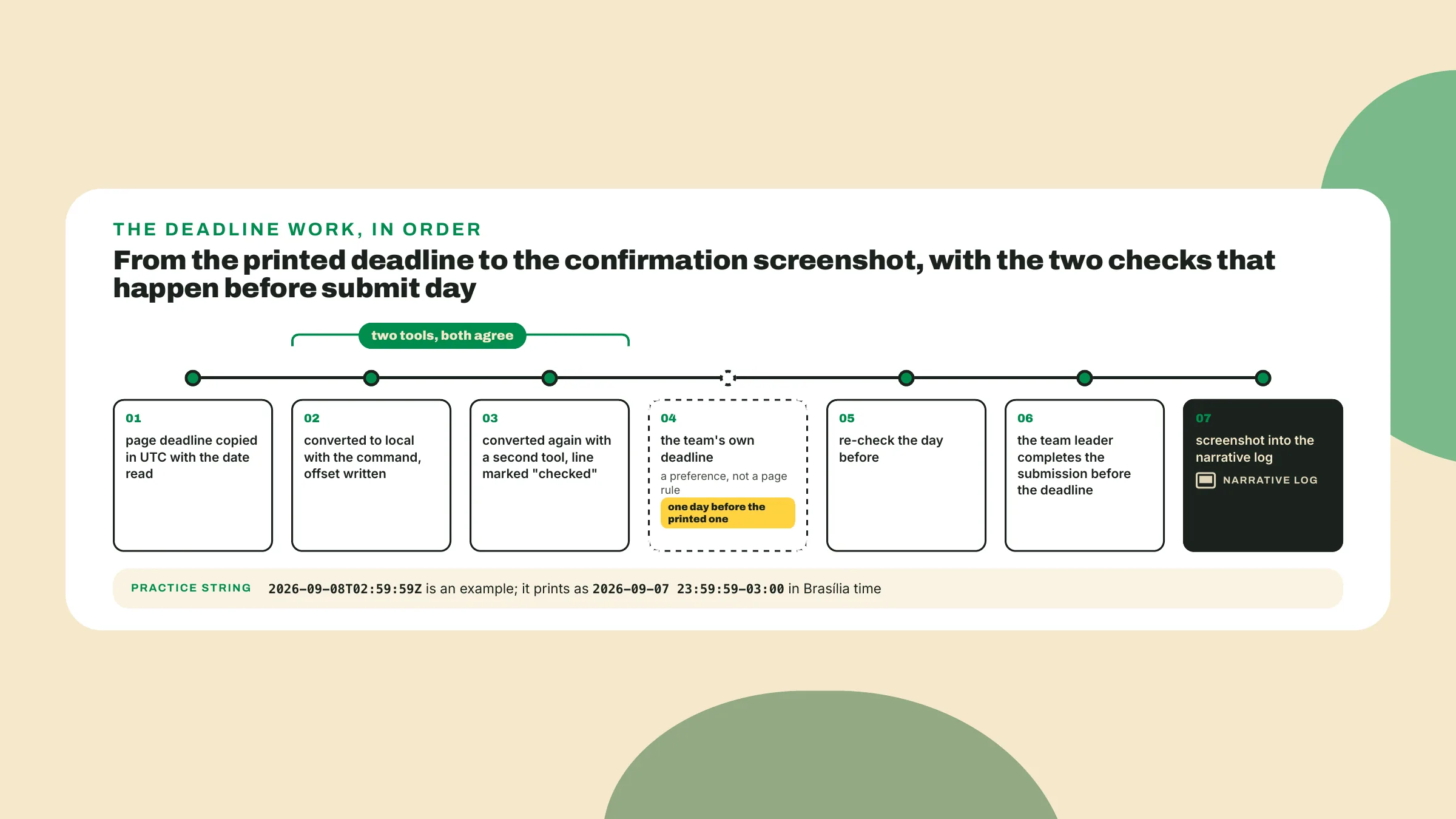
python3 -c "from datetime import datetime, timezone; d = datetime.fromisoformat('2026-09-08T02:59:59+00:00'); print(d.astimezone(timezone.utc)); print(d.astimezone())"
Num laptop configurado no horário de Brasília as duas linhas saem como 2026-09-08 02:59:59+00:00 e 2026-09-07 23:59:59-03:00. A página diz dia oito. O seu calendário diz dia sete, um segundo antes da meia-noite. Um time que escreveu "dia 8" no grupo e planejou submeter na manhã do dia 8 já perdeu, com produto funcionando e vídeo bom. O +00:00 no comando é o Z do fim escrito por extenso. No Python 3.11 ou mais novo o Z funciona sozinho, então numa máquina mais antiga mantenha a forma longa.
Para a Colosseum a string vem do seu brief da Colosseum. A lição 2 copiou a data de fim da temporada da página ao vivo, e em 2026-09-06 a hora era a parte que a página ainda não tinha impresso, por isso o brief guarda um espaço para ela. Na semana final, releia colosseum.com/hackathon, cole no comando a hora que a página imprime e escreva o resultado local na linha do prazo, ao lado do original em UTC.
Depois converta uma segunda vez com outra ferramenta, o relógio mundial do celular basta, e só quando as duas concordam a linha ganha a palavra "conferido" no fim. Escreva o nome do líder nessa mesma linha, porque a página diz que o líder do time deve completar a submissão antes do prazo. Minha regra pessoal, uma preferência, não uma regra da página, é marcar o prazo do time um dia inteiro antes do impresso, para que o último dia seja para a captura de tela, e não para o formulário.
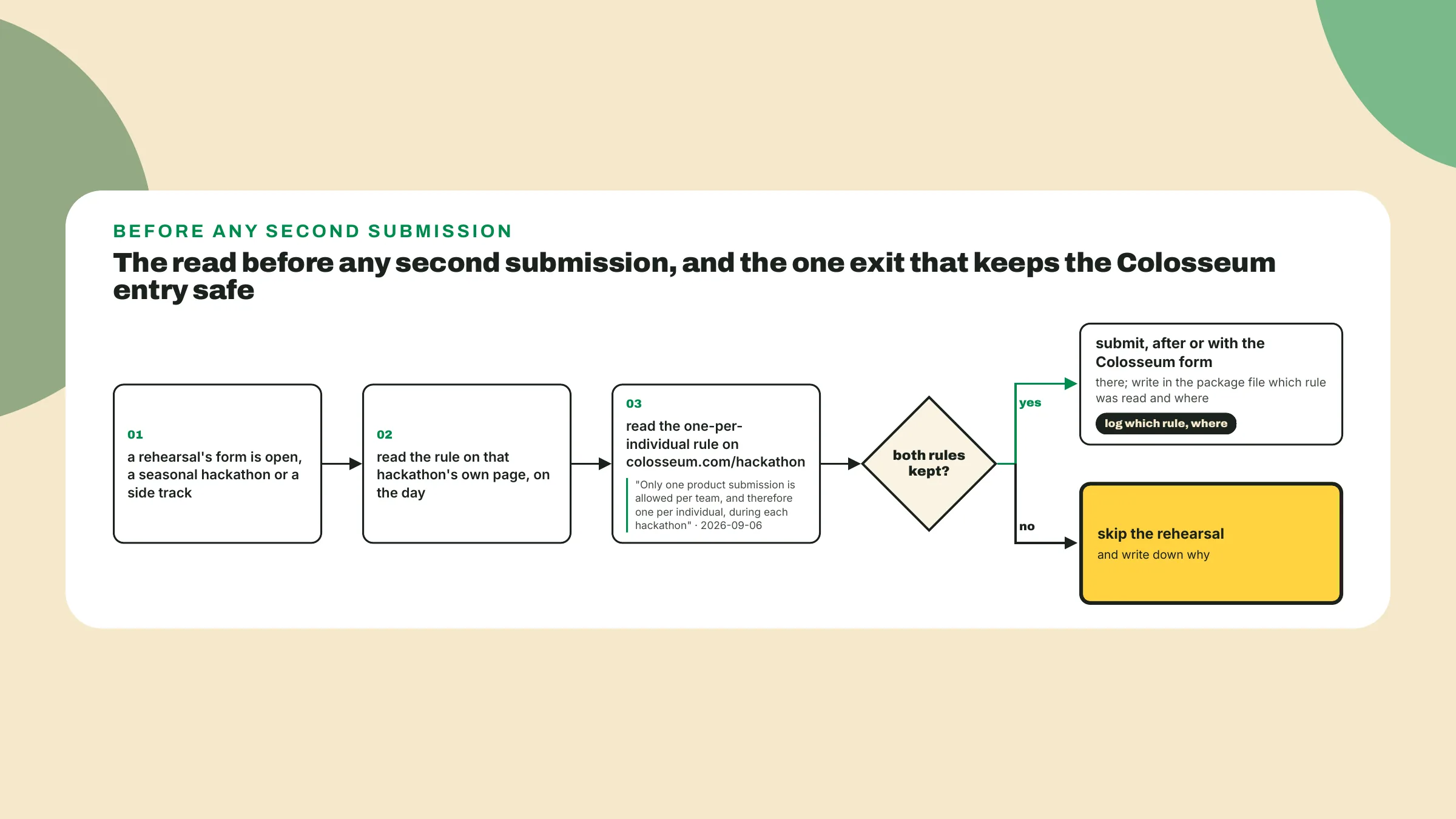
'Only one product submission is allowed per team, and therefore one per individual, during each hackathon' (só uma submissão de produto é permitida por time, e portanto uma por pessoa, em cada hackathon) (colosseum.com/hackathon, 2026-09-06).
Um produto por time, e portanto um por pessoa. O jeito como os times quebram isso sem querer é a segunda conta: um integrante se cadastra por conta própria para "garantir", ou submete um experimento paralelo no próprio nome, e agora uma pessoa tem duas submissões na temporada. Ninguém no time submete mais nada, e o líder é a única pessoa que aperta o botão.
Segundo, o líder do time completa a submissão antes do prazo, então o líder é nomeado no arquivo, na linha do prazo, onde o nome já está. Terceiro, a página diz que deturpar o histórico de desenvolvimento pode desclassificar, então código anterior é declarado na submissão, em 'What works today' ou onde o formulário der espaço, copiado do log narrativo, onde a versão honesta já mora, com data. Quarto, acesso. Um repositório privado sem acesso para hackathon@colosseum.com é um repositório que o revisor não consegue abrir, e a minha leitura, que a página não explicita, é que repositório que ninguém consegue abrir é pontuado como nenhum repositório.
checklist de desclassificadores, colosseum.com/hackathon, lido em 2026-09-06
[ ] um produto deste time, e ninguém nele submete outro                     assinado: líder
[ ] código anterior e histórico de desenvolvimento declarados na submissão  assinado: líder
[ ] o líder completa a submissão antes do prazo                             assinado: líder
[ ] acesso ao repositório concedido a hackathon@colosseum.com, confirmado por um segundo integrante
O líder assina três e um segundo integrante assina o quarto, e o arquivo não é um checklist enquanto os nomes não estão nele. Um checklist que ninguém assinou é uma lista de coisas que alguém torceu para serem verdade.
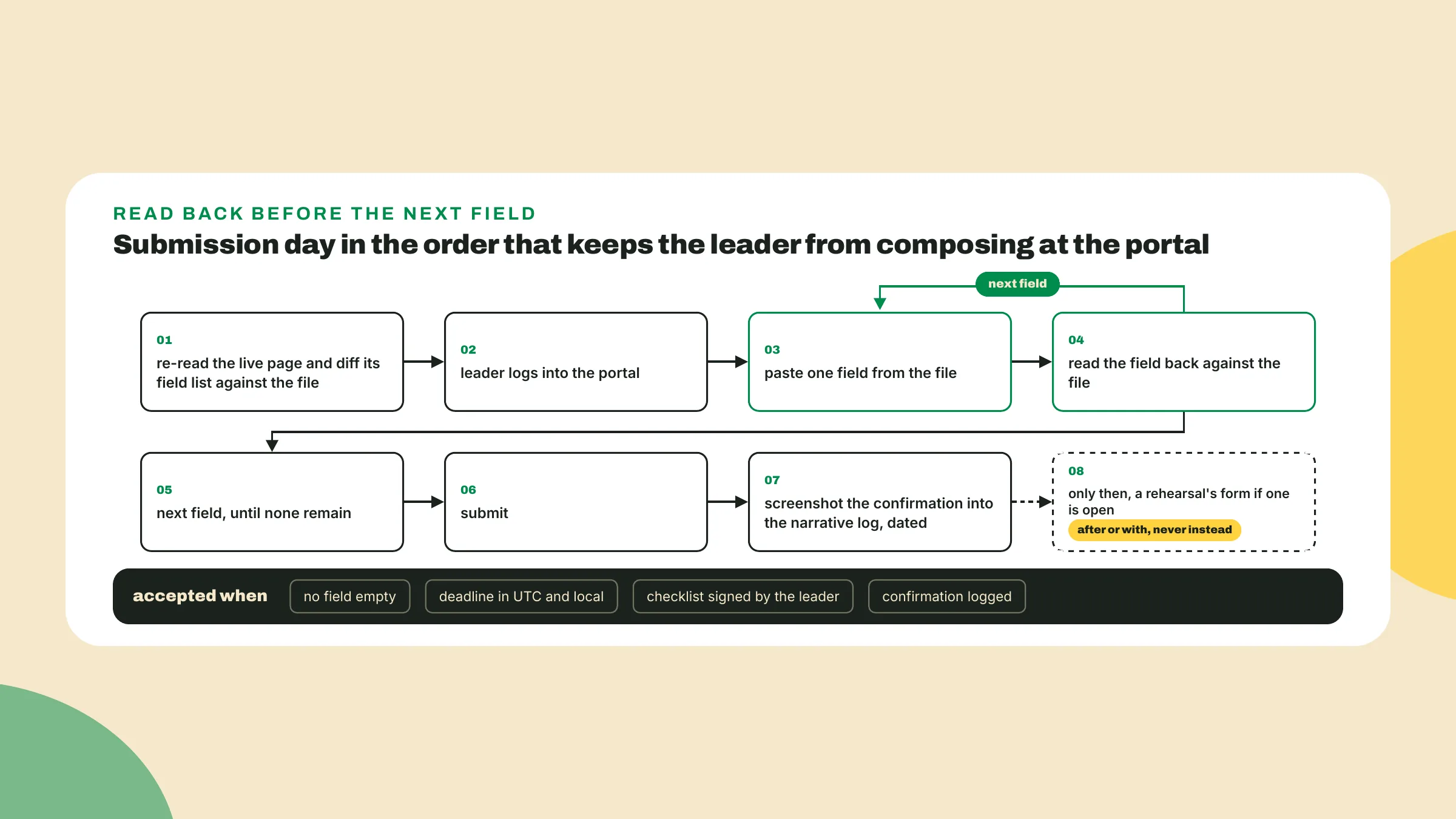
Depois o líder entra no portal, cola cada resposta do arquivo, relê cada campo comparando com o arquivo antes de passar para o próximo, submete e tira uma captura de tela da confirmação para o log narrativo, com a data. Fora de temporada, quando não tem portal aberto, o formulário simulado é este mesmo arquivo: os campos na ordem da página, nada em branco, e o nome do líder e a data na última linha, no lugar da captura de tela.
O método cabe em uma frase: abra a página do ensaio, copie as entregas e o prazo para o arquivo do material com a data, responda às perguntas dele e cole o resto. Não reconstrua o material para ele e não escreva uma segunda descrição. Antes de qualquer segunda submissão, leia a regra na página do próprio hackathon e a regra de um-por-pessoa na página da Colosseum, no dia, e escreva no arquivo do material qual regra você leu e onde. Se as duas regras não podem ser cumpridas ao mesmo tempo, pule o ensaio e escreva por quê.
As regras ficam na mesma página dos critérios de julgamento, alguns parágrafos abaixo, e são a parte que o time controla por completo: cada campo preenchido a partir de um arquivo que já existe, um prazo convertido por duas ferramentas e escrito nos dois fusos, um produto por pessoa, e o líder apertando o botão com um dia de folga. O vídeo de apresentação é o campo que o jurado abre primeiro, e a regra de um-por-pessoa é a que desclassifica o time que ninguém avisou.
O capstone está pronto quando a confirmação está no log, o último arquivo que a promessa do curso pediu. A primeira ação da próxima lição é um arquivo chamado next-season-plan.md ao lado deste material, com duas frases copiadas da página ao vivo sobre o que acontece depois que as submissões fecham: a entrevista de 15 minutos para a qual um grupo menor é convidado, e o anúncio mais ou menos um mês depois do prazo. A partir daí ela percorre por que um pitch perdido não é um projeto perdido.
Você termina o mês com um material de submissão que o jurado consegue abrir, um formulário que ninguém redigiu na hora dentro do portal e uma captura de tela com data. Guarde a captura de tela, porque daqui a um mês, diga o que disser a página de vencedores, ela é a prova de que o formulário não te venceu.
Inscreva-se para fazer o quiz
O quiz faz parte do curso — inscreva-se para respondê-lo, acompanhar seu progresso e ganhar XP.