Cargando...

 BetaBeta
La lección pasada hiciste la pasada "¿parece real?" sobre tu pantalla del fiado, anotaste en la bitácora narrativa un video de actualización de la semana 2 y reescribiste el pitch como v2. Abre la bitácora y el pitch v2 lado a lado. La semana 4 empieza sobre esos dos archivos, y lo primero que pregunta es lo que la bitácora no puede responder sola: ¿cómo encuentra alguien esto?
Colosseum es multichain: al momento de la temporada World's Fair de 2026, la página de la temporada muestra ocho ecosistemas socios, el blog de Colosseum dice que los tracks de premios se organizan alrededor de esos ecosistemas con una bolsa de premios general, y la lista completa de jurados, tracks y patrocinadores sale el 14 de septiembre. El Colosseum Accelerator, leído el 2026-09-06, invierte $250,000 en cada startup que acepta y exige alguna forma de integración con Solana. O sea que Solana es un track que elegiste, y un jurado en un panel multichain puede preguntarte por qué, una pregunta que antes la sala daba por sentada y que ahora lleva puntuación.
La distribución es una afirmación con evidencia: quiénes son los usuarios, dónde se juntan ya, y cómo el producto les llega a través de ese lugar, una hipótesis porque todavía no lo hiciste, una afirmación porque un jurado la puntúa igual. Abre un archivo nuevo llamado gtm-one-pager.md y pon la fecha de hoy en la primera línea.
gtm-one-pager.md, Fiado, iniciado el 2026-10-05
primeros 100 usuarios: los clientes habituales de cinco tiendas de la cooperativa de Lucia, unos veinte fiados por tienda,
                       a los que se llega por las dueñas en la reunión mensual de la cooperativa
Si tu línea nombra un mercado y ningún lugar, guárdala como registro del primer día y escribe una segunda línea debajo con un lugar adentro. Cien personas a las que puedas señalar con el dedo es todo el requisito, y cuesta más escribirlo de lo que parece.
Después busca el canal en el registro de tracción. Junto a cada tienda que llevó un fiado real, escribe cómo llegó: la presentación de Lucia, alguien que entró de la calle, el chat de la cooperativa. El canal más fuerte es el que trajo las tiendas que volvieron, no el que trajo más nombres, y la hipótesis se queda solo con lo que el registro respalda. El registro de Fiado dice que las tres tiendas que volvieron eran todas de dueñas de las conversaciones de la semana 1, y que ninguna de las que entró de la calle abrió un fiado, así que el canal es primero una conversación en persona, y la reunión mensual de la cooperativa es donde van a pasar las próximas diez de esas conversaciones.
Esa última frase es toda la sección de precios para un proyecto con cuatro tiendas y sin ingresos. Una diapositiva de precios para un producto que nadie paga todavía es una diapositiva sobre nada. La línea honesta tiene tres partes. La de Fiado: ninguno todavía, pagaría la tienda, porque la tienda es la que pierde la libreta, y no antes de que diez tiendas hayan llevado un fiado durante un mes.
Bajo el precio, escribe lo que cuesta mantener el producto andando cada mes, el burn rate (costo mensual de operación), y el punto en que los clientes que pagan lo cubrirían. Un jurado que lee para Viability pregunta las dos cosas, y para un recorte de un mes las dos son números chicos que vale la pena escribir. Los de Fiado, como estimaciones con sus insumos: hosting y base de datos unos US$25, los mensajes de recordatorio unos US$15 con el volumen de cuatro tiendas, unos US$40 al mes, y nadie en el equipo cobra todavía, y la línea lo dice. El punto de equilibrio es ese costo dividido entre lo que pagaría un cliente: a US$5 por tienda al mes, ocho tiendas que paguen lo cubren, y la condición de las diez tiendas es la prueba de si pagarían siquiera.
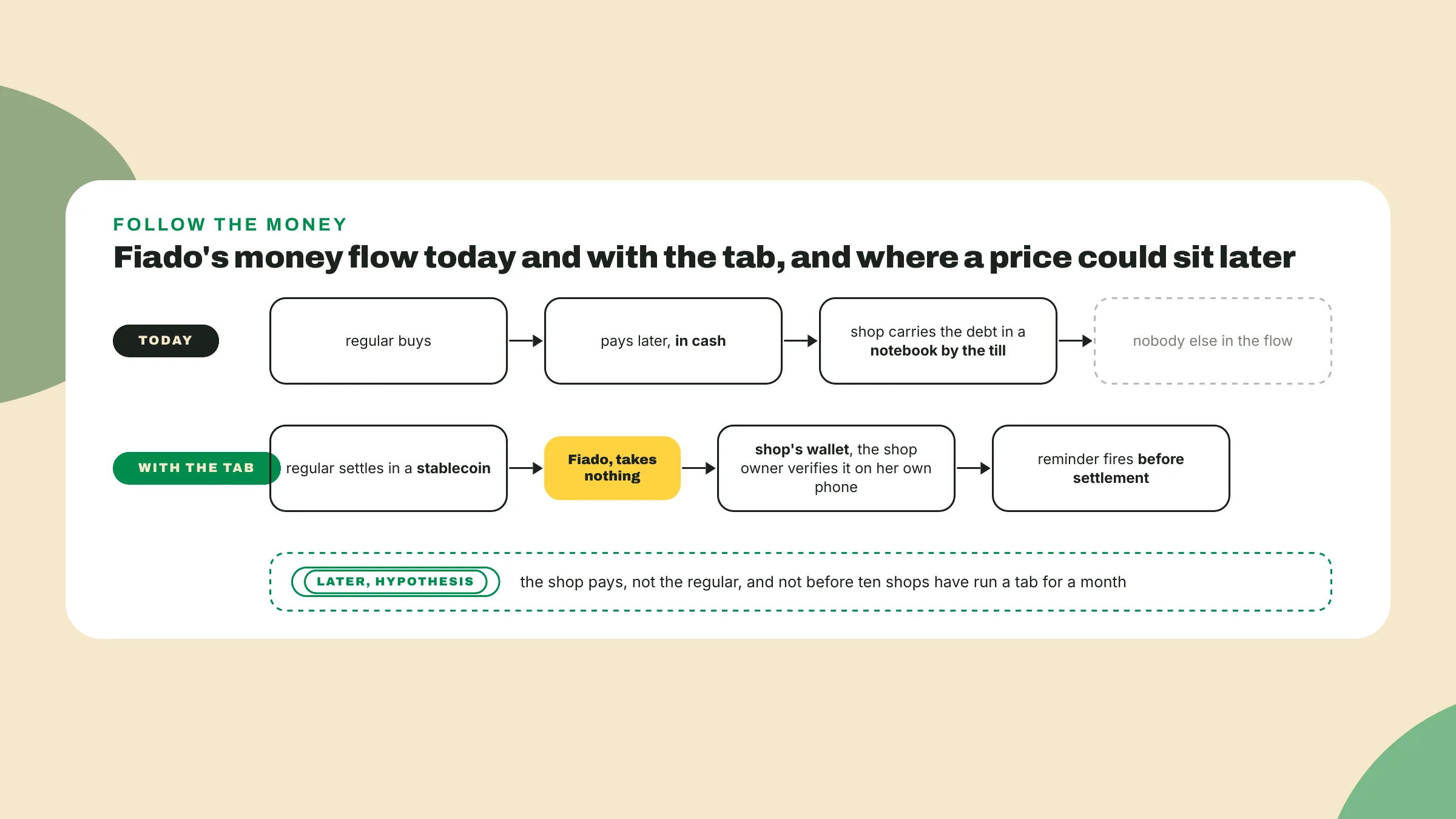
Viability está en la lista vigente de factores, y aquí es donde la página la responde. Un ninguno todavía al final de un flujo de dinero dibujado suena a una decisión que el equipo tomó con los ojos abiertos, y las mismas palabras sin el flujo dibujado suenan a un equipo que nunca lo pensó.
Escribe el por-qué-ahora: qué cambió hace poco para que el producto sea posible o necesario hoy y no hace tres años, y apunta al paquete de evidencias de la semana 1 en lugar de volver a argumentarlo. El de Fiado: un saldo en stablecoin que un cliente puede tener en el celular sin cuenta bancaria, con la evidencia en evidence-pack.md. Escríbelo antes del por-qué-Solana. Es el más fácil de los dos, y le da al párrafo de por-qué-Solana una razón para existir.
Escribe el por-qué-Solana para dos lectores. El jurado de track puntúa el track de Solana, uno de los ocho ecosistemas socios, y en la misma temporada ya vio la misma categoría de proyecto argumentada para cada uno de los otros, así que la pregunta en la cabeza de ese jurado es simple, qué hace este recorte que este ecosistema le facilita, y la respuesta que quiere es un mecanismo: algo que el recorte hace y qué usa de la cadena para hacerlo.
El accelerator, leído el 2026-09-06, dura ocho semanas, las dos primeras en San Francisco, no cuesta nada asistir, termina en un Demo Day con inversionistas, a esa misma fecha había invertido en 74 startups de su portafolio, y exige alguna forma de integración con Solana. Ese lector quiere la integración nombrada en una línea.
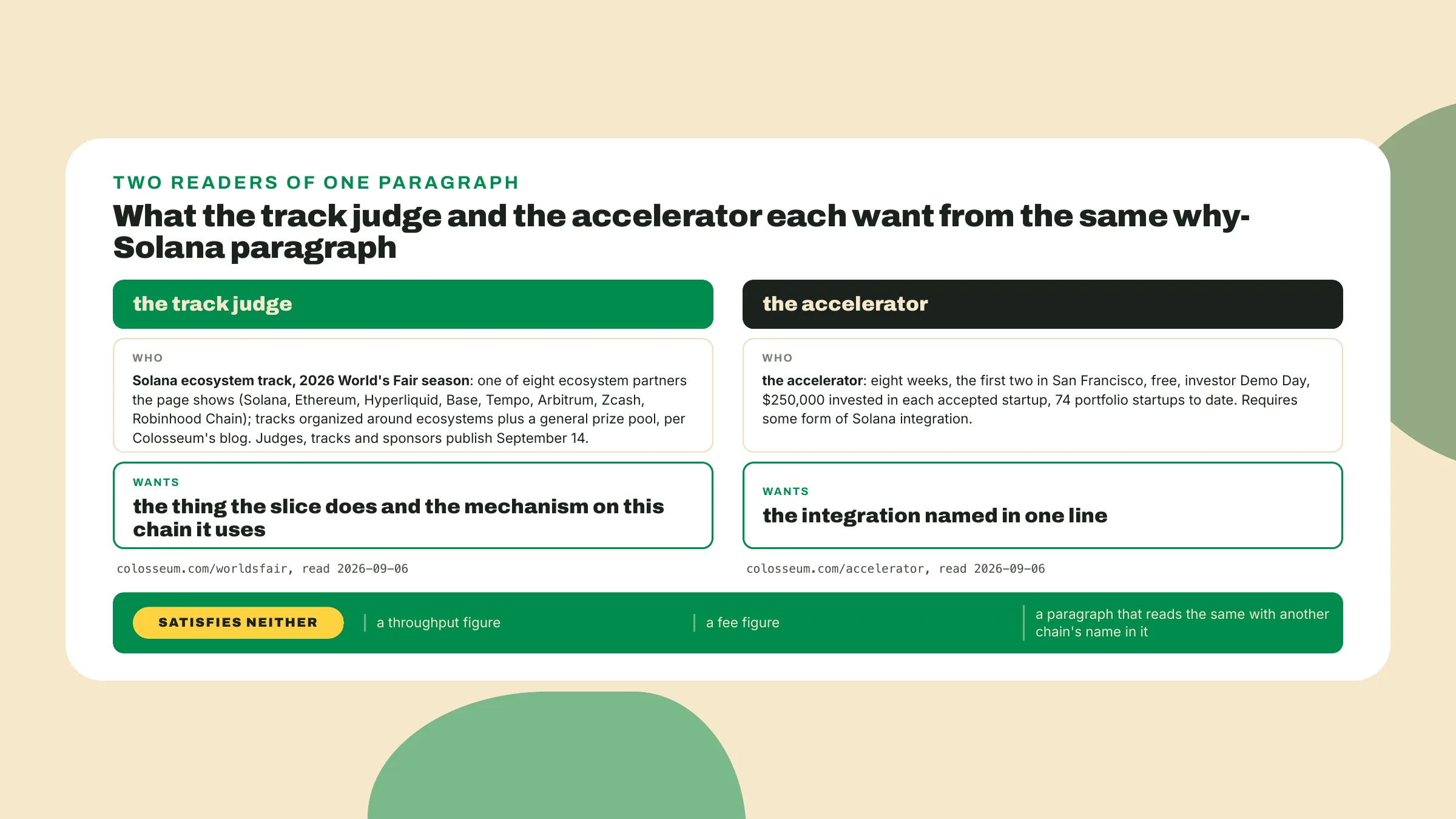
El párrafo que escribe la mayoría de los equipos no le sirve a ninguno de los dos lectores: una cifra de throughput, una cifra de comisiones, y el mismo párrafo en cada track del edificio con el nombre de la cadena cambiado. Un número sobre la cadena es una afirmación sobre la cadena, y tu recorte no está ahí. Llena esta forma en su lugar, unas cuatro oraciones:
por-qué-Solana, la forma del párrafo
el recorte hace:           <una cosa, en las palabras de la demo>
en Solana usa:             <la cuenta, la transferencia, la billetera, el mecanismo que sea>
en el track de al lado:    <lo mismo, o qué se rompe>
para el accelerator:       <la integración en una línea, con la transacción de la bitácora narrativa>
El párrafo de Fiado está marcado como ABIERTO en su página, y la materia prima está en una nota al lado. El recorte deja que un cliente pague parte de un fiado y que la tienda lo vea llegar.
El mecanismo es el propio historial de pagos: cada pago parcial es una transferencia de USDC en devnet con un memo que nombra el fiado, el saldo que muestran los dos celulares sale de esas transferencias, y la app guarda solo el directorio de clientes, así que una tienda y un cliente pueden leer el registro sin confiar en la app ni el uno en el otro, y la dueña verifica un pago desde su propio celular, sin estado de cuenta del banco. Después, una billetera que el cliente ya tiene, y cuyos usuarios están en esta cadena. Para el accelerator, la integración es la liquidación misma, y la transacción está en la bitácora narrativa.
Escribe el párrafo de Fiado desde esa nota, después escribe el tuyo, y hazles la prueba a los dos: ¿el recorte haría lo mismo en el track de al lado? Si sí, el párrafo es por-qué-una-cadena, y la versión honesta habla de dónde ya están los usuarios y los socios, que sigue siendo un mecanismo. Si no, escribe qué se rompe. Esa oración es el párrafo.
Un proyecto adyacente es uno cuyos usuarios son tus usuarios, o cuyo producto tu recorte ya toca. Cada mensaje pide una integración o una frase, con un pedido más chico al lado, y dice qué es tu producto con la oración que un desconocido ya entendió en el registro de feedback. Un mensaje que pide asociarse no pide nada, y recibe lo mismo de vuelta. El método es el de David: dedícale horas de verdad a venderles la idea a los proyectos que podrían integrarse con tu recorte, porque un equipo que llega al demo day con algunos socios ya de su lado tiene una ventaja, y es la única ventaja que yo tomaría por encima de cualquier función en la semana 4.
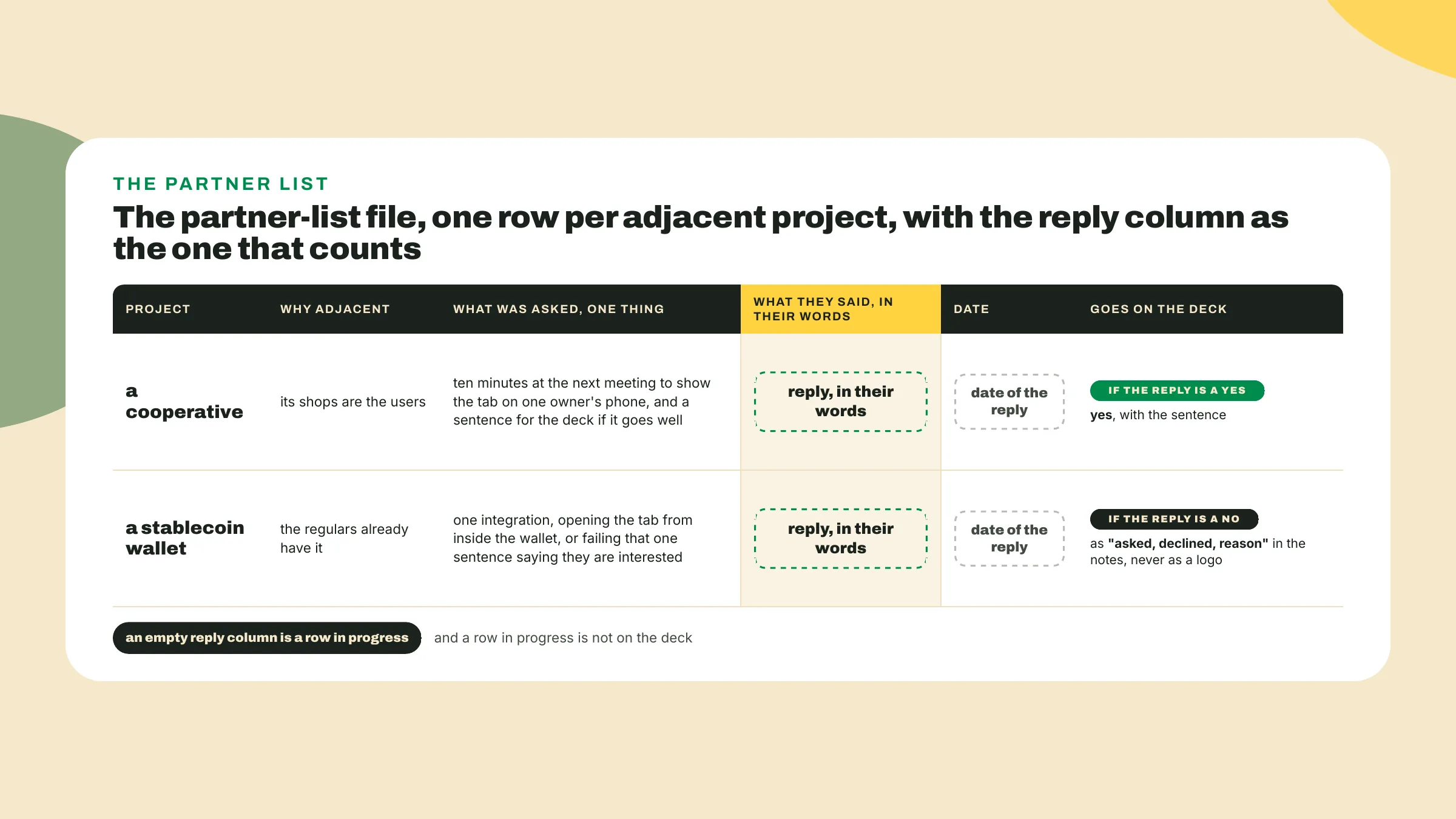
Los dos mensajes de Ana salen el 2026-10-05. El primero va a la coordinadora de la cooperativa y pide diez minutos en la reunión de octubre para que Lucia muestre el fiado en su propio celular, más una oración para el deck si a la sala le gusta lo que ve. El segundo va a la billetera que los clientes ya usan y pide una integración, abrir el fiado desde adentro de la billetera, con el plan B en el mismo mensaje: si no, una oración diciendo que el caso de uso les interesa.
Un mensaje con solo el pedido grande adentro no recibe respuesta. Un mensaje con un pedido chico al lado recibe el chico, que es una respuesta, que es una fila.
Los mensajes a socios tienen tope porque cada uno necesita seguimiento. Las actualizaciones públicas no. De hoy a la fecha límite, publica el video de actualización semanal en la cuenta de X del equipo y en el chat donde se juntan tus primeros cien usuarios, y cierra cada publicación con un número del registro de tracción. Las primeras cinco palabras de la publicación son todo el pitch para alguien que va deslizando, así que llevan el one-liner y nunca el nombre del proyecto.
partner-list.md, Fiado, semana 4, iniciado el 2026-10-05

proyecto       por qué adyacente      pedido                    dijeron                            fecha       deck
cooperativa    sus tiendas son los    diez minutos en la        "sí, después de la tesorera,       2026-10-06  sí, con
               usuarios               reunión de octubre; una   traigan el celular de Lucia.                   la oración
                                      oración para el deck      podemos decir que lo estamos
                                                                probando en tres tiendas"
billetera      los clientes ya la     abrir el fiado desde      "no antes de fin de año.           2026-10-07  solo notas:
               tienen                 adentro de la billetera;  interesante, pero el roadmap                   pedido, rechazado,
                                      si no, una oración de     está fijo"                                     razón
                                      interés
El sí va al deck como una oración, el nombre de la cooperativa y las tres tiendas. El no se queda fuera del deck como logo y va a las notas como pedido, rechazado, y la razón, porque en la entrevista de 15 minutos un jurado que pregunte por billeteras recibe una respuesta verdadera con fecha. En esa entrevista un jurado lee la diapositiva de socios, elige un nombre y pregunta:
jurado:    Cuéntame de la cooperativa.

equipo A:  Les escribimos. Parecían interesados.
equipo B:  Pedimos diez minutos en su reunión de octubre. La coordinadora dijo que sí el
           2026-10-06, después de la tesorera, y les están diciendo a sus tiendas que lo
           están probando en tres de ellas. Lucia muestra el fiado en su celular en esa reunión.
El equipo A le mandó un correo a cinco logos una vez, así que tiene cuatro nombres de los que no puede hablar, y el jurado eligió al azar. El equipo B tiene un nombre y una historia verdadera, con una fecha, una persona y un próximo paso adentro.
Una respuesta real vale más que cinco logos, y un no anotado sigue siendo una respuesta: le dice al jurado que preguntaste, que aprendiste la razón, y que sabes qué tiene que cambiar antes de que ese proyecto diga que sí, y yo diría que la mitad de los equipos de la sala nunca le preguntó a nadie, una suposición que no puedo respaldar con una cuenta.
La distribución es una afirmación con evidencia: un grupo de unas cien personas que puedes señalar, el lugar donde ya les llegas, y un flujo de dinero dibujado lo bastante lejos como para que un ninguno todavía suene a decisión. El por-qué-Solana nombra algo que el recorte hace y el mecanismo en la cadena con el que lo hace, nunca un benchmark, y una respuesta anotada en las propias palabras de un socio vale más que cinco logos. Si un número salió primero, dilo otra vez sin el número. Casi siempre sigue siendo cierto, y queda mejor.
La próxima lección el pitch se convierte en un deck, y lo primero que haces es abrir un archivo nuevo llamado deck-judge.md y escribirle siete encabezados antes de que ninguna diapositiva tenga contenido. Cinco a siete diapositivas para un jurado, y un hackathon de temporada o un side track (el track regional) van a tener su propia página con sus propios entregables, así que lees esa página el día que decides entrar y reacomodas el mismo deck, porque el one-pager, la bitácora narrativa y el archivo de dimensionamiento ya son el deck, en la forma equivocada. La fila de socios con una respuesta real adentro es la línea que un jurado va a creer primero.
Inscríbete para hacer el quiz
El quiz es parte del curso: inscríbete para responderlo, seguir tu progreso y ganar XP.