Cargando...

 BetaBeta
La lección pasada mandaste el recorte de siete pasos a devnet con un equipo de agentes, y la última línea de tu bitácora es la firma de la transacción que un jurado puede abrir. Deja el recorte corriendo en una segunda pantalla, porque hoy no se construye nada nuevo, con una pequeña excepción para las tiendas que empiezan a usarlo de verdad. Hoy se lo mira, tú y gente que no estuvo en la construcción, y lo que ven queda por escrito.
Dos demos, la misma función. Una tiene un frontend que cualquier jurado que haya usado una herramienta de agentes reconoce en un segundo: el mismo layout, el mismo degradado, el mismo texto de relleno. La otra parece hecha por alguien a quien le importaba la persona del otro lado de la pantalla. Las demos que quedaron entre los premiados no parecían hechas por IA, y funcionaban lo suficiente para una demo, y nada en esa oración dice bonita ni completa. Averigua cuál es la tuya antes de seguir leyendo.
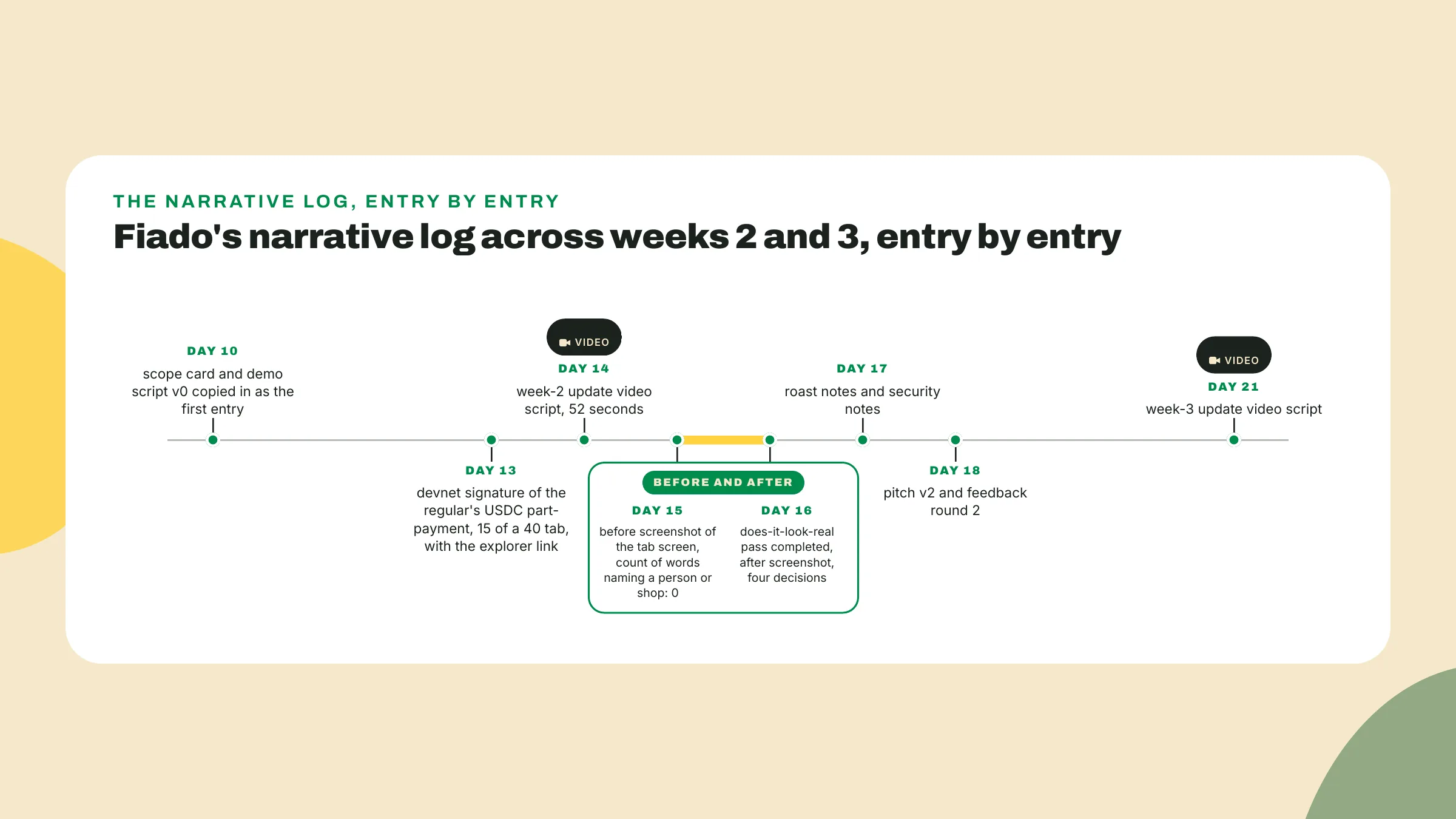
bitácora narrativa, Fiado, día 15
captura:     tab-screen-day15.png (antes de la pasada)
palabras en pantalla que nombran a una persona o una tienda: 0
lo que la pantalla dice en su lugar: Dashboard, Welcome back, Total Balance
La cuenta es casi siempre cero, porque eso es lo que entrega un subagente de frontend cuando nadie le dijo quién es el usuario. Una bitácora narrativa es un registro con fecha de la construcción, que se lleva mientras la construcción ocurre: una captura cada vez que una pantalla cambió, con la vieja arriba, la firma de cualquier transacción que la demo vaya a mostrar, con su enlace, una decisión cada vez que algo se cortó, en las palabras que el equipo usó en ese momento, y una vez por semana el guion del video de actualización. El deck y los dos videos de la semana 4 se cortan de este archivo.
La actualización semanal de Colosseum es opcional y muy recomendada, y su forma es un video de un minuto, según la página del hackathon leída el 2026-09-06. El guion son cuatro oraciones: qué cambió esta semana, mostrado y no descrito, por qué cambió, con la decisión de la bitácora, qué vería hoy un jurado si clonara el repo, y qué viene la próxima semana. Menos de 60 segundos, cámara del celular o grabación de pantalla, una toma. Una segunda toma está bien. Una tercera toma es la trampa del pulido. El guion de la semana 2 de Fiado, como entró en la bitácora el día 14:
video de actualización, semana 2, Fiado, grabado el día 14, 52 segundos
0:00  Esta semana el fiado pasó de un mock a devnet. Esta es la transacción donde
      un cliente habitual paga 15 de un fiado de 40, y este es el mismo fiado marcando 25
      en el celular de la dueña.
0:18  Cortamos el registro de clientes. Dos dueñas nos dijeron en la semana 1 que el fiado
      vive en su celular, así que solo la dueña abre fiados y el cliente solo ve un
      saldo.
0:35  Si clonas el repo hoy, el quickstart corre los siete pasos y el primer
      pago parcial confirma en devnet.
0:46  La próxima semana la pantalla deja de decir Dashboard, y una página real de una
      libreta real va ahí.
La línea de 0:18, una decisión con la evidencia de la semana 1 detrás, es la oración que un jurado que pregunta cómo prioriza el equipo quiere oír.
Sin el look de componente por defecto: la grilla de tarjetas, el encabezado con degradado y las tres fichas redondeadas de estadísticas se van, y el único número que le importa a la dueña va donde su ojo cae primero, una fuente, un color de acento, el total adeudado en grande, unos 30 minutos. El estado vacío está resuelto: abre la app como una tienda nueva sin fiados, y si lo que aparece es una tabla con encabezados y nada debajo, la demo tiene un hueco, porque esa es la primera pantalla que va a ver un jurado que clone el repo. No hay un quinto ítem sobre gusto.
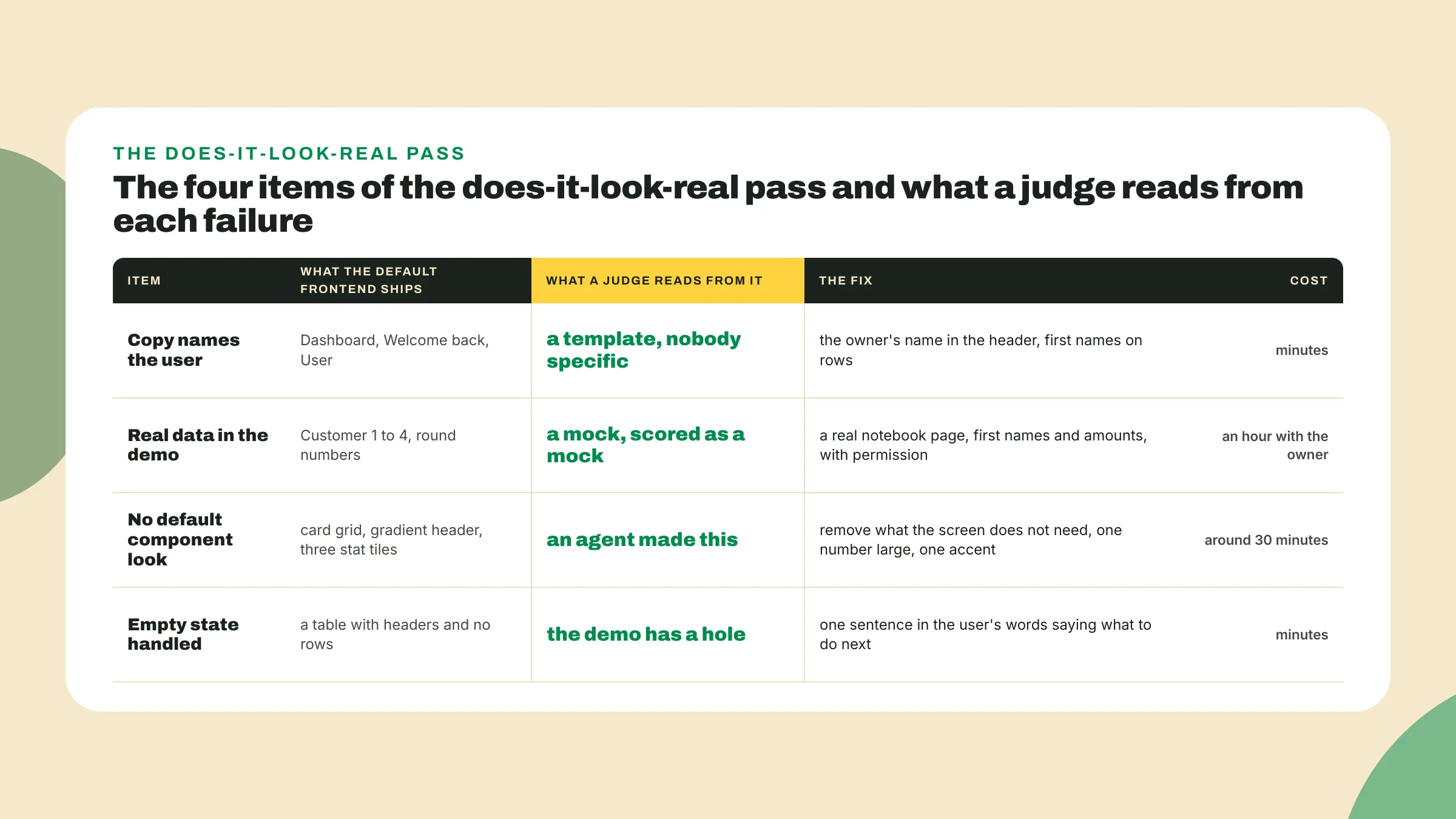
La pantalla del día 15 de Fiado era la de siempre, tres fichas de estadísticas en cero porque leían otra tabla, y si la tuya se ve así, eso es lo que la herramienta entrega y no un fracaso. El checklist para esa pantalla, con tres ítems hechos:
pasada ¿parece real?, Fiado, pantalla del fiado, día 16
el texto nombra al usuario   cambió: encabezado "Dashboard" -> "Tienda de Lucia"; saludo
                             quitado; cada fila lleva el nombre de pila del cliente
datos reales en la demo      cambió: filas Customer 1 a 4 -> seis clientes habituales de la
                             página de la libreta de Lucia, nombres de pila y montos, con su permiso
sin look por defecto         cambió: tres fichas de estadísticas -> un número, el total adeudado,
                             grande arriba; grilla de tarjetas quitada; un color de acento
estado vacío resuelto        (te toca terminarlo)
Lucia es la dueña de la tienda de las conversaciones de la semana 1, la tía de Ana, que ya está en el registro de feedback desde el día 0 y la ronda 1, y la bitácora deja anotado su permiso con la fecha, porque un jurado puede preguntar. Ahora el cuarto ítem: abre Fiado como una tienda sin fiados, como lo vería un jurado que acaba de correr el quickstart, toma la captura, y escribe el estado vacío en palabras de Lucia, algo como todavía no hay fiados, abre el primero desde la libreta, con el botón que lo hace justo debajo de la oración. Marca el ítem con lo que cambió, pega la captura de después bajo la de antes, y ponle fecha.
El segundo roaster es una persona que no construyó el producto, con la misma instrucción: qué está mal, qué confunde, qué no te creerías. Anota tres líneas por roaster, en las palabras del roaster. Las de Fiado:
notas del roast, Fiado, día 17
persona   el cliente no puede saber desde la pantalla qué pasa cuando el fiado se
          paga completo
persona   el total adeudado de arriba no tiene una fecha al lado
persona   la palabra devnet aparece en el pie donde una dueña de tienda la leería
          sin saber qué significa
comando   el quickstart asume una billetera con fondos y nunca lo dice
Dos de las cuatro se volvieron decisiones en la bitácora esa misma tarde. La tercera, la fecha junto al total, esperó a la ronda 2 de feedback para confirmar que alguien más también la quería.
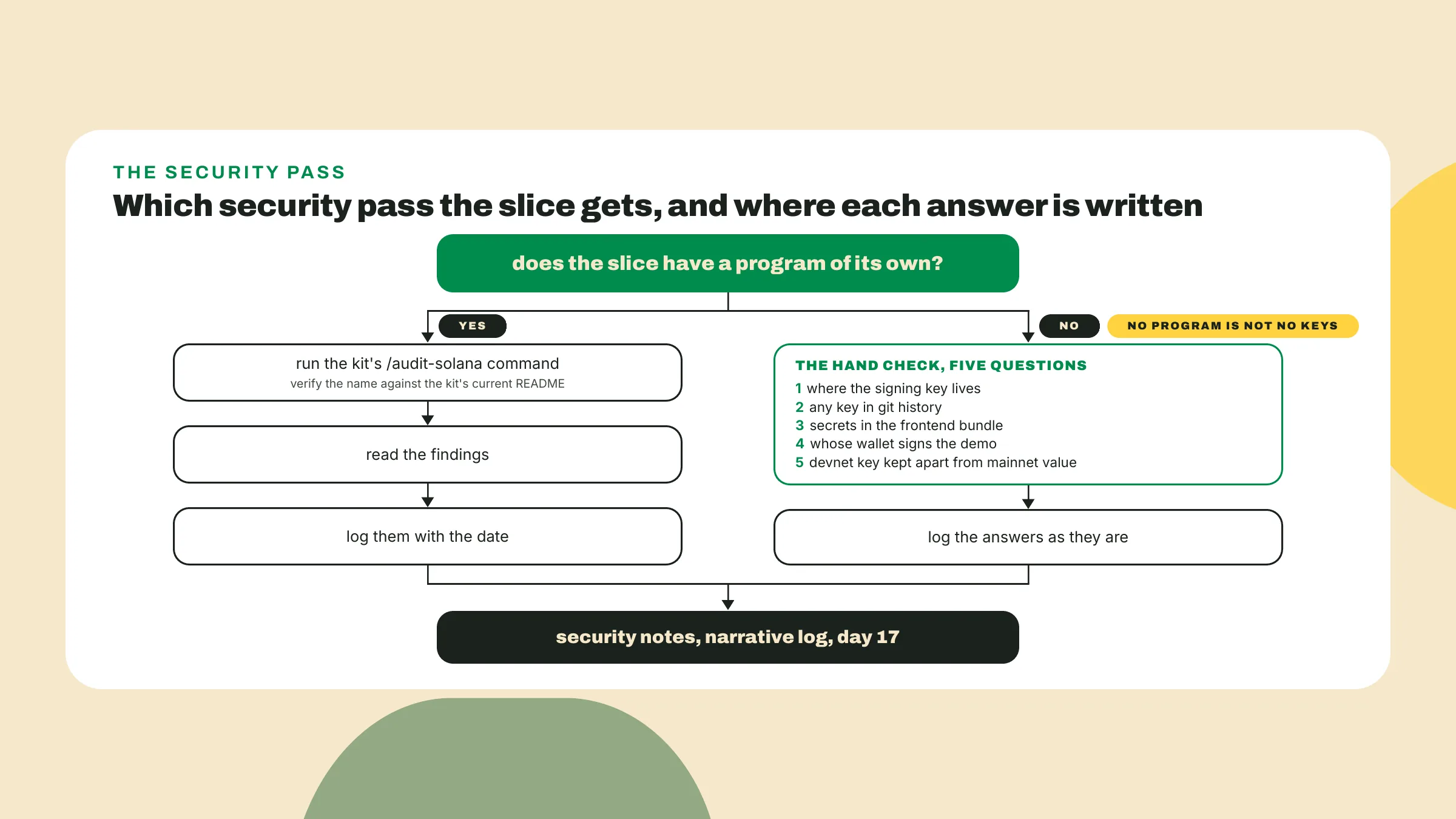
Cinco preguntas, con las respuestas a la bitácora tal cual salen. ¿Dónde vive la llave que firma la transacción de la demo: un archivo en el repo, una variable de entorno o una billetera en el navegador? ¿Está esa llave, o cualquier otra, en el historial de git? Una búsqueda de los formatos habituales de llave lo responde en un minuto. ¿El bundle del frontend manda algo secreto? ¿La demo firma con la billetera de la dueña o con una llave del equipo que la reemplaza, y el guion dice cuál? ¿La llave de devnet está separada de cualquier llave con valor en mainnet, en otra máquina o al menos en otro archivo que nunca esté en la laptop de la demo?
El código que construyen los agentes puede parecer correcto y aun así traer un hueco de seguridad, y encontrarlo es un costo que paga el humano, no la herramienta, cerca de una hora el día 17. Las respuestas de Fiado: la demo firma con un keypair de devnet en una variable de entorno que el día 13 estuvo, por poco tiempo, en un archivo .env commiteado. Se quitó, la llave se rotó, y la bitácora lo dice con la fecha, porque un jurado que lo encuentra en el historial sin una nota es peor que un jurado que encuentra la nota.
Pon el recorte en manos reales. El recorte pulido va a los design partners (clientes socios) de la semana 1 esta semana, no después de la fecha límite, porque Traction (tracción) se cuenta en gente usando el producto y esa cuenta necesita días para crecer. El builder configura a mano cada tienda socia, porque el registro sigue siendo un no-objetivo. El fiado es real: la dueña abre fiados para sus clientes habituales de verdad, agrega compras de verdad, y los clientes abren su saldo en sus propios celulares.
La liquidación se queda en devnet, así que un cliente real paga como pagó siempre, en efectivo en el mostrador, y la dueña lo marca como pagado. Ese botón es lo único que se construye hoy, porque una tienda no puede llevar un fiado que no puede bajar, y la transferencia en devnet sigue siendo el camino de la demo hasta que el producto pase a mainnet. Ahora tienes nombres y teléfonos reales en tu backend, así que la revisión de manejo de llaves del paso 4 cubre también esa base de datos.
Después empieza traction-log.md y llénalo cada día desde los propios registros de la app, nunca desde lo que un socio dijo por teléfono. Cinco columnas: tiendas invitadas, tiendas con al menos un fiado real, fiados abiertos, clientes que abrieron su enlace de saldo, y tiendas que volvieron otro día sin que nadie se lo pidiera. La última es el uso recurrente, el número en el que un jurado más confía, porque cualquiera prueba algo una vez por cortesía.
traction-log.md, Fiado, semana 3 (contado desde los registros de la app)
día  tiendas invitadas  tiendas con fiado real  fiados abiertos  clientes abrieron enlace  volvieron sin pedirlo
16   4                  2                       9                4                         n/a
18   6                  3                       21               11                        1 de 2
21   7                  4                       34               19                        3 de 4
Cuatro tiendas de siete lo usaron y tres volvieron otro día sin que el equipo les recordara nada. Esa línea alimenta el pitch v2, la diapositiva de demo del deck y la respuesta de validación de demanda del portal, y el registro sigue creciendo durante la semana 4. La farmacia paró después de dos fiados, así que le toca una llamada y una fila en el registro de feedback, porque la razón por la que un usuario real dejó de usarlo es la oración más útil que produce el mes.
pitch v1 (día 7):   Una dueña de tienda que pierde la libreta pierde cuarenta deudas
                    pequeñas, así que Fiado guarda el fiado en su teléfono, le muestra
                    a cada cliente el mismo saldo y lo liquida en una stablecoin.
pitch v2 (día 18):  Una dueña de tienda que pierde la libreta pierde cuarenta deudas
                    pequeñas, así que Fiado abre el fiado en su teléfono, le muestra
                    al cliente el mismo saldo, cobra parte en USDC y le manda el
                    recordatorio al cliente por ella.
cambió:             "guarda el fiado" -> "abre el fiado" (la primera pantalla que
                    muestra la demo; un formulario, no la transacción); "lo liquida
                    en una stablecoin" -> "cobra parte en USDC" (la única transacción
                    en devnet, lo que el cliente hace en pantalla); el recordatorio
                    vuelve, porque el recorte dispara uno; "a cada cliente" -> "al
                    cliente", uno a la vez en pantalla
La mitad del problema no se movió otra vez, y después de dos rondas de evidencia y una construcción probablemente ese sea el problema correcto. El recordatorio vuelve porque el recorte lo dispara, y nada más que eso: si reduce los pagos atrasados sigue siendo el supuesto sin probar del memorando de decisión, así que la v2 afirma que el recordatorio se manda, que es lo que la demo muestra.
registro de feedback, ronda 2, día 18
1  Marcos, entró a un         vio la demo; preguntó qué pasa cuando el cliente
   hackathon una vez          paga todo el fiado, si se cierra
                              cambió: nada en la oración; una decisión en la bitácora
                              de que el fiado se cierra en cero y se reabre con la
                              siguiente entrada; una línea para el estado vacío
2  Lucia, la dueña de la      vio su propia página en la pantalla; preguntó a quién
   tienda                     le llega el recordatorio, a ella o al cliente
                              cambió: la oración. el borrador decía "manda el
                              recordatorio"; la v2 dice que el cliente "recibe el
                              recordatorio"
3  Jorge, un cliente          vio la demo; preguntó cómo revisaría el pago él
   habitual con fiado         mismo, sin confiar en la app
                              cambió: nada en la oración; el enlace al explorer
                              va en la pantalla junto al total, así que la demo
                              muestra la firma sin salir de la app
Tres entradas, un cambio de una palabra en la oración, dos cambios en la construcción. La tercera entrada es la que hay que copiar: la firma que anotaste la lección pasada estaba en un archivo, y después de la ronda 2 está en la pantalla, a un toque del número que la dueña mira.
El entregable es la bitácora narrativa con seis cosas adentro, y está lista cuando:
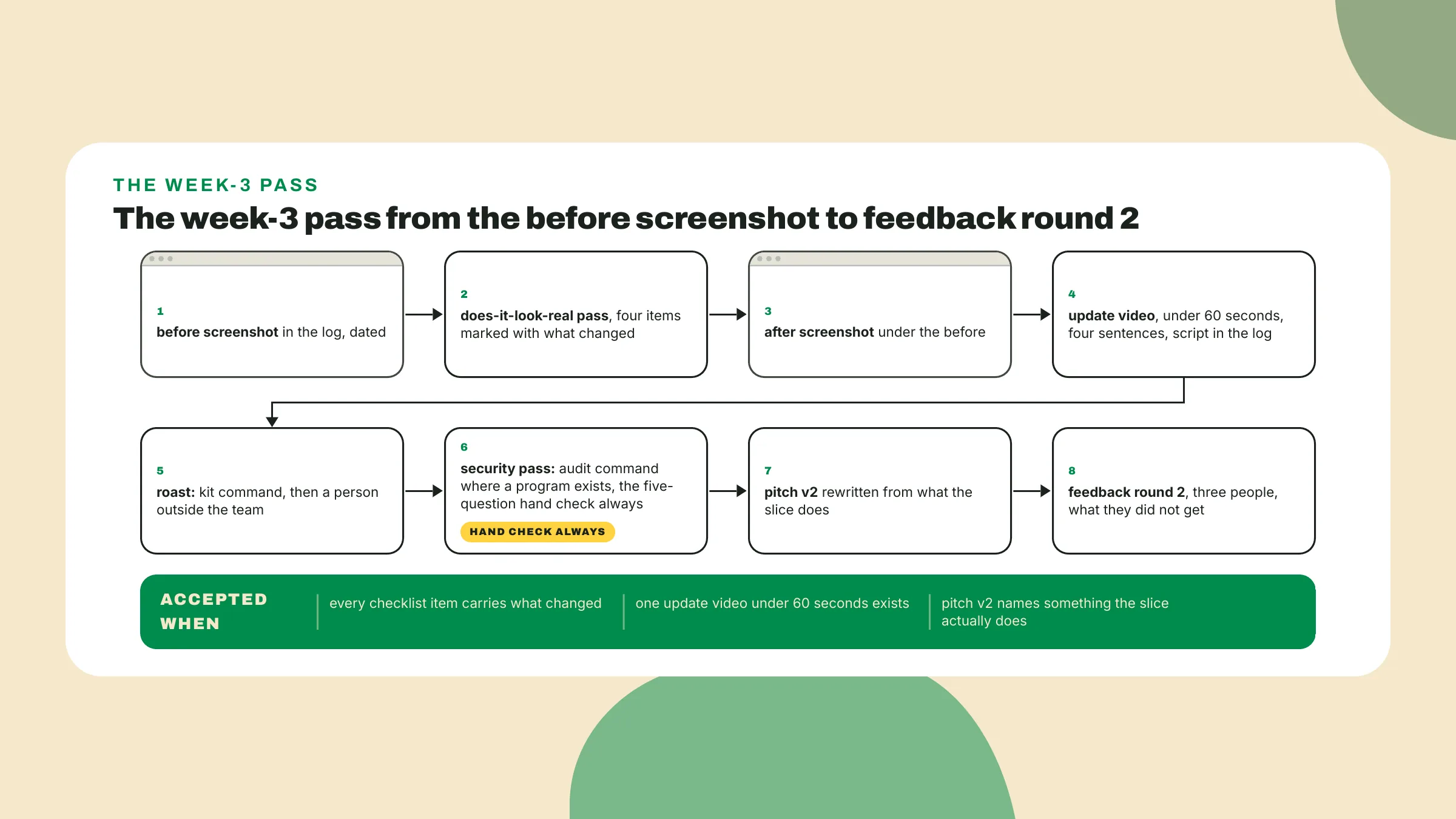
El tiempo de pulido es tiempo de construcción, así que la pasada es un checklist y no un rediseño: un checklist tiene cuatro ítems y un costo fijo, unas dos horas en total, mientras que un rediseño encuentra un quinto ítem y un sexto, una navegación nueva y un sistema de color, y sigue abierto el día 21, cuando debería grabarse el video de actualización de la semana 3, así que ese equipo llega a la semana 4 con una pantalla más linda y sin video. La misma disyuntiva vive dentro del video: la primera toma suele estar bien, la segunda suele ser mejor, y yo diría que en la tercera es donde la mayoría de los equipos empieza a perder la semana, llámalo una corazonada.
El pulido es un checklist con cuatro ítems y un costo fijo, no un rediseño, y la bitácora narrativa se escribe los días en que las cosas cambian. La tracción empieza esta semana, en tiendas reales con una liquidación en devnet, y el registro de tracción cuenta uso, nunca promesas. Un desconocido que vea tu actualización de 60 segundos debería poder decir qué cambió esta semana, y si en lugar de eso describiría el producto, el minuto fue un pitch, y la diferencia está en la primera oración.
La semana 4 empieza la próxima lección con la pregunta que todo jurado hace y la mayoría de los equipos esquiva: cómo encuentra alguien esto, y por qué Solana. Lo primero que escribes son los primeros 100 usuarios, como un grupo con nombre y un canal que llega a ellos, antes de cualquier discusión sobre la cadena. Trae la bitácora, porque el párrafo de por qué Solana se escribe desde lo que el recorte hace, y el recorte está ahí con su firma en la pantalla.
Inscríbete para hacer el quiz
El quiz es parte del curso: inscríbete para responderlo, seguir tu progreso y ganar XP.