Carregando...

 BetaBeta
Este curso ainda não está disponível em Portugues (BR), então você está lendo o original em English.
Last lesson the researcher answered one question by name. This lesson two agents take Stamp from three lines of idea to a design an engineer can build from, and you learn what each of them owes you when it finishes. Around twenty minutes, and nothing here needs a toolchain.
Most of the hackathon projects I have watched fail lost their month in the first week, with the wrong account model and a copied idea. The kit puts two specialists at that spot. solana-researcher answers ecosystem questions with cited, dated sources and a confidence label on every finding, because the ecosystem moves faster than any model's memory. solana-architect settles accounts, PDAs, program boundaries, signers and the trust model before code exists, so the engineers never reopen them. Games have their own architect, game-architect, which writes a concept file and a plan file and decides what lives on-chain. The output of this lesson is a file the rest of the course reads.
idea.md in the project with a person, the thing they cannot do today, and what Stamp does about it. Ours:Stamp
Rita runs a coffee shop and gives a free coffee every tenth purchase, tracked on paper cards that customers lose.
Stamp keeps the card on Solana: the shop stamps a customer's wallet at the till, ten stamps redeem one coffee, and the customer sees their card in any wallet app.
Use the solana-researcher agent. What exists on Solana today for small-business loyalty cards or punch cards, including projects that shut down and why? Cite a source for each finding with a date and a confidence label, and end with what you could not verify.
Its file fixes the shape of the answer: a two or three sentence answer first, then findings each with a link and a label, High when several authoritative sources agree, Medium for one, Low for community sources only or sources that conflict, Speculative for an inference, then a recommendation and a list of what it could not verify. Read the Low items as leads, not facts. The agent is allowed to say it found nothing solid, and that answer is worth having before you build.
The researcher's findings stop at what is public on the web. The kit also ships Colosseum Copilot as a core skill pack, which answers from Colosseum's hackathon archives and project histories: what past submissions claimed, what they shipped afterwards, and what remains unknown. It needs a Colosseum account and a sign-in once per machine, in a terminal, with Node 20 or newer:
npx @colosseum-org/copilot-connect login
The sign-in opens the browser. Add --device on a machine where no browser can open, and check the connection with status, which is also what /doctor runs on its fifth check. Then ask inside Claude Code:
Use the solana-researcher agent with the Colosseum copilot skill. Which past hackathon submissions built loyalty or punch cards for small businesses? For each, separate what it claimed at submission from what happened later, with dates, and end with what you could not find.
Read the kit's registry entry before you sign in. It marks the pack caution: the helper is an unpinned npm package, the skill queries Colosseum's API as you, and your questions and the agent's answers go to Colosseum when you tick the optional sharing box at sign-in, which is off by default. For a workshop, the public findings are enough. For a hackathon entry, this is the archive you want checked.
Use the solana-architect agent to design Stamp from idea.md. I want every account with its owner, seeds, size, rent payer and who can change or close it, every instruction with its signers, the invariants, the authority model and the open risks. Default to Anchor unless you can show a measured reason for Pinocchio. Write the result to design.md.
That list is the architect's own Output section, quoted back at it, which is a trick worth keeping: an agent asked for exactly what its file promises rarely leaves anything out. Expect something like this for Stamp:
/plan-feature after it, will ask who pays rent for a new card, and the honest answer for a coffee shop is the shop.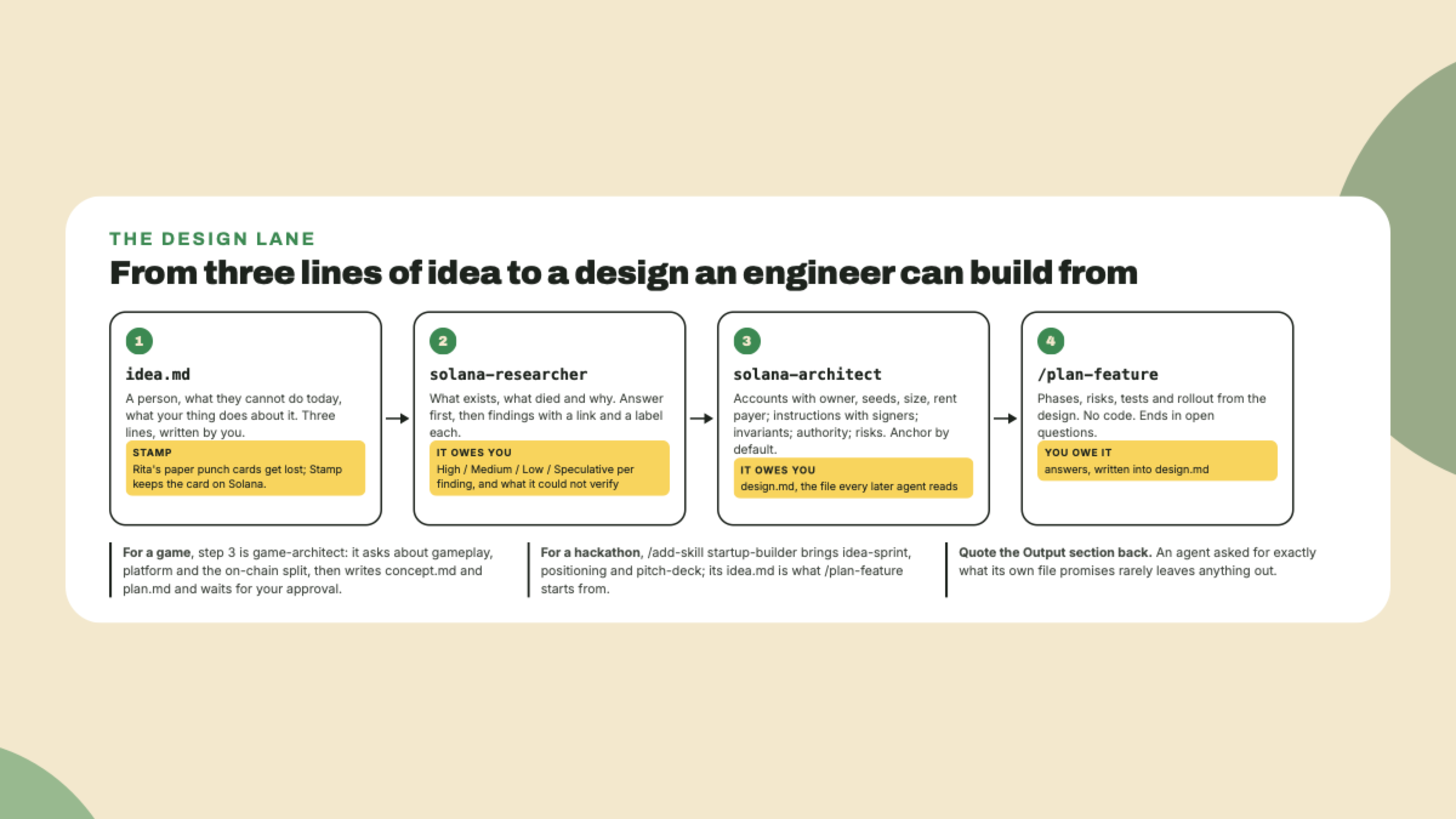
/plan-feature Stamp, from design.md
The command writes no code. It reads the design, asks about decisions that change it, and returns a plan from nine sections, summary, accounts, instructions, integrations, clients, phases, risks, tests and rollout, dropping the ones that do not apply and ending in open questions for you. Answer them in design.md so the next agents read one file.
/add-skill startup-builder installs the whole pack of ten skills, idea-sprint, positioning, pricing, pitch-deck, the hackathon skill, build-status, fundraising, launch, incident-comms and ecosystem-bd, because they link to each other's files. Its idea-sprint writes .claude/context/idea.md, and /plan-feature starts from that file when it exists. Colosseum Copilot, from the research aside above, is what its hackathon skill reads for prior art.The same two prompts work on any idea. Replace the three lines and keep the rest:
idea.md holds three lines and design.md holds accounts, instructions, invariants, authority and risks.design.md.concept.md and plan.md and waits for your approval before anyone implements.Research comes back cited and labelled, and a design comes back as accounts, instructions, invariants, authority and risks in a file. Ask each agent for the output its own file promises, and keep the file, because the next agents read it.
Next lesson the anchor-engineer builds Stamp's three instructions from design.md, the QA engineer tests them, and you see the three commands that close every program task. Rust, Anchor and the Solana CLI enter here, so install them before the session if you want to follow along at the keyboard. /doctor printed the Solana CLI command already, and the engineer's scaffold step brings the Anchor toolchain into view.
Inscreva-se para fazer o quiz
O quiz faz parte do curso — inscreva-se para respondê-lo, acompanhar seu progresso e ganhar XP.