Carregando...

 BetaBeta
Este curso ainda não está disponível em Portugues (BR), então você está lendo o original em English.
Last lesson ended with design.md: a shop account, a card per customer, three instructions. This lesson an engineer builds them, a QA engineer tests them, and an audit reads the result. Rust, Anchor and the Solana CLI enter here. If they are not on your machine, follow on the screen and install them tonight. The Solana CLI command is in your /doctor report. The Anchor toolchain appears there once an Anchor workspace exists, so for tonight it is rustup for Rust, then cargo install --git https://github.com/solana-foundation/anchor avm --force && avm install latest && avm use latest for Anchor. Around twenty minutes.
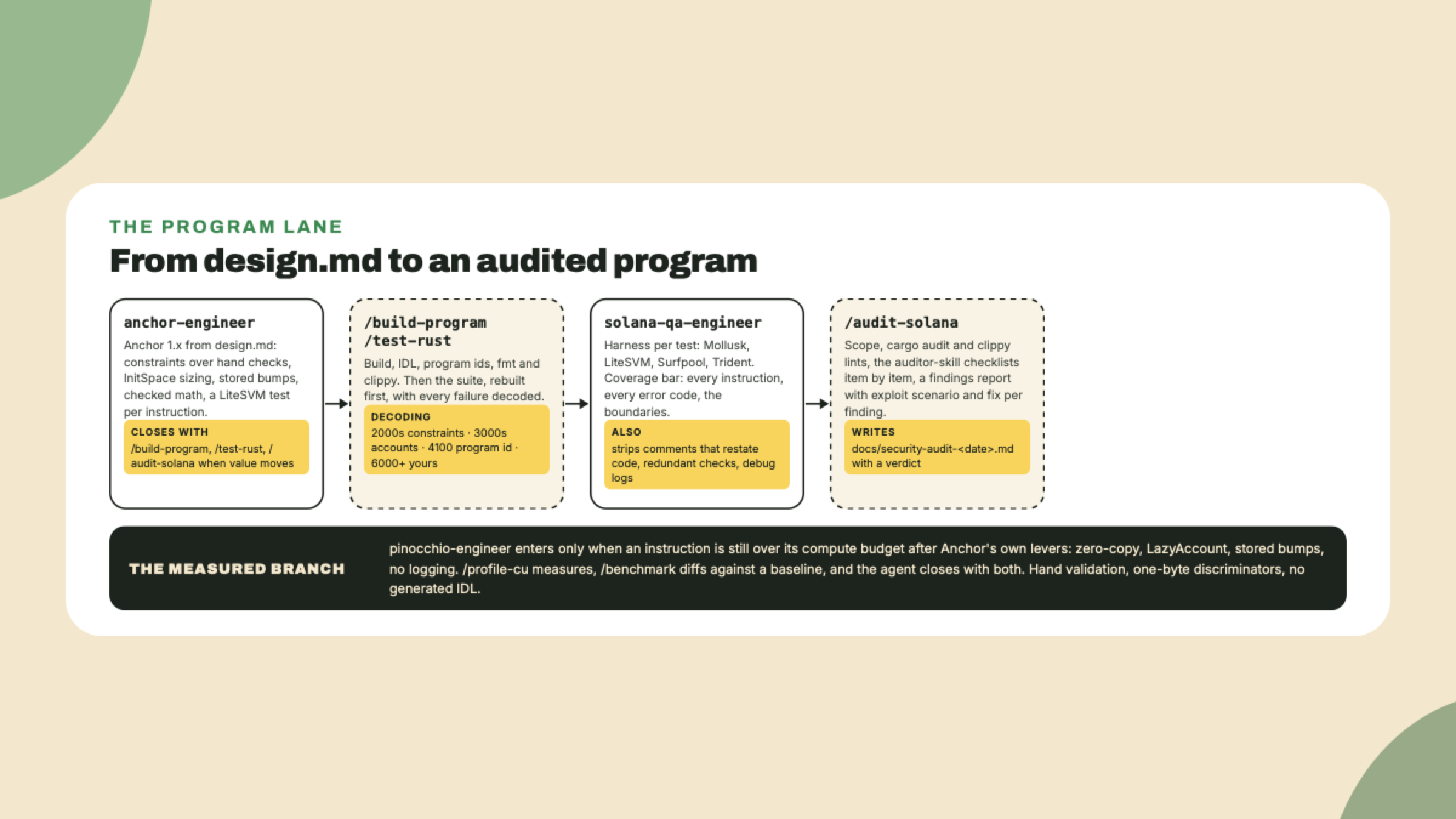
Program code is where a copied tutorial hurts most, because the Anchor API changed at 1.0 and most of the web still shows the old shape. The kit has two implementers and one tester. anchor-engineer is the default: Anchor 1.x, constraints instead of hand-written checks, generated IDL, Rust LiteSVM tests. pinocchio-engineer exists for the measured cases, an instruction still over its compute budget after Anchor's own levers, compute fees at volume, or a binary-size limit, and it writes every check by hand. solana-qa-engineer owns how the program is tested: which harness for which test, the coverage bar, compute baselines, and stripping the noise a model leaves in a diff. Three commands tie them together: /build-program, /test-rust, /audit-solana.
Use the anchor-engineer agent. Set up an Anchor 1.x workspace for Stamp with the LiteSVM test template and implement the three instructions in design.md: create_shop, stamp and redeem. One card account per customer as designed, checked arithmetic, stored bumps, and a Rust test per instruction. Run /build-program and /test-rust before you hand back.
Watch for the file it reads first: the Anchor reference inside the solana-dev pack. Then the shapes its own file insists on, the ones older habits get wrong: account space from DISCRIMINATOR.len() + INIT_SPACE, CpiContext::new taking a program key rather than an account info, stored PDAs validated with bump = card.bump, error codes starting at 6000. The house rules in CLAUDE.md add checked arithmetic and no unwrap outside tests. Its closing rule is build, test, and an audit for code that moves value, and it reports the instructions and accounts it changed with the test results.
/test-rust's file decodes it: 2000 to 2999 are constraint violations, 3000 to 3999 account errors, 4100 means the program was loaded at an address other than its declare_id, and 6000 and up are your own error enum. Ask for the program logs before anyone changes code:Show me the program logs from the failing redeem test and tell me whether the test or the program is wrong, before you change anything.
Use the solana-qa-engineer agent. Review Stamp's tests against your coverage bar: every instruction, every error code hit by a negative test, and the boundaries, including a redeem with nine stamps and a stamp on a card at the maximum count. Add what is missing, run /test-rust, and strip any AI slop from the diff.
Its file gives it a harness table: Mollusk for one instruction and exact compute, LiteSVM for multi-instruction flows, Surfpool for real mainnet state, Trident for fuzzing before mainnet. For Stamp it will stay in LiteSVM. The part people do not expect is the slop pass: comments that restate the code, defensive checks around trusted internal calls, debug logging left in, verbose error strings. It removes them and tells you what it removed in a sentence or two.
/audit-solana
The command scopes every instruction, runs cargo audit and clippy with the arithmetic and unwrap lints, walks the auditor-skill checklists, and writes docs/security-audit-<date>.md: counts per severity, each finding with file:line, the exploit scenario and the fix, a separate list of unconfirmed suspicions, and a verdict. For Stamp expect it to look hard at who can call stamp, because a shop key that signs from a phone is the risk the architect already named, and at the redeem arithmetic.
/profile-cu measures compute per instruction, /benchmark diffs it against a baseline, and pinocchio-engineer closes with both. Its file is also the honest list of what manual validation costs: one-byte discriminators, zero-copy alignment, no generated IDL./build-program reports the program built, its size and id, and the IDL written./test-rust passes with a negative test per error code.docs/security-audit-<date>.md exists and you have read its verdict line.cargo test alone tests whatever was built last. The test command does this for you./audit-solana recommends one in its own output for programs that hold user funds.One engineer builds from the design with the current Anchor API, one tester holds the coverage bar and strips the slop, and one command writes an audit report, with build, test and audit as the fixed closing routine. Pinocchio is a measured decision, never a default.
Next lesson the frontend engineer puts a customer's card on a web page with a wallet connected on devnet, which runs on Node alone. The mobile and backend engineers get their turn in the same lesson.
Inscreva-se para fazer o quiz
O quiz faz parte do curso — inscreva-se para respondê-lo, acompanhar seu progresso e ganhar XP.