Carregando...

 BetaBeta
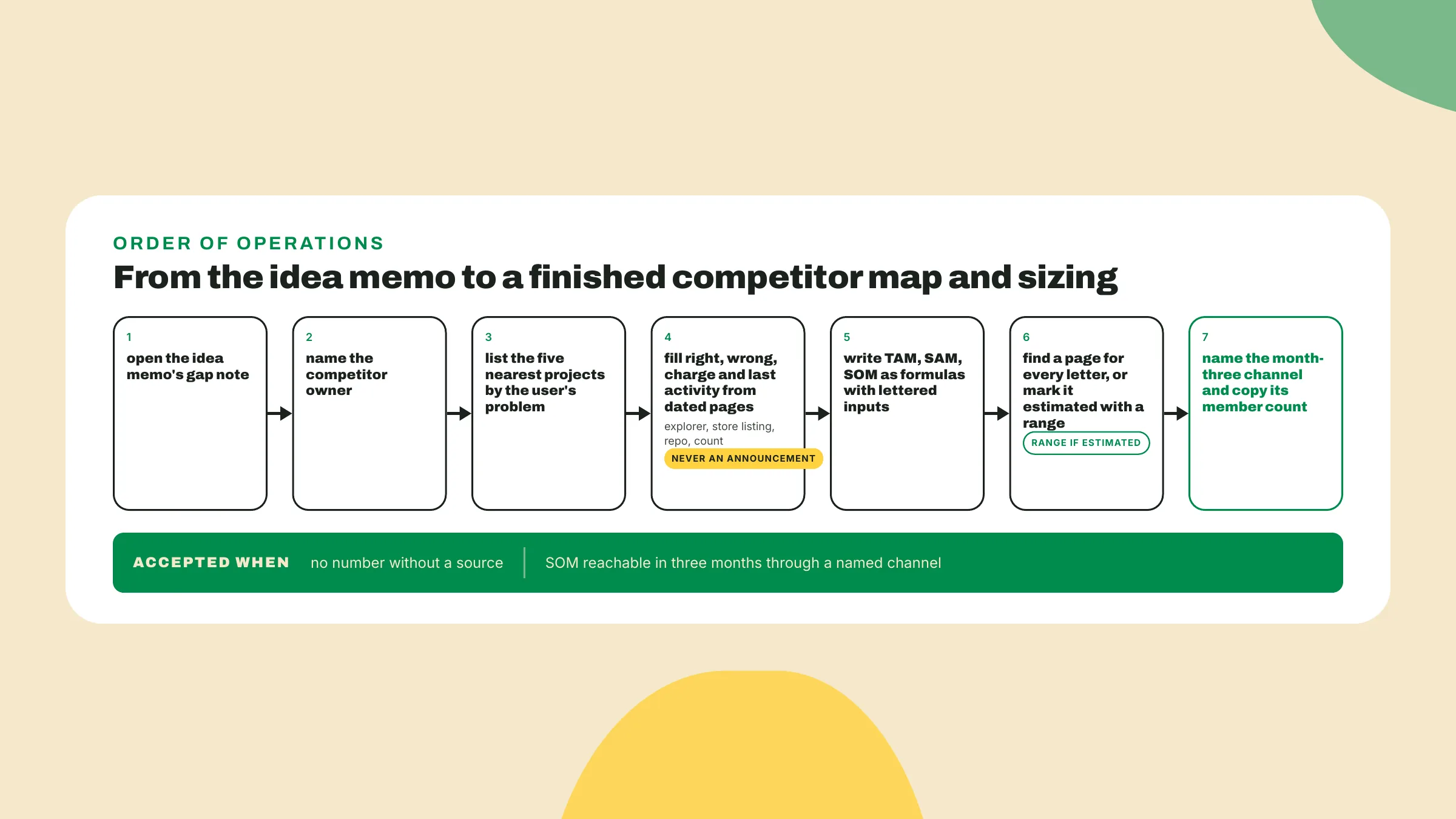
Na lição passada você pontuou três ideias e ficou com uma, e o memorando de ideias tem os projetos anteriores mais parecidos anotados ao lado da sobrevivente. Abra esse memorando. A nota de lacuna dele, a linha que diz o que esses projetos não fizeram, é a primeira linha do arquivo que você monta hoje.
Imagine a entrevista. Um jurado pergunta qual o tamanho disso e o time responde bilhões. A pergunta seguinte é quantas pessoas poderiam usar isso no mês que vem, e a sala fica em silêncio. O primeiro número saiu de um slide que alguém achou em um relatório. O segundo, ninguém foi buscar. O segundo número é o que pontua, e até o fim de hoje você tem os dois, de fontes que um jurado consegue clicar.
Um número que o jurado consegue clicar é uma contagem em uma página pública, com a URL e a data ao lado, que ele pode abrir durante a avaliação. O mapa de concorrentes e os três números de tamanho de mercado são esse formato aplicado duas vezes. Comece agora: abra colosseum.com/hackathon, encontre Potential Market Size (tamanho potencial do mercado) na seção de julgamento e crie competitor-map-sizing.md ao lado do memorando de ideias, no repositório do toolkit.
competitor-map-sizing.md, aberto em 2026-09-06
Potential Market Size, colosseum.com/hackathon, copiado em 2026-09-06
How big is the total addressable market for this project? (Qual é o tamanho do mercado total endereçável deste projeto?)
Is it already large, or small but growing rapidly? (Ele já é grande, ou pequeno mas crescendo rápido?)
What will be the impact of this project on the growth rate of their market? (Qual será o impacto deste projeto na taxa de crescimento desse mercado?)
Só a primeira pergunta quer um número grande. A segunda quer uma direção, e a terceira quer saber o que o seu projeto faria com essa direção. Um slide que diz bilhões responde um terço do fator.
Depois peça para o responsável treinar o formato em earn.superteam.fun. Em 2026-09-06 a página inicial mostrava 213,730+ usuários e 2,680+ patrocinadores. Em 2026-09-07 ela mostrava 214,040 e 2,690. Anote as duas leituras no arquivo com a URL e a data. Isso é demanda por outro produto, mas tem o formato que todo número do seu arquivo precisa ter: uma contagem, uma página, uma data, e um sinal de mais que avisa que a página arredonda para baixo.
linha quem acerta erra cobra última atividade (fonte, data)
Preencha quatro células por linha. Preencha cobra mesmo quando a resposta for zero, porque ela alimenta a linha de Viability (viabilidade) mais para frente. Preencha última atividade com a página do explorer, a data da última atualização na loja de apps, a data do último commit no GitHub ou uma contagem pública que se mexeu, nunca com um anúncio, e se anúncio for tudo o que você achar, escreva "só anúncio" na célula, com data.
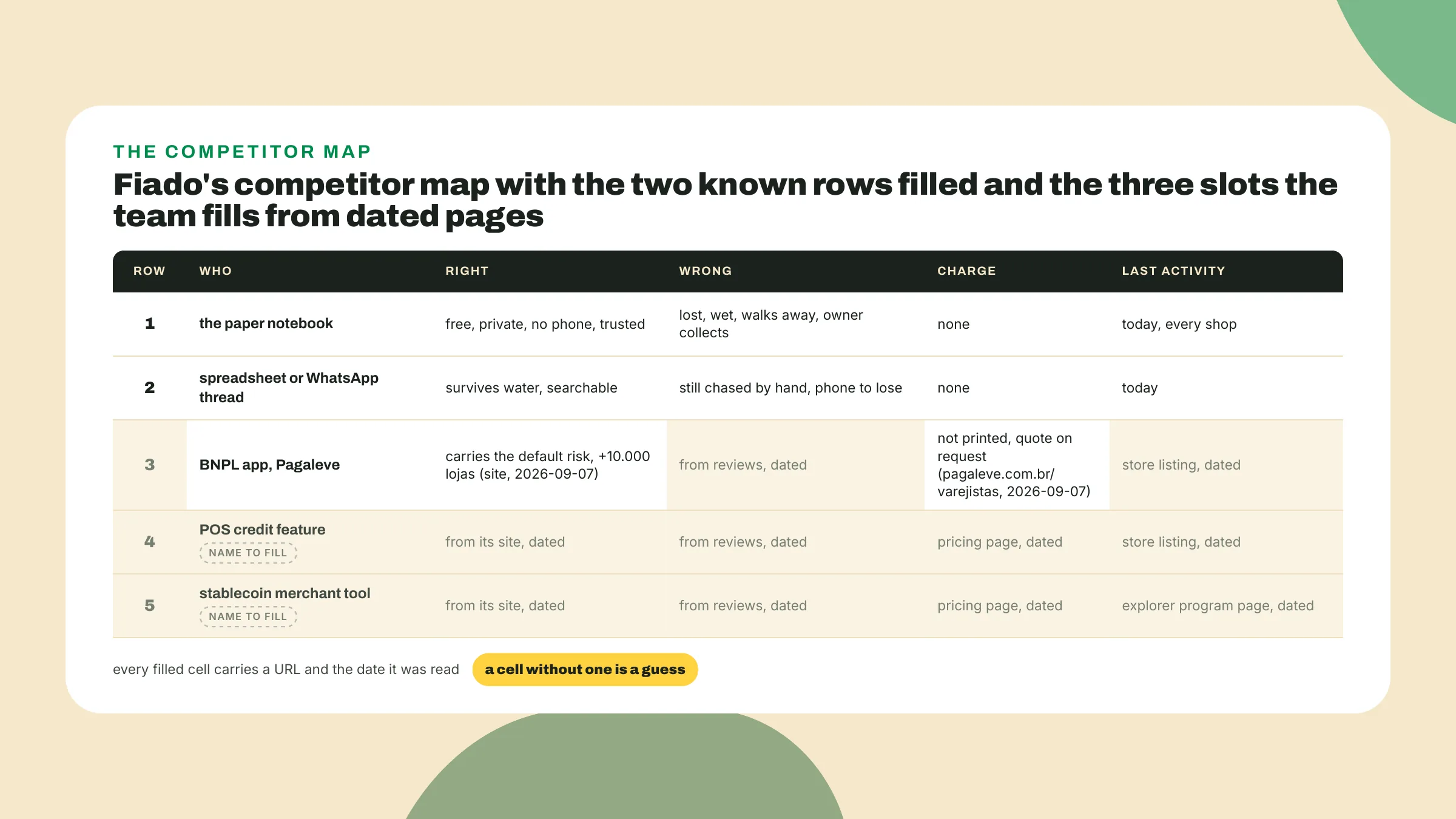
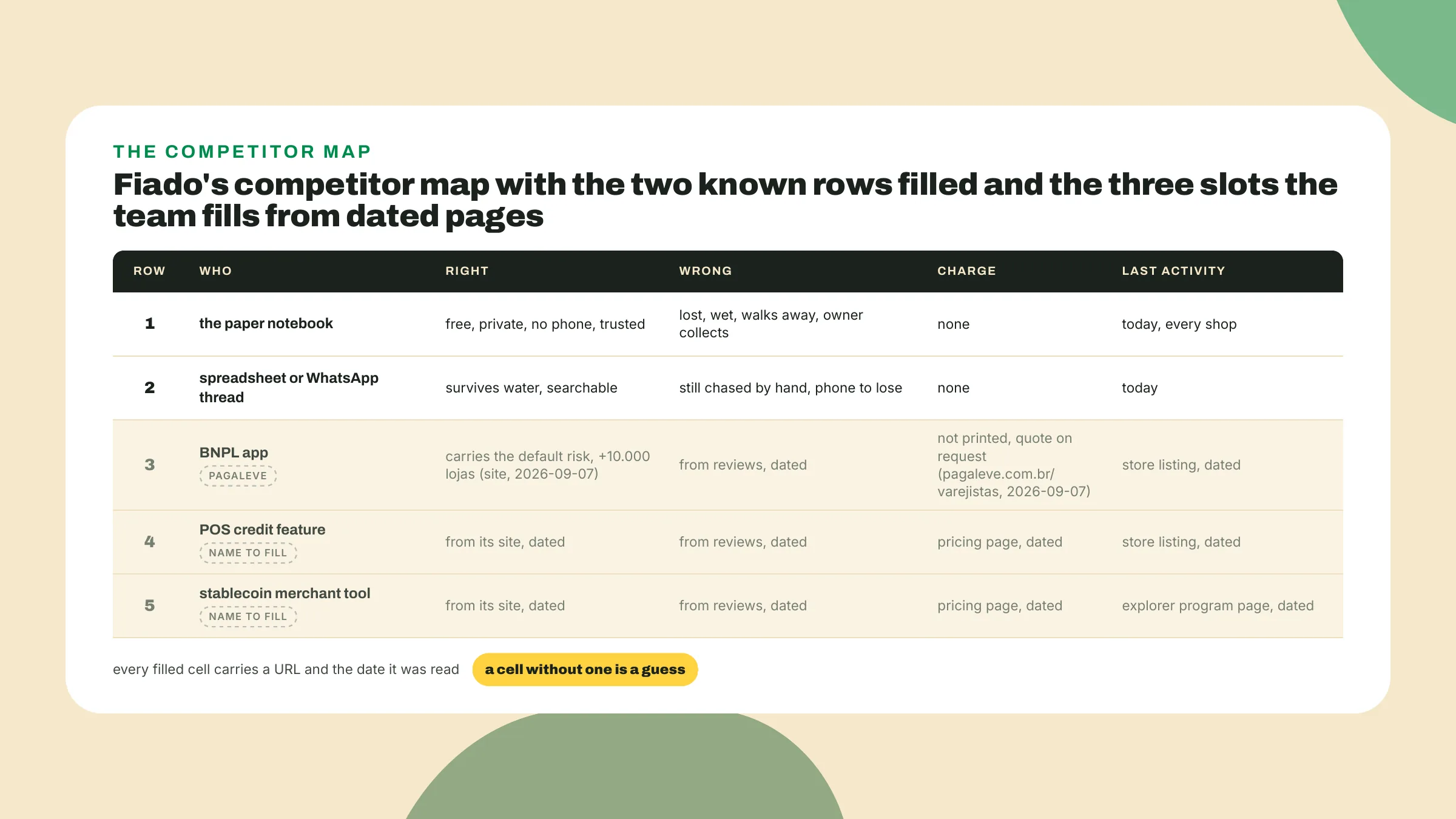
Para o Fiado, cujo usuário é o mercadinho que guarda o fiado numa caderneta ao lado do caixa, as cinco linhas vão da caderneta até um app de fintech que empresta no caixa. A linha um é a caderneta de papel: de graça, privada, funciona sem celular e sem sinal, se perde ou molha, não cobra nada, em uso hoje em todo mercadinho da rua. A linha dois é a planilha ou a conversa de WhatsApp: sobrevive à água e dá para pesquisar, a cobrança continua na mão, não cobra nada.
A linha três é um app de compre agora, pague depois, e o mais parecido no dia da leitura era a Pagaleve: a página para varejistas mostra faixas de faturamento e "A Pagaleve assume 100% dos riscos" sem taxa para o lojista, então a célula cobra diz não informado, cotação sob consulta, com data, e a home mostra +10.000 lojas. A página do Pix Parcelado da Koin, lida no mesmo dia, mostra "3x sem juros ou em ate 24x" e nenhuma porcentagem.
A linha quatro é a função de crédito dentro de uma maquininha ou sistema de PDV que o mercadinho já aluga. A linha cinco é uma carteira ou ferramenta para lojistas em stablecoin que já liquida em stablecoin e poderia ganhar um fiado. As linhas quatro e cinco precisam de nome, página de preços e leitura de última atividade, tudo de páginas que você abre hoje:
mapa de concorrentes, Fiado, 2026-09-06
linha  quem                                acerta                          erra                           cobra                última atividade
1      a caderneta de papel                de graça, privada, sem celular  perde, molha, dona cobra       nada                 hoje, todo mercadinho
2      planilha / conversa de WhatsApp     sobrevive à água, pesquisável   cobrança ainda na mão          nada                 hoje
3      app BNPL: Pagaleve                  assume o risco de calote, +10.000 lojas (site, 2026-09-07)   <das avaliações, com data>   não informado, cotação sob consulta (pagaleve.com.br/varejistas, 2026-09-07)   <listagem na loja, com data>
4      crédito no PDV: <nome>              <do site dele, com data>        <das avaliações, com data>     <página de preços, com data>  <listagem na loja, com data>
5      ferramenta stablecoin: <nome>       <do site dele, com data>        <das avaliações, com data>     <página de preços, com data>  <página do programa no explorer, com data>
Os colchetes angulares estão aí para você tirar. Uma linha que ainda tiver um na sexta é uma linha sobre a qual o jurado vai perguntar.
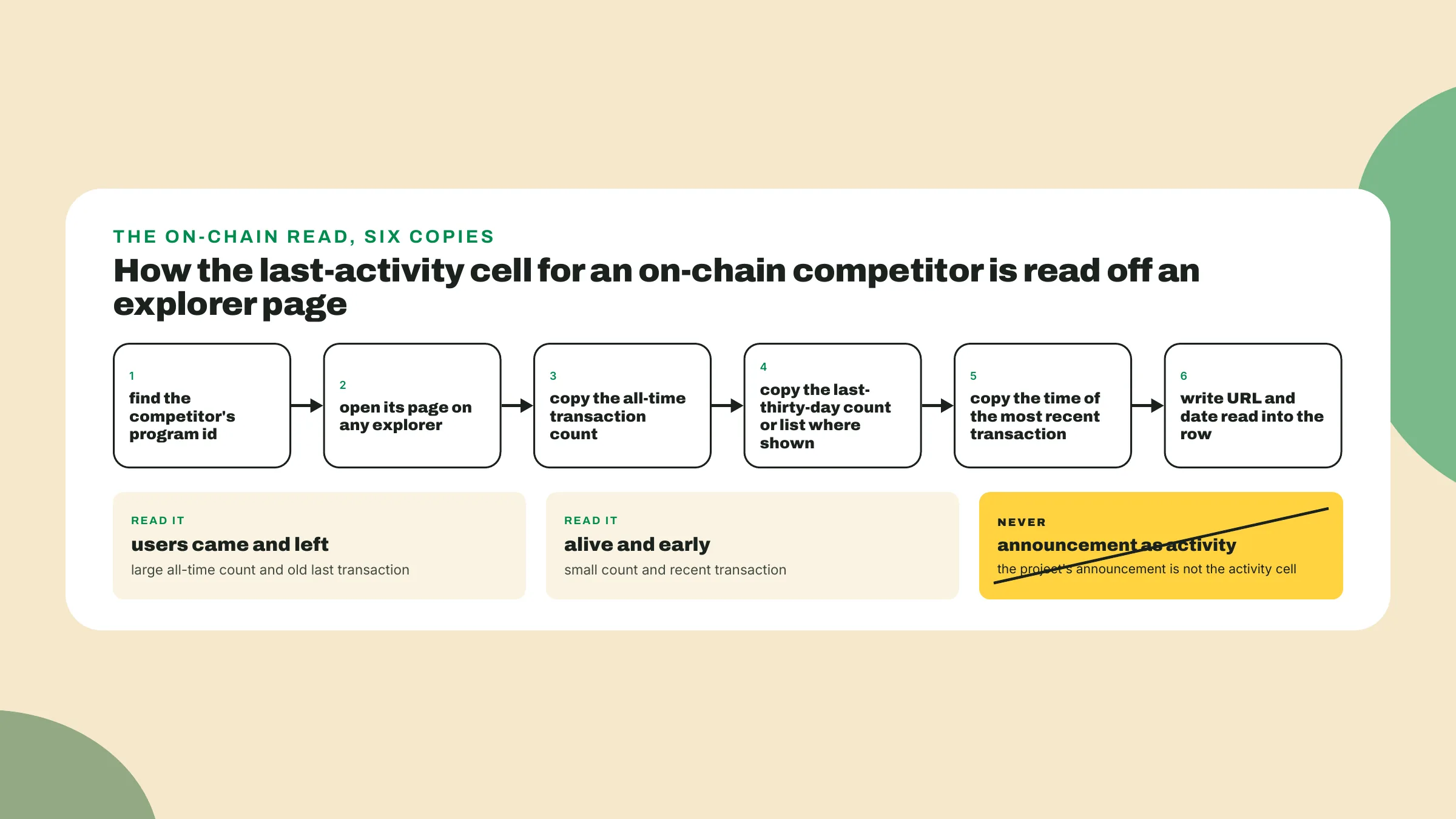
Agora leia o que você copiou. Contagem total grande com a última transação semanas atrás é um produto que teve usuários e perdeu. Contagem pequena com uma transação de uma hora atrás é um produto vivo e no começo. Nenhum dos dois é o que o site do próprio projeto diz. Um comparável, ou seja, um projeto que faz um trabalho parecido para um usuário parecido, também pode publicar o TVL, o valor que as pessoas depositaram nele, e esse número com data diz quanto dinheiro as pessoas já confiam a esse tipo de produto.
Com a aba aberta, faça a leitura da stablecoin para o tamanho de mercado: a página do token mostra a contagem de holders e as transferências recentes. A contagem de holders entra como um limite superior de pessoas, porque uma pessoa tem várias carteiras e um bot tem milhares, e as transferências dos últimos trinta dias entram como leitura de atividade, as duas com data. Se o emissor publica um número regional, copie esse também e marque de que página veio, porque o número do emissor e o do explorer não vão bater.
Para as linhas três e quatro a leitura é off-chain: a listagem na loja de apps mostra a data da última atualização, um repositório público mostra o último commit, uma página de preços mostra o preço e a data em que você leu, e a data da avaliação mais recente é um sinal de última atividade. Uma side track ou bounty da Earn também serve, quando a listagem mostra quantas pessoas se inscreveram, porque essa contagem diz quantos builders acharam que o problema do patrocinador valia uma semana deles.
A Colosseum pontua Potential Market Size com as três perguntas que estão no topo do seu arquivo. Um hackathon sazonal ou uma side track tem página própria, com entregas e prazo próprios. Leia essa página no dia em que decidir entrar, e reaproveite o material de submissão que você já tem. O slide é escrito na semana 4. A conta é feita hoje, com uma regra: nenhum número sem as entradas, e nenhuma entrada sem URL e data. A conta do Fiado:
tamanho de mercado, Fiado, 2026-09-06

TAM = A x B
  A = número de pequenos comércios de varejo no Brasil     424,120 lojas de varejo alimentar, todos os portes, um limite superior
                                                            (ABRAS Ranking 2025, abras.com.br/dados-ranking-2025, lido em 2026-09-07)
                                                            só mercadinhos: parcela estimada de A, faixa
  B = crédito anual concedido por mercadinho no fiado       <estimativa, URL da fonte, data>

SAM = TAM x C x D
  C = parcela desses mercadinhos que vendem fiado           <parcela, URL da fonte, data>
  D = parcela cujos fregueses já conseguem pagar em
      stablecoin ou por um trilho que o fiado pode usar     <contagem de adoção, URL da fonte, data>
      contexto: o Brasil recebeu US$318.8 bilhões em valor cripto, jul 2024 a jun 2025, todas as criptos
      (chainalysis.com/blog/latin-america-crypto-adoption-2025, 2025-10-02, lido em 2026-09-07); parcela de stablecoin: espaço

SOM = E, alcançável até o mês três
  E = mercadinhos alcançáveis por uma cooperativa ou
      associação de comerciantes que o time consiga nomear  <número de membros, página própria, data>
Cada letra é uma página. A é uma contagem pública e um limite superior, porque o número da ABRAS conta toda loja de varejo alimentar, não só mercadinhos, então a parte que é só mercadinho vai ao lado como estimativa, com uma faixa. B não tem página e vai ser estimado a partir das conversas da próxima lição, então escreva como faixa agora, com "estimado" ao lado. C e D são parcelas, e parcela precisa de duas contagens, a de cima e a de baixo, as duas com data.
E é o menor número do arquivo e o que o jurado lembra. Eu trato estimativa como uma previsão que carrega incerteza, não um compromisso, e é por isso que B e C entram no arquivo como um mínimo e um máximo, com o raciocínio ao lado, em vez de um número só, cheio de confiança.
SOM, Fiado: <E> mercadinhos, alcançáveis por <nome da associação, página dela, data>,
até o mês três, porque <a pessoa que vai nos apresentar, e o que ela combinou>
A última parte é trabalho da semana que vem. A contagem é de hoje.
Para a segunda pergunta, a direção, copie a página de adoção de stablecoin do D duas vezes, hoje e na data mais antiga que a página ou um arquivo mostrar, e escreva as duas leituras lado a lado. Se a página não tem leitura anterior, escreva "uma leitura, sem tendência" e não invente uma curva. A terceira pergunta, o mecanismo, quer uma frase, e a do Fiado diz: cada mercadinho que abre um fiado traz os fregueses dele para o trilho, então a contagem de adoção em D cresce pelo número de fregueses do mercadinho cada vez que E cresce em um.
Um TAM grande sem caminho até os primeiros cem usuários pontua pior do que um pequeno e alcançável, porque Traction (tração) e Viability ficam ao lado de Potential Market Size na lista e um SOM de mês três alimenta os três, então a honestidade custa o slide impressionante e compra a entrevista.
Potential Market Size faz três perguntas, e um número grande responde só a primeira. Todo número do seu arquivo é uma contagem em uma página pública, com URL e data, a última atividade de um concorrente vem de um explorer ou de uma listagem, nunca de um anúncio, e contagem de carteiras é limite superior de pessoas, nunca contagem de clientes. SOM é o menor número do arquivo, alcançável por um canal com nome, e é o que o jurado lembra.
Agora você tem um mapa de concorrentes e três números, e os estimados do arquivo, B e C no caso do Fiado, são faixas esperando evidência. A próxima lição começa escrevendo a única suposição que, se estiver errada, torna o arquivo inteiro inútil, e o teste mais barato capaz de provar que ela está errada até sexta. Você passa o resto da semana tentando matar a própria ideia, e reescreve o pitch com o que sobreviver.
Inscreva-se para fazer o quiz
O quiz faz parte do curso — inscreva-se para respondê-lo, acompanhar seu progresso e ganhar XP.